Most notable historic snippets or facts extracted from the book ‘On This Day’ first published in 1992 by Octopus Publishing Group Ltd, London, as well as additional supplementary information extracted from Wikipedia.
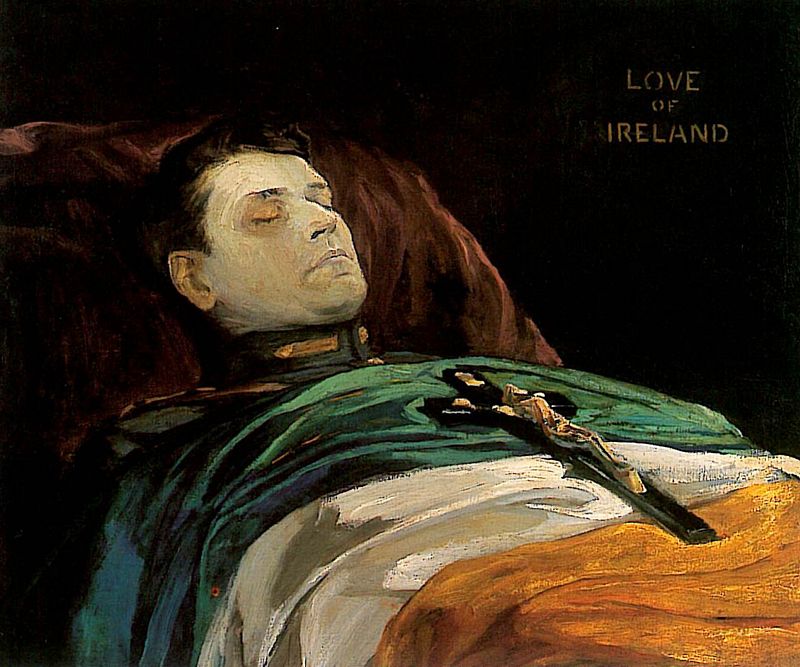
Michael Collins - Love of Ireland by John Lavery - Wikipedia
Michael Collins (16 October 1890 – 22 August 1922) was an Irish revolutionary, soldier and politician who was a leading figure in the early 20th-century Irish struggle for independence. He was Chairman of the Provisional Government of the Irish Free State from January 1922 until his assassination in August 1922.
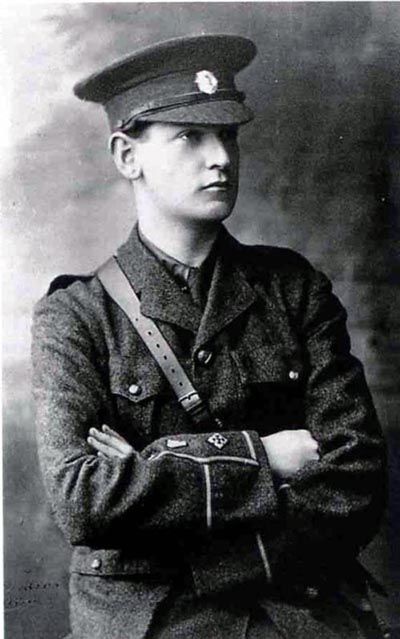
Collins as a young recruit – Wikipedia
Collins was born in Woodfield, County Cork, the youngest of eight children, and his family had republican connections reaching back to the 1798 rebellion. He moved to London in 1906, to become a clerk in the Post Office Savings Bank at Blythe House. He was a member of the London GAA, through which he became associated with the Irish Republican Brotherhood and the Gaelic League.
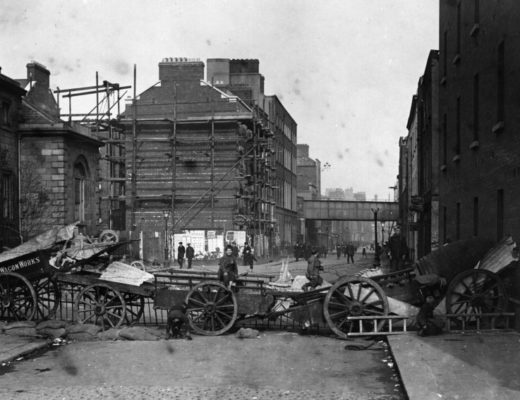
Irish Volunteers barricade Townsend Street, Dublin, to slow down the advance of troops, during the Easter Rising – Wikipedia
He returned to Ireland in 1916 and fought in the Easter Rising. He was subsequently imprisoned in the Frongoch internment camp as a prisoner of war, but was released in December 1916.
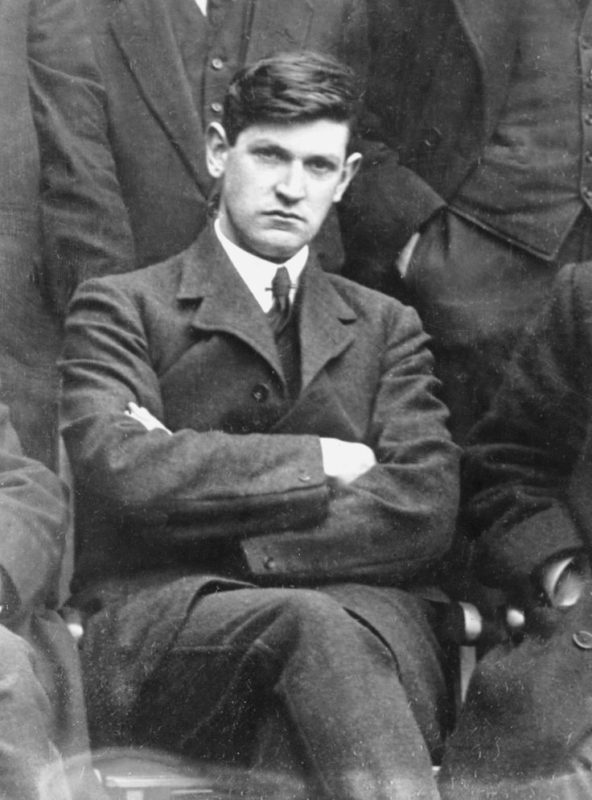
Michael Collins as Minister for Finance in 1919 – Wikipedia
Collins rose through the ranks of the Irish Volunteers and Sinn Féin after his release from Frongoch. He became a Teachta Dála for South Cork in 1918, and was appointed Minister for Finance in the First Dáil. He was present when the Dáil convened on 21 January 1919 and declared the independence of the Irish Republic. In the ensuing War of Independence, he was Director of Organisation and Adjutant General for the Irish Volunteers, and Director of Intelligence of the Irish Republican Army. He gained fame as a guerrilla warfare strategist, planning and directing many successful attacks on British forces, such as the assassination of key British intelligence agents in November 1920.
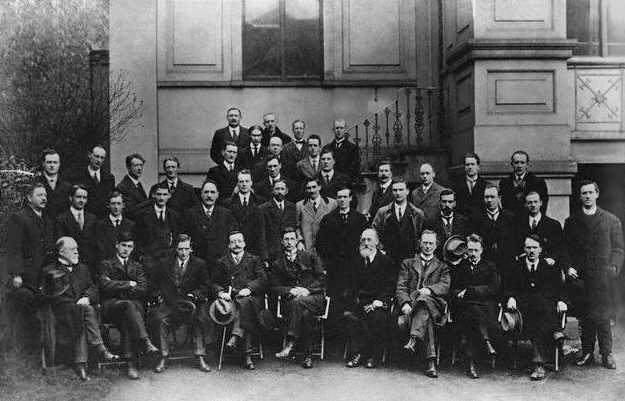
The Sinn Fein members elected in the December 1918 election at the first Dail Eireann meeting, called by Sinn Fein on January 21, 1919. First row, from left: L Ginell, Michael Collins (leader of the Irish Republican Army), Cathal Brugha, Arthur Griffiths (founder of Sinn Fein), Eamon de Valera (president of the Irish Republic), Count E MacNeill, William Cosgrave and E Blythe; Second row: P Maloney, Terence McSwiney (Lord Mayor of Dublin), Richard Mulcahy, J O’Doherty, J O’Mahony, J Dolan, J McGuinness, P O’Keefe, Michael Staines, McGrath, Dr B Cussack, L de Roiste, W Colivet and the Reverend Father Michael O’Flanagan (vice-president of Sinn Fein); Third row: P War, A McCabe, D Fitzgerald, J Sweeney, Dr Hayes, C Collins, P O’Maillie, J O’Mara, B O’Higgins, J Burke and Kevin O’Higgins; Fourth row: J McDonagh and J McEntee; Fifth row: PB 1919 Ireland – Wikipedia
After the July 1921 ceasefire, Collins and Arthur Griffith were sent to London by Éamon de Valera to negotiate peace terms. The resulting Anglo-Irish Treaty established the Irish Free State but depended on an Oath of Allegiance to the Crown, a condition that de Valera and other republican leaders could not reconcile with. Collins viewed the Treaty as offering “the freedom to achieve freedom”, and persuaded a majority in the Dáil to ratify the Treaty. A provisional government was formed under his chairmanship in early 1922 but was soon disrupted by the Irish Civil War, in which Collins was commander-in-chief of the National Army.
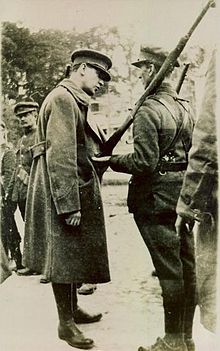
Collins inspects a soldier – Wikipedia
The ambush
On 22 August 1922 Collins set out from Cork City on a circuitous tour of West Cork. He passed first through Macroom then took the Bandon road via Crookstown. This led through Béal na Bláth, an isolated crossroads. There they stopped at a local pub named ‘Long’s Pub’, now known as The Diamond Bar, to ask a question of a man standing at the crossroad. The man turned out to be an anti-Treaty sentry. He and an associate recognised Collins in the back of the open-top car.
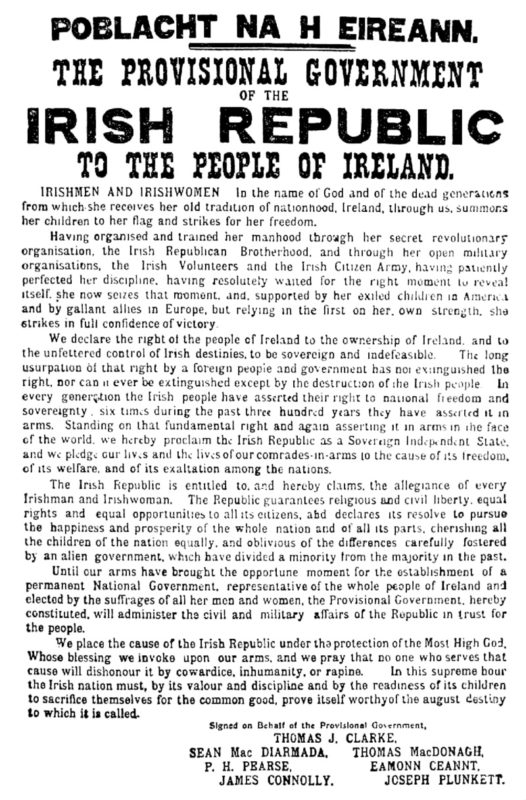
Proclamation of the Republic, Easter 1916 – Wikipedia
As a result, an ambush was laid by an anti-Treaty column at that point, on the chance that the convoy might come through again on their return journey. Between 7.30 and 8pm, Collins’ convoy approached Béal na Bláth for the second time. By then most of the ambush party had dispersed and gone for the day, leaving just five or six men on the scene. Two were disarming a mine in the road, while three on a laneway overlooking them, provided cover. A dray cart, placed across the road, remained at the far end of the ambush site.
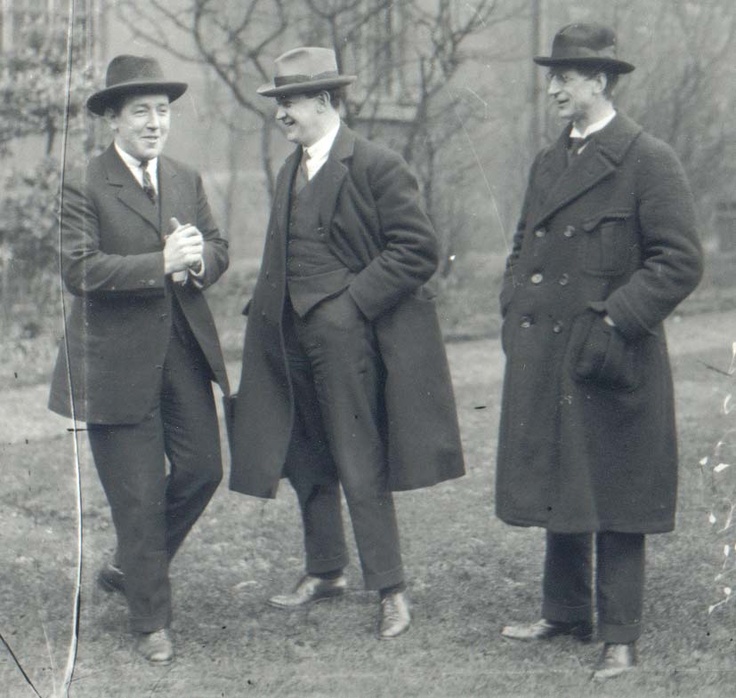
Harry Boland (left), Michael Collins (middle), and Éamon de Valera (right) – Wikipedia
The Irregulars in the lane-way opened fire with rifles on the convoy. Emmet Dalton ordered the driver of the touring car to ‘drive like hell’, but Collins said ‘no, stop and we’ll fight ‘em’ and jumped from the vehicle along with the others. Collins first took cover behind the low grass bank bordering the road but then jumped up and ran back along the road to begin firing with his Lee Enfield rifle from behind the armoured car. The Vickers machine gun in that car had also been firing at the attackers but then stopped because a badly-loaded ammunition belt caused it to jam. Apparently to get a better view of the lane-way, Collins left the protection of the armoured car and moved even further back along the road.
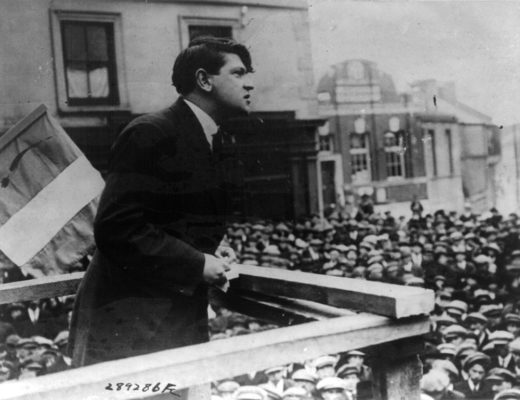
Michael Collins addresses a crowd in Cork on Saint Patrick’s Day, 1922 – Wikipedia
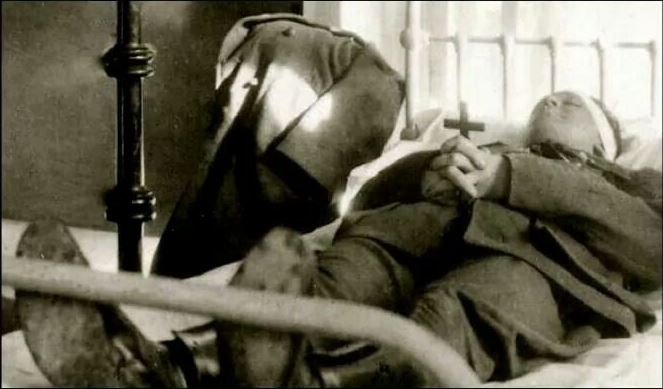
Now standing in the open, he fired a couple of shots and as he was once more working the bolt of his rifle he was shot in the head. He was the only fatality, although another member of his party suffered a neck wound. At this stage, the firing abated and the Irregulars moved away. Collins was found, face down, on the roadway. One of his men whispered an ‘Act of contrition’ into his ear, but Collins was clearly dead. He was lifted into the back of the touring car with his head resting against the shoulder of Emmet Dalton. The convoy cleared the dray cart obstruction and resumed its journey to Cork.
Michael Collins’s body lying in hospital after he was shot dead at Béal na Bláth – Wikipedia
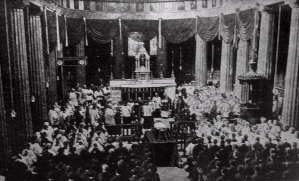
Collins lay in state for three days. Tens of thousands of mourners filed past his coffin to pay their respects, including many British soldiers departing Ireland who had fought against him. His funeral mass took place at Dublin’s Pro Cathedral where a number of foreign and Irish dignitaries were in attendance. Some 500,000 people attended his funeral, almost one fifth of the country’s population at that time.
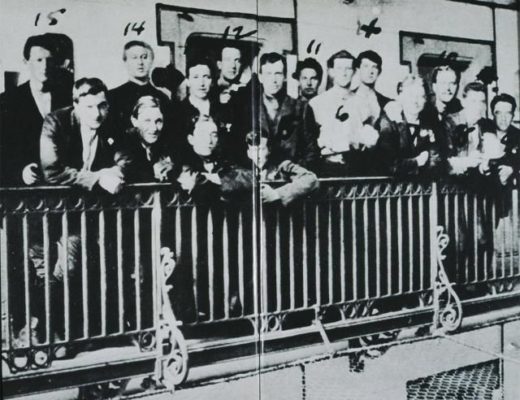
Captured Irish soldiers in Stafford Gaol after the failed Easter Rising. Collins is fifth from the right with an ‘x’ over his head – Wikipedia
No official inquiry was ever undertaken into Collins’s death and consequently there is no official version of what happened, nor are there any authoritative, detailed contemporary records. In this vacuum, independent investigations and conspiracy theorists have put forward a number of suspects as having executed or ordered his death, including an anti-Treaty sharpshooter, members of his own escort, the British secret service, or de Valera himself.
De Valera is alleged to have declared in 1966: “It is my considered opinion that in the fullness of time history will record the greatness of Michael Collins; and it will be recorded at my expense.”
Funeral of Michael Collins in the Pro-Cathedral, Dublin – Wikipedia
A number of books have been devoted entirely to the study of Collins’ death (in chronological order): ‘The Day Michael Was Shot’ by Meda Ryan, ‘The Shooting of Michael Collins: Murder or Accident?’ by John M Feehan, ‘The Dark Secret of Béal na mBláth’ by Patrick Twohig and ‘The Assassination of Michael Collins: What Happened at Béal na mBláth?’ by SM Sigerson.
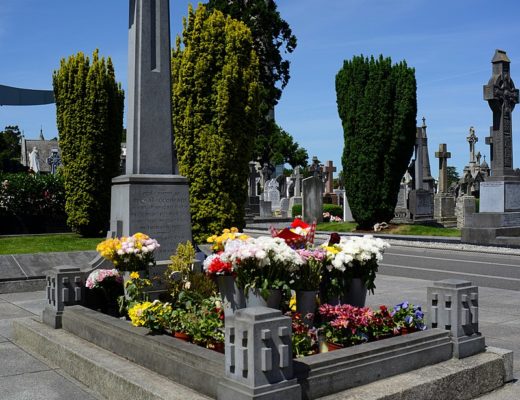
Collins’s grave, Glasnevin Cemetery, Dublin – Wikipedia