
Cape white-eyes can be found in your garden
Cape white-eyes are a sociable species forming large flocks outside the breeding season.
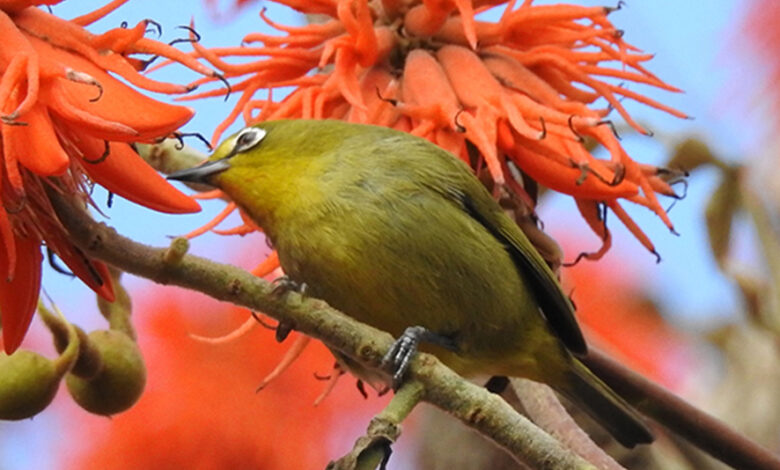
CAPE white-eyes have rounded wings, strong legs, and a conspicuous ring of white feathers round the eyes. The upperparts are green, and the throat and vent are bright yellow.
They are very common residents throughout South Africa. They like forests, woodlands, savannas, parks, gardens, exotic plantations, riverine scrubs and bushes.
ALSO READ: Amanzimtoti SPCA appeals for soft food for cats
These white-eyes are found in pairs when breeding, otherwise gregarious in small or large flocks. They forage restlessly from the canopy of trees to undergrowth below. They are able to agilely hang in all kinds of postures and often probe tubular flowers for nectar. Frequently drink and bathe in streams, birdbaths, puddles and dew on foliage.
The flight is straight and slightly undulating. Food comprises insects, spiders, fruit, nectar and fleshy flower petals and sepals.
They are highly vocal at all times, starting at dawn and the voice is a loud warbling song with constant chittering contact calls.
Breeding takes place from August to April in the south of South Africa and June to February in the north. The nest is a neat thin walled cup of fine grass, stems, roots and hair. Two to three plain white, pale green or light blue eggs are laid. Incubation is from 10 to 12 days and the nesting period is 12 to 13 days. Chicks are fed by both parents.
The isiZulu name is umBicini and in Afrikaans die Kaapse glasogie.
DID YOU KNOW?
Click on the words highlighted in red to read more on this and related topics. To receive news links via WhatsApp or Telegram, send an invite to 061 694 6047.

Do you have more information pertaining to this story? Feel free to let us know by commenting on our Facebook page or you can contact our newsroom at 031 903 2341 and speak to a journalist.
(Comments posted on this issue may be used for publication in the Sun)