Building a culture that delivers – how accountability turns change into results
When the norms of accountability are established, when the rules of accountability are enforced, the results will always be predictable.
Once we accept that behaviour must change to embrace change, the next question becomes how leaders create an environment of accountability and responsibility as the norm, not the exception.
Surprisingly, it’s quite structured. High-performance organisations don’t count on people being motivated.
They design a system where accountability is visible, measurable, and requires engagement. Excellence is not accidental.
Step one: Build the foundation – face reality
Every transformation begins with an honest diagnosis. Leaders must clearly identify what is not working and name it openly. Avoidance protects comfort but destroys progress.
People rarely change simply because they are told to. They change when they understand the cost of staying the same.
When weak accountability damages trust, careers, and results, that reality must be visible.
Clear diagnosis creates urgency. Urgency drives movement. Next, leaders must clarify what success means.
Vague goals produce vague performance. A one-sentence mission that defines winning gives direction to daily behaviour.
When everyone knows what matters, alignment becomes possible.
Step two: Establish non-negotiable standards
Once reality is clear, then expectations must be explicit. High-performance cultures define specific behaviours that are not negotiable.
Behaviours such as reliability, taking ownership, transparency, keeping commitments, and proactive issue resolution may all be part of the required operating style.
When standards are defined and shared, people understand what is needed – not what would be nice. Defined standards also need defined consequences.
If there are no consequences for not meeting expectations, then there is no standard. There is a preference.
Some organisations go so far as to have structured exit paths for people who are persistently underperforming.
This is not heavy-handed. It is clarity. Ambiguity enables dysfunction.
READ MORE: Over a cup of coffee, Reverend Maans van Zyl digs into time management failures
Step three: Make accountability visible
What is invisible cannot be managed. Accountability for performance is enhanced when it is measured on a periodic or continuous basis.
Performance measurements must be based on objective metrics rather than subjective ones. Ownership of specific tasks must be established.
Review cycles must be established to reduce the impact of failure to correct it. Failures have a hard time hiding in a structured environment.
Accountability pathways (escalation pathways) must also be created.
An accountable team will know who must address each issue, and when, and will not be able to bypass those accountable for resolving it by blaming others.
An accountable structure reduces friction. An accountable structure increases reliability.
Over a cup of coffee, Reverend Maans van Zyl looks at how leadership can servehttps://t.co/ntUpAiWJsG #reverendmaans #witbanknews #witbank #opinionpiece pic.twitter.com/AhRa3RLkvF
— WitbankNews (@WitbankN) April 13, 2026
Step four: Align culture with behaviour
Culture is not what leaders say. Culture is what gets rewarded. If organisations praise last-minute crisis management but ignore prevention, people will wait for crises.
If they encourage silence rather than speaking up, problems will not be solved. If they go easy on people, making excuses will be made.
High-accountability cultures reward early problem reporting, consistent behaviour, and reliable follow-through. They celebrate preparation more than heroics.
They also reflect regularly – weekly check-ins, progress updates and structured reviews. This reinforces discipline and prevents drift.
More importantly, leaders demonstrate this personally. When leaders own up to mistakes promptly, keep promises publicly and demonstrate this visibly, others are given permission to do the same.
Leadership behaviour sets cultural boundaries.
Step five: Support the behaviour you expect
People cannot be expected to change on their own. Support systems matter.
Support systems include: Coaching and mentoring; Tools to organise work; Reminders that keep priorities front and centre; Environments that create a smooth path; Peer accountability.
Research shows that behaviour change sticks when it is supported by social and structural factors rather than when it depends on individual willpower.
No leader is an island. Change is communal.
Recognising warning signs of accountability failure
Certain patterns signal that accountability is weakening:
• blame replaces ownership
• deadlines slip regularly
• problems are reported too late
• people say “that’s not my job”
• action requires constant instruction
When several of these appear simultaneously, a reset is needed. Not cosmetic change – structural change.
READ MORE: Coffee with Reverend Maans – the moral compass for a nation in need
Reliability is the core of accountability
Accountability is simple when broken down to the two essentials: Do what you say you are going to do.
Do what you are supposed to do – not what is convenient. Reliability builds trust. Resourcefulness solves problems.
Together, trust is built in performance that others can count on. Trust is earned through consistency – not intention.
Why this matters for the future?
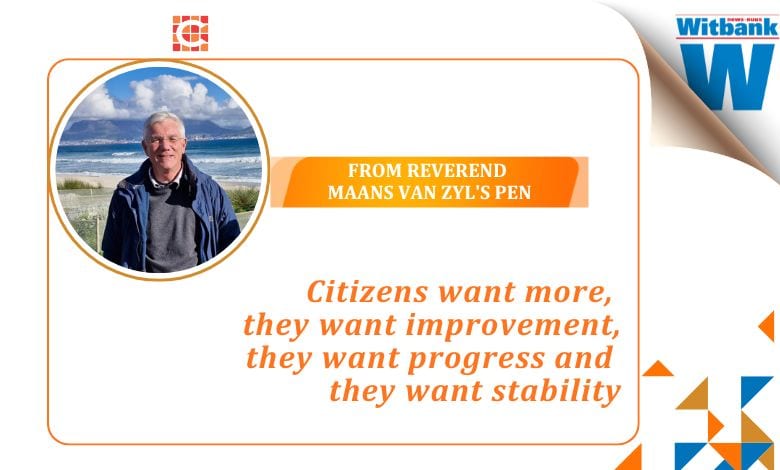
Many societies are frustrated with their leaders today. Citizens want more. They want improvement. They want progress.
They want stability. Improvement does not come from empty promises. Improvement comes from wise execution.
Nations achieve greatness when institutions function properly, when standards are upheld, and when individuals are accountable at all levels.
Accountability does not occur naturally. It must be created and defended. Therefore, accountability is not a management technique. It is a virtue of citizenship.
The leadership choice before us
Every leader, whether in business, government, organisation, or family, must make one simple decision: Will I tolerate the status quo of failure, or will I adopt systems that produce accountability?
The decision has nothing to do with ideology. It has nothing to do with self-righteousness. It has nothing to do with vague philosophising.
It has nothing to do with wishful thinking. It has nothing to do with opinion. It has everything to do with behaviour.
Every leader must decide: Will I wait for better days to come? Or will I create better days? Will I obstruct? Or will I support? Will I punish failure? Or will I reward accountability?
When the norms of accountability are established, when the rules of accountability are enforced, the results will always be predictable. And only then will things finally start to improve.
This column is the opinion of the writer and does not represent the views of Witbank News.
Your city, your story, as it happens. Stay in the loop with WITBANK NEWS.
Find us on our website, Facebook, X, Instagram or TikTok
Got a tip? Email: info@witbanknews.co.za