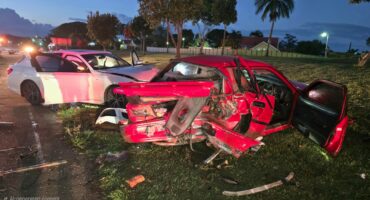
Park visitors ‘pull leopard’s tail’
Dubbed 'Scarface', the leopard appeared to have deep lacerations with traces of blood.
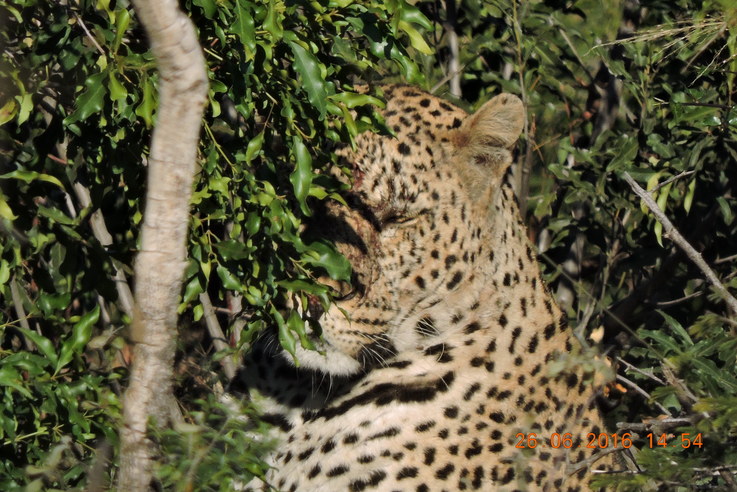
A LEOPARD with fresh injuries on its face and body, was spotted at the Hluhluwe-iMfolozi Park’s Nyalazi gate on Sunday.
Dubbed ‘Scarface’, by wild life enthusiast and photographer, Sarie Kilian, the leopard appeared to have deep lacerations with traces of blood.
‘It was speculated that the injuries might have been caused during a fight,’ she says.
But, while a crowd gathered at the sighting, photographers caught two park visitors sitting on the roof of their vehicle and another standing on the spare wheel.
Worse, two men in a white Toyota Fortuner, exited their vehicle to get a closer look, causing the animal to rise.
The incident sparked severe criticism and outraged on Facebook.
While overseas tourists are often accused of endangering their lives by exiting vehicles, hanging out of windows and venturing too close to dangerous and unpredictable wild animals, the offenders were reportedly local.
Park rules
It is strictly against park rules to exit vehicles except at the designated places.
Clear warnings are displayed at entrances and throughout the park, warning visitors not to hang out of windows.
Guides say the ‘profile’ of the vehicle is changed by a person standing up or hanging out, which may provoke an attack.
The animal is usually euthenised when it has been responsible for an attack on a human.
A leopard is regarded by many professional hunters as the most dangerous animal to encounter, because of its speed, stealth and strength.
An owner of a Namibian game farm and professional hunter, says if he is required to track an injured leopard, he charges his hourly rate per second.
‘The only thing a leopard cannot do, is read,’ says Roysten Wright, who survived a leopard attack by shooting the animal in mid-air.
Wright was forced to track the animal down, after it was wounded by an American hunter.
Leopards are notorious for deadly attacks on humans and a number of well-known man-eaters have been documented throughout history.
In July last year, a safari guide was attacked by a leopard in the Kruger National Park, when the animal launched itself onto a safari truck full of tourists.
The shocking incident was captured on camera and can be viewed on Youtube.
The animal’s behaviour could have been caused by an injury, as a second leopard was also spotted nearby.
Leopard can reach a speed of 58 kmph and can easily jump three metres high.