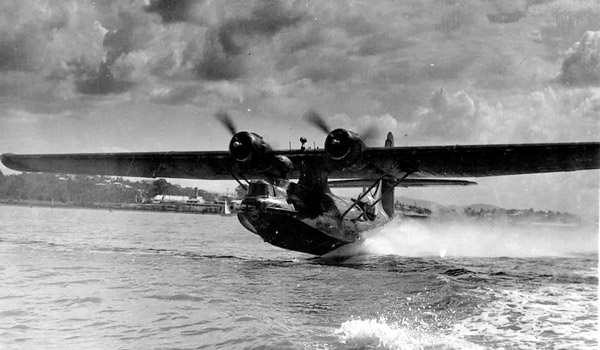
Catalina flying boat strikes from Zululand
Brand new, on her first and last voyage, she sailed from Kiel on 3 April 1943 to sink allied ships in the waters between south Madagascar and Durban.
U-197 displaced 1 610 tons and she was the pride of German Kriegsmarine.
Brand new, on her first and last voyage, she sailed from Kiel on 3 April 1943 to sink allied ships in the waters between south Madagascar and Durban.
On 20 May she sunk the Netherlands tanker, Benakat, on 24 July she sunk the neutral Swedish tanker, Pegasus, on 30 July she damaged the Liberty ship, William Ellery, and on 17 August she sunk the British merchant ship, Empire Stanley.
Three days later she herself was sunk by two Catalina Flying Boats, one from St Lucia and one from Madagascar. All 67 hands died.
Robert Bartels (32), the Korvettenkapitän of U-197, was 973kms east of St Lucia and 413kms south of Madagascar. He radioed at 14h26 on 20 August 1943: ‘Aircraft attacked with a stick of bombs. Am unable to dive. Locality is 8252 southerly. U-197’.
Robert Bartels inadvertently gave away the location of U-197 in a flurry of radio messages. Radio Direction Finders built and operated by South Africans, succeeded in pin-pointing the exact location.
On 20 August 1943 a Catalina Flying Boat in Lake St Lucia was ready for action, armed with six machine guns and six depth charges to attack U-197 some 973 km east of St Lucia.
With the co-ordinates of U-197 in his log book, Flight Lieutenant Lionel O Barnett in Catalina 126 ‘C’ of 259 Squadron RAF, departed from Lake St Lucia.
The second pilot, F/O L Eccles, spotted the submarine at 28 degrees 40 minutes south and 42 degrees 36 minutes east. The exact location was 973km east of St Lucia and 413km south of Madagascar.
Barnett immediately attacked with six depth charges. Damage was done and U-197 listed to port.
At 13h45 U-197 started to dive and Bartels reported that he was under attack and he called for help. Above, Wireless Operator, Sergeant Kenneth Caligari, was reporting their position while the Catalina circled.
Forty minutes later U-197 was forced to surface, but Barnett had no more bombs and could only shadow the U-boat, while the gunners exchanged fire.
Caligari continued to report their position and for four hours the Catalina continued to shadow the U-boat until at 17h05 a second Catalina, FP 313 ‘N’ of 265 squadron, flown by Canadian Flying Officer, Clarence Ernest Robin, out of Tulear in Madagascar, arrived on the scene.
It was decided Robin would attack with depth charges while gunners from both aircraft would lay down suppressing fire.

On the first two passes Bartels took evasive action. Robin began his third pass with his crew ‘giving him flack’, but Bartels made a mistake and he turned U-197 into the Catalina’s line of attack, enabling Robin to straddle the U-boat with depth charges from a very low level.
Two depth charges struck the port side of U-197 and a third landed on the boat’s deck. Robin climbed steeply to avoid the U-boat’s conning tower and masts.
Once again U-197 disappeared below the waves shrouded by plumes of water as the depth charges detonated.
The two aircraft continued to circle until night began to fall. The only evidence of U-197 was a gradually growing oil slick. Bartels and his crew of 66 perished.
Medals awarded
On 1 October 1943 the London Gazette announced that Flying Officer Robin and Flight Lieutenant Barnett had been awarded the Distinguished Flying Cross.
Sergeant Caligari had been awarded the Distinguished Flying Medal and Sergeant Stanley Oxley, a gunner in Robin’s crew, had been mentioned in dispatches.
Robert Gysea in U-177 complained on 24 August 1943 that he was being shadowed by flying boats and Befehlshaber Karel Dönitz ordered the flotilla of U-boats to relocate to the Atlantic Ocean. The sinking of 163 ships then stopped.