
World’s fastest bird rescued in Richards Bay
The world's fastest bird is recovering in Richards Bay after a suspected high-speed collision left it grounded in Birdswood.
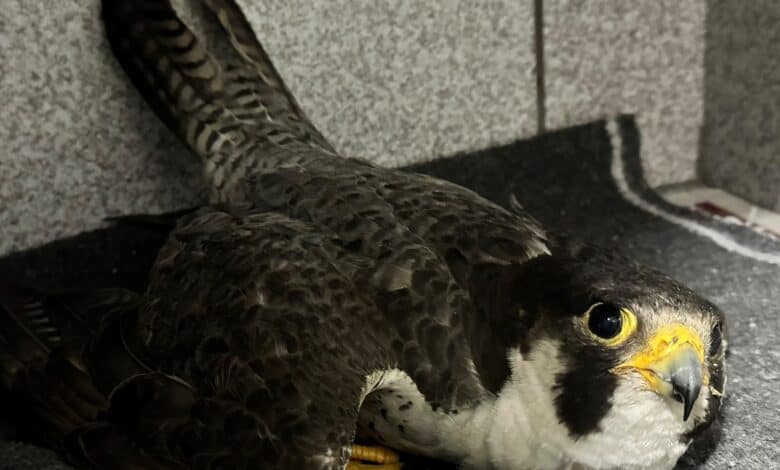
IT’S not every day that the world’s fastest bird makes an appearance in Richards Bay – let alone ends up needing a rescue.
A peregrine falcon, one of the world’s most widespread but elusive birds of prey, was found grounded in Birdswood last week, suspected to be suffering from concussion after a high-speed collision.
ALSO READ: WATCH: Empangeni concrete spill raises health, environmental concerns
While the bird has been recuperating at Arboretum Veterinary Clinic, it will soon be transported to the African Raptor Centre in Camperdown for more specialised rehabilitation to get it back in the air.
While no one knows exactly what happened to the falcon, it is suspected that, while diving for prey – as they are renowned to do – it collided with a wall.
“There’s nothing visibly wrong with the bird, it’s not injured. It more than likely misjudged its speed and crashed into something,” said Miriam Otto from Arboretum Vet.
“It’s wonderful to know we’ve got these beautiful birds in Richards Bay. I’ve only seen one in my life, and that was at the Raptor Centre in Camperdown.
“I didn’t even know we got them in Richards Bay, so for me, it’s amazing to have that bird here.”
Peregrine falcon fast facts
- The world’s fastest bird: The Peregrine falcon can reach speeds of around 320km/h when diving towards prey. This makes it the fastest animal in the world in a powered dive.
2. Found almost everywhere: Peregrine falcons occur on every continent except Antarctica.
3. Spectacular hunting technique: The peregrine climbs high above its intended prey before folding its wings and plunging downwards in a steep dive known as a stoop.
4. It can knock prey out of the sky: Rather than grabbing its prey immediately, it often strikes it with its clenched feet at tremendous speed, stunning or killing it on impact.
5. Exceptional eyesight: Its vision allows it to spot potential prey from several kilometres away.
6. They adapt to city life: In urban environments, tall buildings, bridges and other structures can provide alternatives to natural cliff nesting sites. Pigeons provide a readily available food source.
7. They are devoted parents: A typical clutch consists of two to five eggs, which take 29–32 days to hatch.
8. They have specialised nostrils: Small bony structures inside their nostrils help regulate airflow during their high-speed dives.
9. They were once seriously threatened: Widespread use of the pesticide DDT caused dramatic peregrine falcon population declines in several parts of the world during the 20th century. Conservation and breeding programmes helped populations recover.
10. They can live for many years: Wild peregrines can live well over a decade, with some recorded individuals reaching almost 20 years.
Don’t have the ZO app? Download it to your Android or Apple device here:


HAVE YOUR SAY
Like our Facebook page and follow us on Twitter.
For news straight to your phone invite us:
WhatsApp – 060 784 2695
Instagram – zululand_observer
TikTok – @zululand_observer