City Power announced a major milestone in its rollout of the city’s energy plans
The initiative will help residents of Johannesburg against load-shedding.
City Power has secured 92MW of power from four independent power producers (IPPs) through a short-term power purchase agreement (STPPP).
This is part of City Power’s 10-point plan to lessen the impact of load-shedding by generating 500MW of energy by 2030.
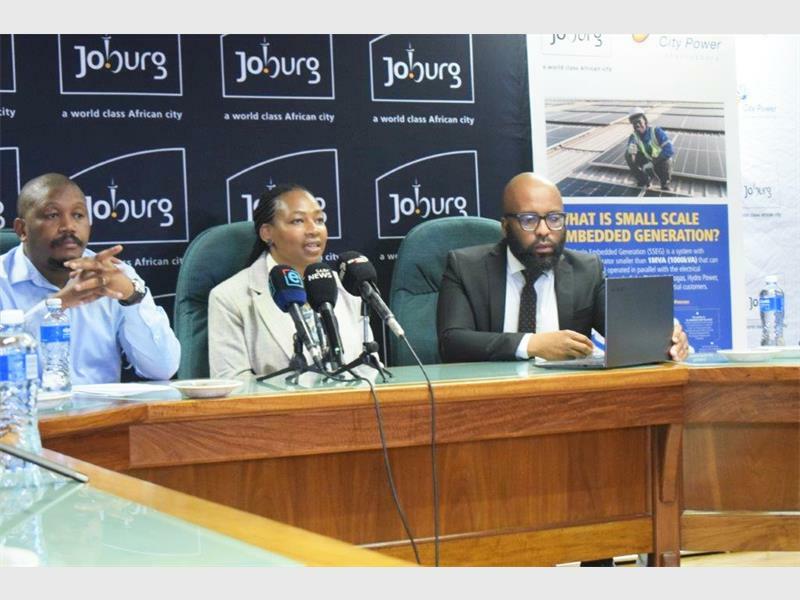
The MMC for Environment and Infrastructure Services (EISD) Jack Sekwaila, alongside his team and City Power chairperson of the board Bonolo Ramokhele and CEO Tshifularo Mashava, announced this development on August 24.
The four IPPs will supply power from a variety of sources, including waste to energy, gas to power and photovoltaic (PV) solar generation. The gas-to-power IPPs will offer the city the flexibility to generate baseload power, which is 24/7 power generation.
MMC for EISD Jack Sekwaila asserted that ‘A total of 16 bids were received and four were successful with a total aggregated capacity of 92MW, comprising the following technologies namely waste to energy making up 20MW, gas to power consisting of 31MW and PV/solar generation x2 with 40.8MW. The gas to power (which is dispatchable generation) offers the city the leverage for baseload generation (24-hour/365-day power generation)’.
In essence, City Power is ready to step on board the STPPP, which is a programme to procure excess power for IPPs, for a capacity of 1MW and above.
Unlike the 20-year PPA (Power Purchase Agreement) that requires approval by the Minister of the DMRE as per Section 34 of the Electricity Regulation Act, the STPPP programme targets installations with excess capacity for capacity 1MW and above to improve the City of Joburg’s energy security.
Currently, the 20-year IPP programme will be tabled at the mayoral committee and council for approval within the next two months.
The STPPPs are a major step forward for City Power in its efforts to reduce reliance on Eskom. The power from the IPPs will be cheaper than what City Power currently procures from Eskom, and two of the IPPs are ready to connect to the grid immediately.
Mashava said, “The entity has made tremendous inroads to cushion Johannesburg residents from the gruelling effects of the ongoing load-shedding. As a result, the main benefit for these STPPPs is that the City will be procuring power from the four successful bidders, which are cheaper than what we currently procure from Eskom.
“In addition, the two winning bidders are ready to connect their energy source to our grid immediately.”
In addition to the STPPPs, City Power is also implementing several other initiatives to reduce the impact of load-shedding.
These include the following:
The installation of the rooftop PV systems at its head office to pilot the rollout to at least 700 other CoJ sites across the City including Joburg Market.
A panel of service providers has been procured to assist City Power in the rollout of alternative sources of energy, and further, plans are underway to exploit the city’s roof space skyline to install and interconnect PV systems to form a Virtual Power Station.
The solar high mast public lighting is illuminating streets across the city. City Power team has been hard at work, since April 2023, with the project already yielding over 50 installed solar lights in most non-affluent areas such as Soweto, Diepsloot, Alexandra, and Orange Farm, among others.
The communities in those areas have expressed their happiness as these lights have proven to be the much-needed stop-gap when the lights go off during load-shedding to provide security. More will be installed in the coming weeks and months in other areas.
Another part of the plan is the small-scale embedded generation (SSEG) programme. City Power is working on implementing its NERSA-approved feed-in tariff, where customers with PV solar systems can feedback/import their excess power to the grid.
The SSEG programme is part of City Power’s efforts to lessen the impact of load-shedding on the city’s residents. The programme entails customer’s application, registration, testing, commissioning, installation of bi-directional metering to measure in-flows and out-flows of energy, and compensation through net billing.
City Power has also started with the installation of rooftop water heating systems or geysers.
As part of City Power’s demand side management programme to reduce peak demand and energy consumption, it has commenced with the rollout of 20 000 solar geysers across the city. This includes Eskom-supplied areas, especially in the non-affluent low-income areas that experience a lot of overloading on the low-voltage network.
The city is currently engaging DMRE for more units which will go a long way to address the challenges brought about by load-shedding.