Kruger’s one concession to pomp and ceremony
The president in his top hat and frock coat suit rode in the state carriage, drawn by beautifully groomed horses.
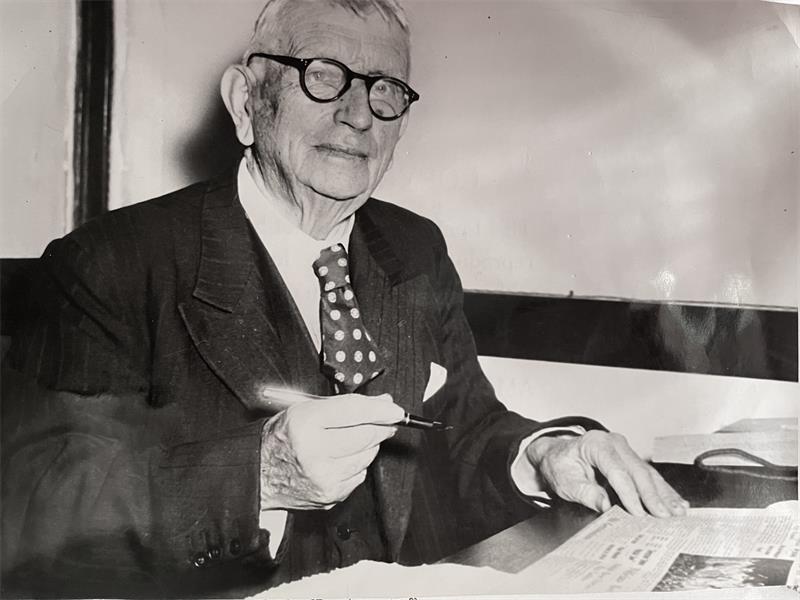
Part 32 in our series on WILLIAM HILLS
President Paul Kruger was an early riser and officials arrived at their work in the Raadzaal Buildings at a proportionately early hour, William Hills wrote of his time as a journalist in the early 1900s.
“The president’s journey from the Presidency to the government buildings was about the only bit of pomp and display in which Oom Paul indulged as president,” wrote Hills.
He doubted that Kruger would have taken part in it but for the advice of State attorney and State secretary Dr Willem Johannes Leyds, who was a stickler for the few conventions in which Pretoria indulged in the days of the Republic.
“The president in his top hat and frock coat suit rode in the state carriage, drawn by beautifully groomed horses and driven by a uniformed coachman from his home to the Raadzaal.
“The coach was accompanied, as outriders, by mounted Zarps (the mounted and foot police of the South African Republic) from the ‘politie stasie’ next door.
“As he proceeded, the president would acknowledge the greetings of those on the sidewalks by lifting his hat.”
The coach remains in the Ditsong National Museum of Natural History (formerly the Transvaal Museum) in Pretoria.
In 1952, a request was made that the coach be transported to Cape Town for the Van Riebeeck Tercentenary Celebrations.
Despite enormous pressure, the request was turned down because the vehicle was considered valuable and fragile, and there was too high a risk of it being damaged.
According to a Ditsong research document, Kruger was offered the coach as a gift but refused, choosing to buy it himself instead.
Manufactured by Turrill and Sons in London, the coach was painted dark blue, had the Republic’s coat-of-arms painted on its doors, and was decorated with the colours of the flag.
Kruger used it from May 12, 1998, the time of his fourth inauguration, until May 1900, shortly before he fled Pretoria for exile in Europe, in the face of advancing British troops (he used a different coach on that occasion).
The coach was acquired by Kruger’s son-in-law FC Eloff in 1904, when he also bought Kruger’s house.
It was donated to the museum in 1919. (Article: Carol Stier).
Next: Sammy Marks: the Transvaal’s first industrialist
ALSO READ: Part 27 in our series on William Hills: Hills helps to start a newspaper
ALSO READ: Part 22 in our series on William Hills: when fortunes were made in a day