Benoni Bygones: Synogogue is a proud landmark
The City Times is proud to revive a monthly history piece compiled by local history enthusiast Glynis Cox Millett-Clay, which she has named Benoni Bygones.
One of the first Jews, Mr MS Ginsberg, arrived in Benoni in 1892, when Benoni was no more than a mining camp.
Other arrivals followed between 1892 and 1896. These included Isaac and Bernard Ginsberg, Michael Levy, IL Meyers and Benjamin Bloch.
During the Jameson Raid, the Jewish residents conducted their daily religious services in the Benoni Hotel.
Shortly after, Max Ginsberg’s brothers, Joseph and George Ginsberg, arrived, followed by W Samuels a few months later.
New Jewish arrivals were few, and the community grew very slowly.
ALSO READ: Benoni Bygones: ‘Meating’ the demand in the early years of Benoni
When the Boer War broke out, most Jewish residents left for the Cape. It was only after 1902 that the growth of the community began to speed up.
In 1905, a regular minyan was conducted in Mr Favish’s house near Kleinfontein Stores.
In 1906, Benoni was proclaimed a town, and in 1907, the first committee of the Benoni Jewish Congregation was formed under the chairmanship of Max Ginsberg.
In September 1907, the first High Holy Day services were held in Stone’s Hall, a wood-and-iron building between the Cecil Hotel and the CNA in Prince’s Avenue.
After the High Holy Days, the committee was granted a site for a synagogue by the Kleinfontein Estates.
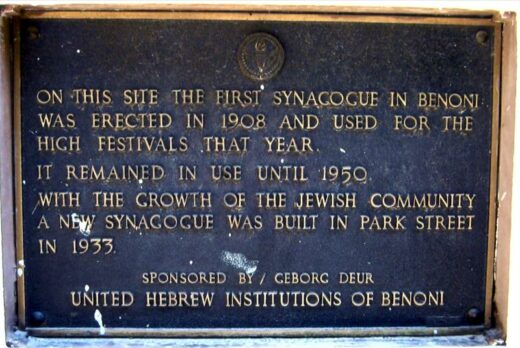
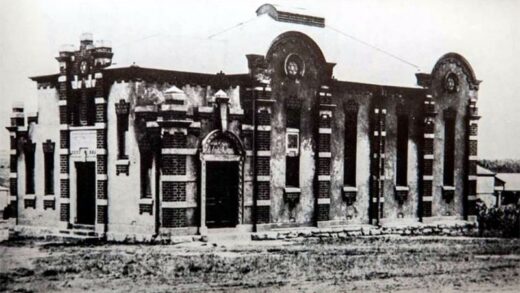
A fund-raising committee went into action and, with the help of a strong ladies’ organisation, the first synagogue was built in 1908 in Woburn Avenue and used for the High Holy Days.
Reverend Hurwitz acted as minister to the congregation until 1909, when he was succeeded by H Silberman, who relinquished his post in 1910 to establish the first kosher butchery in the town.
Rev Hirschowits served the community until 1911. On his death in August 1917, Rev HL Behr was appointed.
The Benoni Hebrew School began its activities in 1918 and grew to the setting of twin stones at the Hebrew Hall on the corner of Bunyan Street and Howard Avenue in 1921.
The opening was in July 1922, and the building was eventually sold in 1948.
The Jewish community grew rapidly, and the old synagogue became too crowded during the High Holy Day services.
Services were also held in the Hebrew Hall, but this could only be regarded as a temporary measure.
A new synagogue became a necessity, and at a special general meeting in March 1929, the council was instructed to proceed with the building of a new shul.
Fundraising began, and in 1930, the Park Street site was purchased.
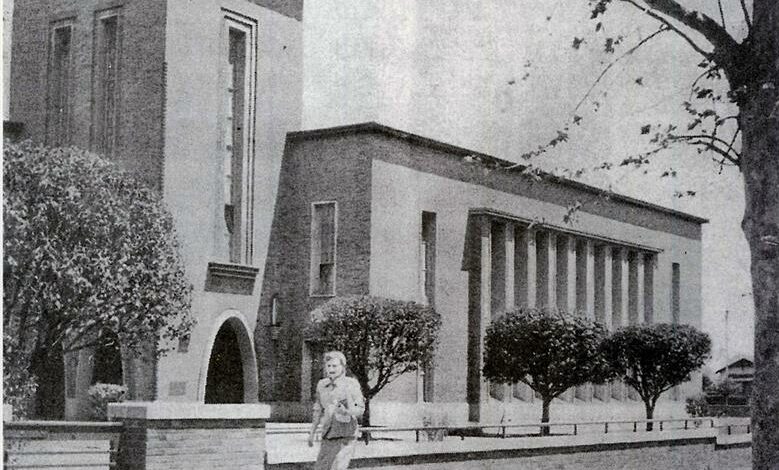
Building began in 1932, and in April 1933, the new shul opened.
The Sifrei Torah was transported by foot from the old shul in Woburn Avenue to the new shul in Park Street.
Abraham Leiman, who was in the procession of transporting the Sifrei Torah, handed it over to his father, Rev Leiman, who in turn entered the shul and placed the Torah in the Aron Kodesh.
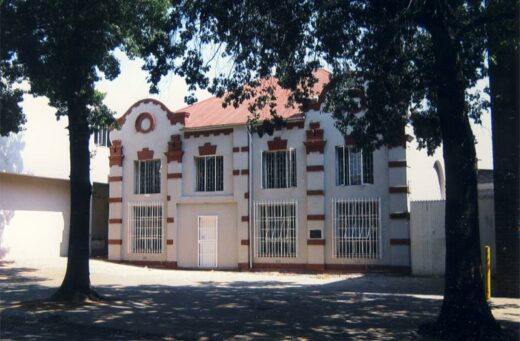
The first synagogue at 26 Woburn Avenue remained in use until 1950, when it was sold and declared a national monument.
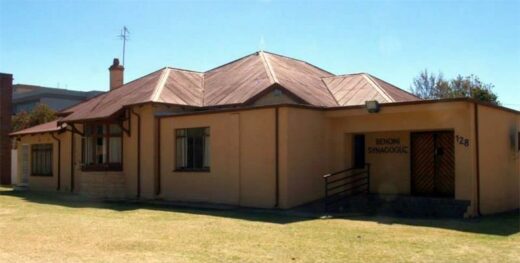
In September 2005, the Park Street synagogue was 70 years old and, with the much-reduced Jewish community, officially relocated to its new home at 128 Woburn Avenue.
This new shul is housed in what used to be the rabbi’s residence.
(Source: Benoni Jewish Community Centenary Annual 1907 – 2007/copied and typed by: Glynis Cox Millett-Clay dated 22 May 2016/modified 21 Oct 2025).
ALSO READ: Benoni Bygones: Meet Joseph Jacob Fine