
“This country hates our boys” launches to packed audiences in Johannesburg
The book positions mothers – particularly single mothers – not as culprits but as heroes carrying impossible burdens.
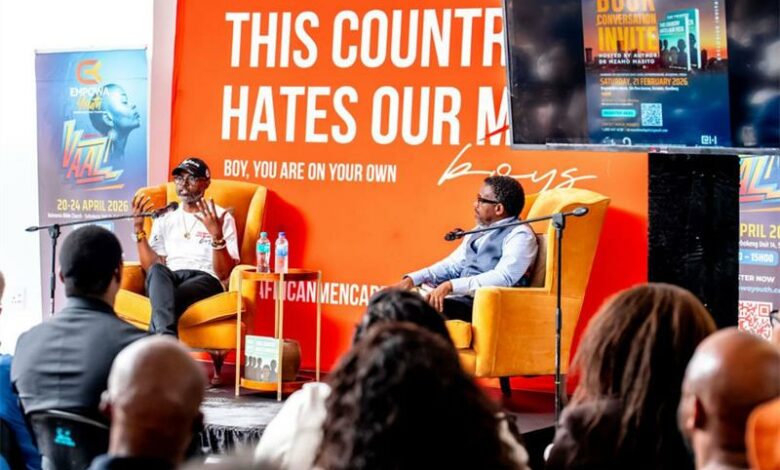
The launch of Dr Mzamo Masito’s This Country Hates Our Boys: Boy, you are on your own marked the beginning of what promises to be one of SA’s most crucial conversations this year.
Published by Tracey McDonald Publishers and distributed by Jonathan Ball Publishers, the 300-page work draws on years of research through African Men Care to expose the systemic failures leaving black and coloured boys abandoned by families, schools, communities, and government.
A truth too uncomfortable to ignore
The book’s provocative title is not hyperbole but evidence-based analysis. When 64.5% of South African children grow up without their biological fathers, when black boys are disciplined at 3.5 times the rate for identical behaviours, and when male suicide rates sit at five times higher than female rates, the data speaks for itself.
“We’re not asking people to feel comfortable,” Masito told the gathering of educators, community leaders, corporate representatives, and African Men Care mentees at Exclusive Books Rosebank on February 17.
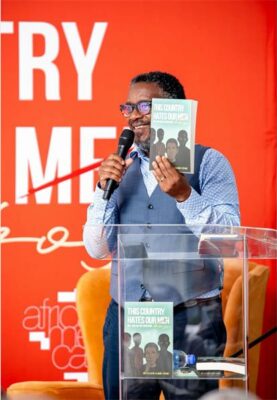
“We’re asking them to feel responsible. Every man is every boy – the struggles we see in adult men are rooted in what we failed to give them as boys.”
According to the research, 40% of learners who begin Grade One will never reach matric. Male suicide rates reach 21 per 100 000, making SA the sixth highest globally. Only 31.7% of black children live with fathers, compared to 80.2% of white children.
Beyond blame: a framework for change
What distinguishes the book from academic critique is its solution-oriented approach. Masito presents a six-domain framework addressing boys’ development across self, home, school, parents, community, and government.
Drawing on African Men Care’s proven interventions, the book demonstrates that change is possible. Where the full framework has been implemented, violence decreased by 67% within 18 months, school attendance improved by 43%, and 58% of participating boys report feeling more hopeful about the future.
Navigating the gender debate
The book does not shy away from SA’s most sensitive fault line: addressing boys’ struggles while the country faces a femicide crisis.
“Some will ask: ‘What about gender-based violence?’” Masito acknowledged.
“The answer is that supporting boys is violence prevention work. Hurt boys become hurting men. If we want to end violence against women, we must ask where violent men come from.”
The book positions mothers – particularly single mothers – not as culprits but as heroes carrying impossible burdens.
The conversation continues
The Johannesburg launch is the first in a series of regional events. African Men Care also partnered with EmpowaHim on a related conversation at Empowaworx House, where Nkosinathi Moshoana of the What about the Boys initiative reinforced the movement’s core message.
“If you are a man, whether you are a biological father or not, there is a young boy watching you. We must redefine what it means to be a man and become the positive role models our boys desperately need,” said Moshoana.
Also Read: Win Ma-Tinka’s Vegetable Magic Cookbook
Also Read: Morehill artist (89) serves up a veggie cookbook