
Public encouraged to respect rights of the blind and visually impaired
KZN Blind and Deaf Society says members should enjoy equal rights and dignity as other members of society.
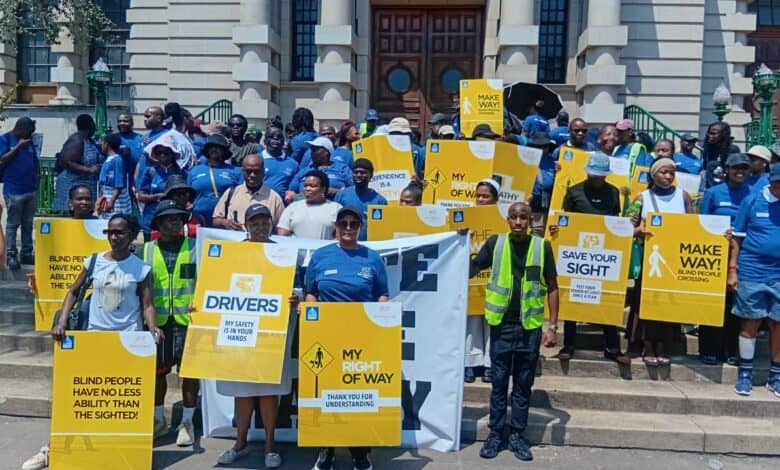
The public have been urged to treat people with blindness and visual impairment with respect and dignity while they navigate their daily lives.
These sentiments were relayed by the President of the KwaZulu-Natal Blind and Deaf Society Veetha Sewkuran, outside the Durban City Hall on Thursday, where they were joining the international community in commemorating International White Cane Day, which is observed on October 15 annually.
Sewkuran said that it was more than about the white cane, and that it was about mobility, dignity, confidence, safety and the right of every blind person to move freely and participate fully in society.
Also read: Durban political parties pledge action on homelessness
“The white cane is one of the most recognisable symbols of blindness and visual impairment. But, beyond being a symbol, it is an essential mobility tool. It helps a blind person identify obstacles, navigate their surroundings, locate changes in ground level and move independently through their community.”
She said that the march from the KZN Blind and Deaf Society offices to the Durban City Hall was therefore more than a walk, but a walk for awareness, understanding and inclusion.
Sewkuran noted that although most of the participants had walked the route with assistance, with some being guided by sighted persons, while others walked independently using their white canes, the assistance received did not translate to a daily requirement.
“Every day, blind and visually impaired people leave their homes, travel to work, attend appointments, use public transport, go shopping, visit government offices, attend schools and universities, participate in sport and social activities, and go about their daily lives often independently.”
She said that public awareness was pivotal.
“When you see a person carrying a white cane, please understand what that cane represents. It represents a person who is navigating the world using their own skills and abilities. Please do not assume that because a person is blind, they are helpless.”
She emphasised that if assistance was needed, it was ideal to ask first and to avoid simply grabbing the person or pulling them across a road, but to rather allow them to tell you about the kind of assistance they require.
A special appeal was made to motorists.
“When you see a person with a white cane near a road, at a pedestrian crossing or approaching an intersection, slow down, be patient and give them the right of way where appropriate.
“A blind person may not see your vehicle, but they may hear it. They may be listening carefully to the movement of traffic and using their cane and other orientation and mobility skills to determine when it is safe to cross.”
Motorists were warned to avoid hooting unnecessarily, intimidating them by driving too close and to not assume they have been seen.
She said that blind and visually impaired people had the same right as everyone else to use public transport and that drivers, passengers and transport operators all had a role to play in ensuring that public spaces and transport systems were accessible and welcoming.
“Information must be accessible. Public announcements must be clear. Signage must be understandable. Technology must be accessible and people working in public spaces must understand how to interact respectfully with persons with disabilities.”
The organisation, which is approaching its 90th anniversary, provides orientation and mobility support, rehabilitation, life skill, education, technology, skills development and opportunities that enable blind and visually impaired people to live more independently and pursue their aspirations.
Sewkuran sent a message to the city and province.
“Blind people are here. We are active. We are capable. We are working, studying, travelling, raising families, participating in sport and contributing to our communities.
“We ask only that society recognises our presence, respects our rights and helps create an environment in which everyone can move safely and independently.”
Also read: Police, NPA dispel March and March arrest claims
She called on the blind and visually impaired participants to be proud of their cane and not see it as a symbol of limitation but of independence, and to carry it with confidence, use it with pride and never allow society’s misconceptions about blindness to limit what they believe they can achieve.
“To the public, I ask you to remember three simple things when you encounter a person using a white cane – see us, respect us and give us space and time to move safely.”
For more from Berea Mail, follow us on Facebook, X and Instagram. You can also check out our videos on our YouTube channel or follow us on TikTok.
Click to subscribe to our newsletter – here