
Six stingrays turn up for their annual medical check-ups
The medical check-up required an extensive team, including 14 aquarists, three veterinarians and a crane driver.
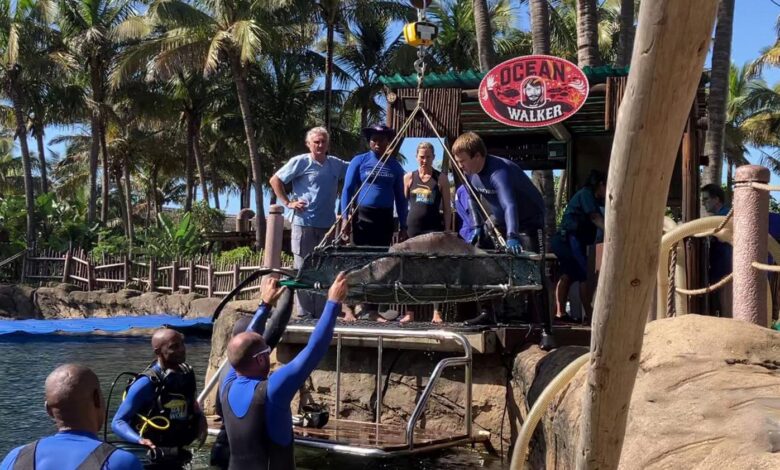
SAAMBR spokesperson Ann Kunz said a Bowmouth Guitarfish also received a medical alongside the stingrays – and it was no small task.
“You might wonder what it takes to perform medical check-ups on six large stingrays and one Bowmouth Guitarfish. The answer is simple. A team of 14 aquarists, three veterinarians, one veterinary nurse, one crane driver, two technicians, four divers and a couple of volunteers,” said Kunz.
The medical also made use of specialised equipment. Each sting was carefully captured in a large hoop net by an experienced team of divers so the exam could take place above the water.
Also read: Saambr celebrates 71 years of conservation
“The rays were then gently brought to the surface of the pool and carefully transferred onto our ‘ray tray’ – a custom-made rectangular stainless-steel frame with reinforced mesh across it which creates a kind of hammock where the ray’s weight is evenly supported throughout the move. A crane is used to lift the animals out of the exhibit and into the waiting sedative bath in the 2 000l trailer tanks used for the procedures,” explained Kunz.
She added that stingrays range in size from just under 50kgs to nearly 200kgs.
“Each animal’s general external condition is recorded before they are weighed and measured. A blood sample is taken from the animals and analysed. This blood sample allows us to pick up signs of maybe something wrong with the animal, which is not yet visible externally, and will allow us to take action in good time. An ultrasound is done to check the animal’s heart rate and the condition of their internal organs,” said Kunz.
Also read: Saambr celebrates 71 years of conservation
After the examination, the stingray is transferred back into the exhibit where an aquarist guides it to a quiet place where it can wait for the effects of the sedative to wear off.
The procedure was simplified for two female stingrays suspected to be pregnant.
“We are sure that two of our largest female stingrays, a ribbon-tail and a thorn-tail ray, are pregnant, so we kept any possible stress on these two special ladies to a bare minimum and didn’t remove them from the exhibit. They have been with us for many years and are acclimatised to being handled, which allowed us to gently hold the rays in the shallows while they underwent their medicals,” concluded Kunz.
For more from Berea Mail, follow us on Facebook, Twitter and Instagram. You can also check out our videos on our YouTube channel or follow us on TikTok.