Depression and suicide: the unseen killers
Following the recent suicides of celebrity comedian Robin William, as well as numerous South Africans across the country that have made headlines, it is important to note that at least 10 per cent of all non-natural deaths in adults and 9.5 per cent in youth in South Africa are due to suicide.
Globally, according to the WHO, suicide is the second leading cause of death among 15-29 year olds, with one person committing suicide every 40 seconds.
For every person that dies by suicide, between 10 and 20 people attempt it.
According to Professor Lourens Schlebusch, there are at least 23 suicides a day in South Africa, which may be underestimated due to the stigma involved in suicide.
However, data on suicides and other unintentional injury deaths are not systematically tracked by any agency in the country making accurate statistics hard to come by, according to SA’s largest mental health NGO, the South African Depression and Anxiety Group (SADAG).
Suicide is a preventable tragedy and with appropriate help, treatment, and support, lives can be saved.
Through raising awareness of the magnitude and scope of the problem, increasing psycho-social support and providing free counselling to those in need of help, and implementing grassroots suicide prevention strategies.
SADAG’s Solutions to Suicide:
Teen Suicide Prevention
Despite the increasingly concerning rate of teen depression and suicide, one in four South African teens have attempted suicide and one in three hospital admissions for suicide involve youth.
Most schools don’t have counsellors or psycho-social support systems in place.
SADAG initiated a school-based suicide prevention programme – Suicide shouldn’t be a secret – that goes class by class to empower youth to identify symptoms of depression and warning signs of suicide in themselves, their peers and loved ones; where to go in their communities for assistance, and how to contact SADAG.
SADAG also trains teachers because giving power and advice to first-line responders helps them better cope in suicide crises.
Counselling Containers in Townships
There are many communities in South Africa that lack any access to mental health care.
Dieplsoot is an example with an ever-increasing population of at least 200 000.
SADAG has established a counselling container in Diepsloot that not only provides free counselling to residents but also outreach programmes with schools, churches, community groups, the police and clinics, and local shopping centres.
Container Counselling units can help entire communities and provide easy access, education, support and save costs.
A Counselling Container costs R600 000.00 per year to run, which includes providing the counsellors, phones, brochures and materials, talks and support to the members of the community.
SADAG’s National Suicide Crisis Lines
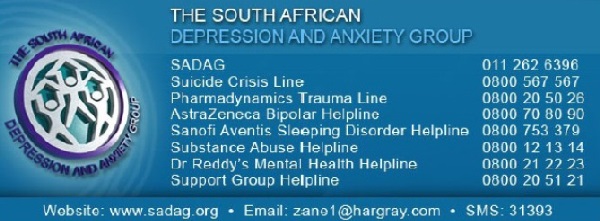
SADAG has been operating the national suicide prevention crisis lines (0800 567 567) for over 12 years with no funding from the Department of Health, despite the massive costs involved in helping callers on the lines.
According to SADAG the line needs to be available 24 hours a day but without funding this is simply not possible.
“Our lines run seven days a week from 8 am to 8pm but depression and suicidal thoughts don’t stop when our lines close”, said Cassey Chambers, from SADAG
“Depression and suicide cross all racial, gender and socio-economic boundaries, affecting males and females, married and single, wealthy and poor, young and old.
“Many people think that depression is a ‘female’ issue but statistics show that there are at least four male suicides for every one female suicide.”
Suicide is a critical issue in South Africa but it can be reduced and prevented.
There is treatment for depression and other mental health issues, help is available.
SADAG not only runs a 15-line toll-free counselling and referral centre but also offers community outreach, education and counselling to under-resourced communities, in schools, and in corporations.
In addition, SADAG works with the South African government and medical aid schemes to increase political commitment and funding for mental health care and ensure that sufferers are treated equally.
SADAG can be contacted on 0800 21 22 23, 0800 12 13 14, or www.sadag.org
South African Stats
* 10 percent of all non-natural deaths in adults and 9.5 per cent in youth are due to suicide.
* there are +/- 23 suicides a day, virtually one every hour.
* nearly two-thirds of all suicide victims are aged between 20 and 39 years.
* Nearly one third of recorded suicides in SA are in Gauteng and there has been a 1.5 percent increase in suicidal deaths in the Transkei over the past five years.
* There are 4.6 male suicides for every one female suicide.
* one in four SA teens have attempted suicide.
* one in three hospital admissions for suicide involve youth.
* less than 1 per cent of mental hospital beds are for children and adolescence.
* 70 per cent of South Africans who attempted suicide had a mental health disorder.
* 75 per cent of people will not get the mental health treatment they need.