Stats SA’s survey reveals South Africa’s crime wave
Consumer fraud incidents rose sharply from 552 000 in 2023/24 to 811 000 in 2024/25.

According to Stats SA’s latest reports, crime remains one of the defining challenges of life in South Africa, cutting across geography, gender, and economic status.
On August 26, Stats SA released its Public Safety and Justice Survey (GPSJS), which highlighted disturbing crime levels in South Africa
This statistical release presents a selection of key findings from the GPSJS 2024/25, conducted by Stats SA from April 2024 to March 2025.
While police statistics capture reported offences, surveys like the GPSJS provide insight into both reported and unreported crime, giving a fuller picture of overall safety.
House burglary tops household crimes
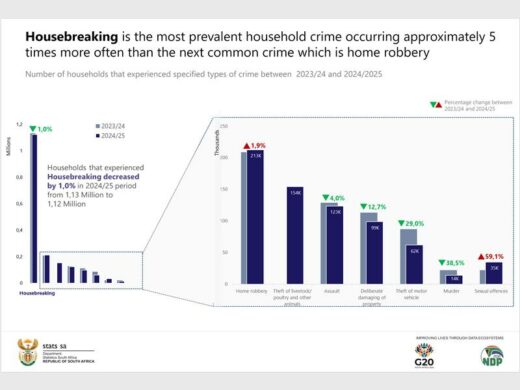
The GPSJS revealed that house burglaries remain the most prevalent crime affecting South African households in 2024/25.
Households most affected
The latest report on crime in South Africa shows that burglary has consistently been the most common crime experienced by households in the country, followed by home robbery.
Male-headed households and those living in KwaZulu-Natal were most affected. Over the year 2024/25, an estimated 1.5 million house burglaries occurred, representing 5.7% of all households in the country.
Least reported crimes
House burglary was one of the least reported household crimes to the police, with only about 43% of affected households taking cases to the police – almost the same proportion as the previous year.
Theft of personal property and consumer fraud dominate personal crimes. When looking at individuals, theft of personal property was the most common crime in 2024/25. A total of 1.2 million people were affected. This is down from 1.3 million in 2023/24. Theft most likely affects males and people living in metropolitan areas.
The estimated 1.3 million incidents of personal theft affecting about 1.2 million individuals are equal to 2.6% of the population aged 16 and older. However, most victims chose not to report these crimes – 69% chose not to report, while just 31% reported some or all incidents to the police.
Consumer fraud
Consumer fraud incidents rose sharply from 552 000 in 2023/24 to 811 000 in 2024/25. Encouragingly, the share of victims reporting to the police also increased from 30.7% to 34.9%.
How individuals try to protect themselves
The proportion of adults aged 16 and older who felt safe walking alone in their neighbourhoods during the day declined from 85.0% in 2020/21 to 80.4% in 2023/24, before edging up slightly to 81,0% in 2024/25.
Fewer South Africans reported feeling safe when walking after dark. Only 36.1% felt safe in 2024/25. It was up marginally from 34.9% the previous year, but still well below the 39.6% recorded in 2020/21.
Provincial differences
Limpopo recorded the highest proportion of people who felt safe walking alone both during the day (97.2%) and at night (64.2%). Western Cape residents, however, were the most likely to feel unsafe during the daytime (31.4%), while Mpumalanga had the highest share who felt unsafe at night (73.0%).
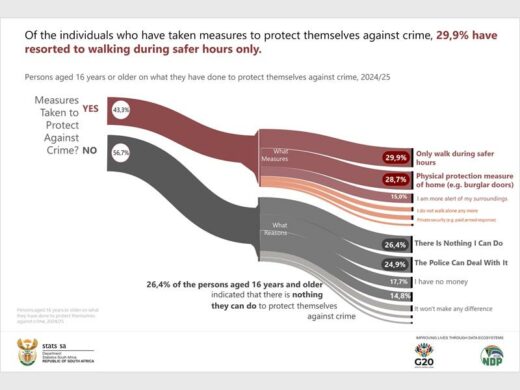
Those aged 16 years and older are also taking active steps to protect themselves against crime. The share of people who took steps to guard against crime rose from 39.9% in 2023/24 to 43.3% in 2024/25.
What they have done to protect themselves against crime
Walking only during safer hours was the most common precaution (29.9%), followed by installing physical protection measures such as security gates (28.7%). Nearly 80% (79.9%) of individuals said these measures made them feel safer.