New ablution facility at school makes safe hygiene a reality
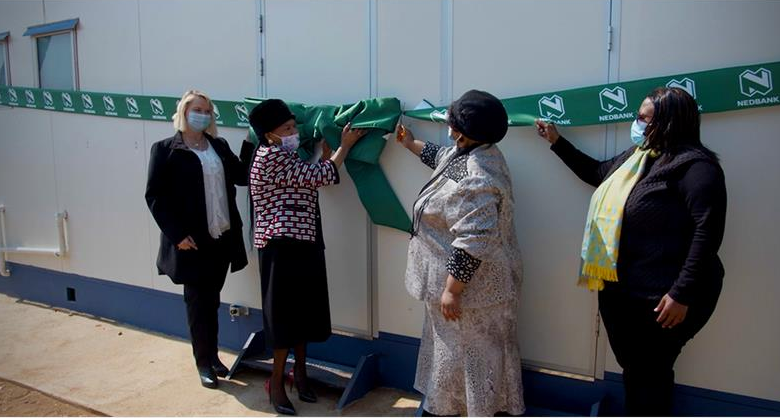
More than 2 500 young learners at Pheasant Folly Primary School in Palm Ridge now have access to modern, hygienic and dignified ablution facilities, thanks to the combined efforts of Nedbank and Habitat for Humanity.
According to recent statistics, 16 000 of South Africa’s 24 000 schools don’t have working ablution facilities and 3 800 of these schools are still using pit latrines, with one in three schools around the world not having access to ablution facilities at all.
“This is an alarming reality, with a devastating negative impact on the country’s education system. It requires urgent intervention,” said Poovi Pillay, executive for the Nedbank Foundation.
“The inability of these schools to provide adequate hygiene that helps combat the Covid-19 pandemic has seen learners lose an entire school year.”
Nedbank’s involvement with the Palm Ridge community goes back to 2019 when hundreds of volunteers from the bank participated in a Habitat for Humanity house-building initiative that saw eight Palm Ridge community members and their families moving into their own homes.
After Covid-19 effectively put the brakes on similar initiatives in 2020, Nedbankers returned to Palm Ridge at the start of 2020 with a new objective of providing ablution facilities for the fast-growing numbers of Pheasant Folly Primary School learners.
According to principal Rita Busisiwe Khubeka, the school has expanded exponentially since it was first established in 1980 with just 16 learners in two small classrooms.
Today, Pheasant Folly is meeting the educational needs of 2 550 young people and boasts 36 Grade One to Grade Seven classrooms and seven Grade R classrooms.
“Since moving to our new premises in Palm Ridge in 2015, we have had very little in the form of infrastructure, and our learners found it difficult to protect themselves from Covid-19 due to a lack of suitable and hygienic ablution and sanitation facilities,” said Khubeka.
“But thanks to Nedbank, our learners will now not only enjoy dignified ablution facilities, but also be better able to protect themselves, and their families and community, from the spread of the virus.”
The new ablution facility provides the female learners with four flush toilets and three water basins, while the boys have three modern toilets, a urinal section and two water basins.
A water-harvesting tank has also been connected to the facility to ensure a sustainable supply of water.
According to Pillay, the project epitomises Nedbank’s commitment to delivering on its purpose by building shared value between business and society, in this instance, through employee volunteerism.
“Nedbank’s purpose is to use our financial expertise to do good for individuals, families, businesses and society, and this is deeply ingrained in the culture and ethos of Nedbank and embraced by all its employees.”
Cyrus Watuku, director of programme operations for Habitat for Humanity Europe, Middle East and Africa, echoed Pillay’s sentiment and said that the handover of the ablution facility demonstrated the power of people-public-private partnerships in building integrated, resilient and sustainable human settlements.
“We are grateful to all the partners involved in this project, especially Nedbank, for helping to improve the quality of the learning environment in schools through increased access to water, sanitation and hygiene solutions for the vulnerable members of our society.”
In addition to the construction of the ablution facility, Nedbank’s support of the school and its learners also included the donation of school shoes, sanitary pads, tables, chairs and cleaning materials, as well as the planting of several water-wise spekboom trees around the school grounds.