
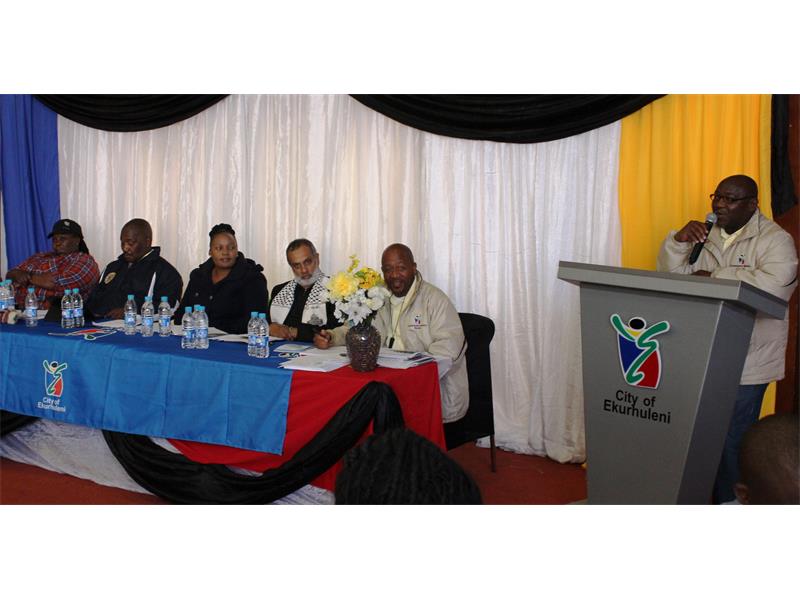
The MMC for community safety, Clr Mthuthuzeli Siboza, who also chairs the Community Safety Forum, (CSF), led the evaluation conference held at the Germiston Council Chambers on Saturday, August 2.
The objective of the conference was to reflect on the past year, and discuss the progress made since the official launch in July 2013.
In laying a firm foundation for the CSF, extensive consultative processes were initiated in 2012, which included sensitising communities at ward committee level and was followed by consultative workshops with all other stakeholders, culminating in an official launching conference in July 2013.
“Three regional CSF structures have been established, at least five major awareness campaigns have been conducted and a significant augmentation in terms of human resources of EMPD personnel has been realised,” MMC for community safety, Clr Mthuthuzeli Siboza announced.
“Although we are still faced with challenges in respect of financial constraints and clarifying of the difference between CSFs and Community Policing Forums (CPFs) to our communities, great strides have been made since the official launch in 2013.
“A Community Safety Plan (CSP) has been adopted, with remedial measures in place to solicit funds and step up on awareness campaigns.
“Over and above these, future plans include the establishment of ward-based CSFs, as well as voting district-based CSFs by mid-2016.”
Siboza made an impassioned plea to the delegates to ensure that all formations, youths, families and individuals actively take a bold stand against crime in their homes, streets, neighborhoods, communities and the entire region, in order to create a safer metro for all.
“The onus is on each and every one of us to play a genuine and sincere role in making our homes and streets safe”, he emphasized.
Delegates officially adopted the CSF Safety Plan (CSP) by signing a declaration to that effect.
For a noticeable improvement to be realised, it is crucial that safety plans are in place and all precincts in the metro have practical and measurable results driven by Community Safety Plans (CSPs).
The advent of CSF was the result of limitations in the Community Policing Forums (CPFs), which lack formal interaction with other criminal justice agencies such as courts, prisons and government departments such as welfare, education and local government.
These limitations in CPFs motivated the establishment of CSFs, as the people needed to be involved not only in determining police priorities in their area, but also identifying the criminal prevention needs.
Crime levels are affected by a range of economic, social and political factors; addressing crime prevention needs require a multi-disciplinary and an integrated approach.
CSFs are community-based structures that play a meaningful role in the fight against crime – it’s a bottom-up integrated process approach that is people-based and people-driven – based on their needs and aspirations.
The CSF Committee, under the chairmanship of MMC Siboza, is charged with the responsibility to coordinate all stakeholders involved in community safety, e.g. CPFs, Business Against Crime, SAPS, Justice Department, Correctional Services, Home Affairs and Non-Profit Organisations (NPOs), with the objective of ensuring a seamless management of the CSF structures in the metro.