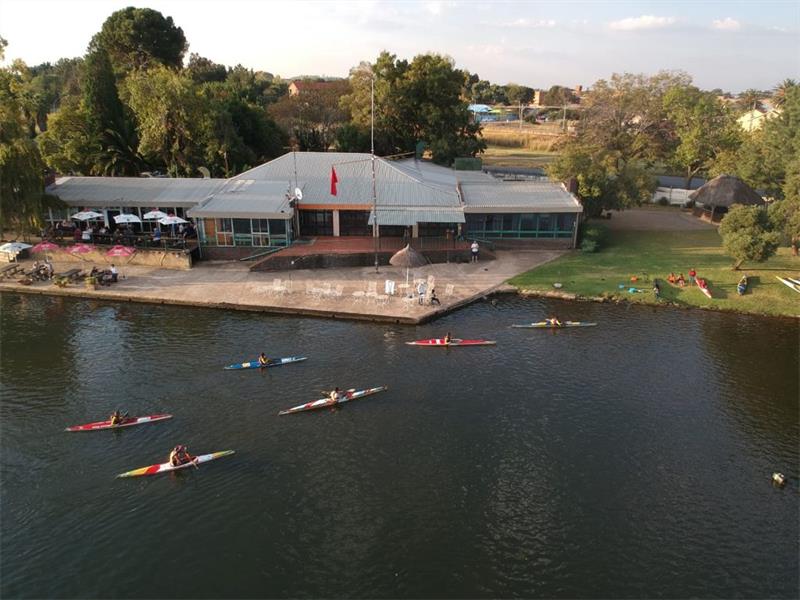
The beautiful Victoria Lake boasts a rich heritage
It is said people think the lake is named after Queen Victoria, but it is named after the Victoria Falls and Transvaal Power Company registered in 1910, which became Eskom in 1948 when the Nationalist Party was formed.
This year’s Heritage Month is being celebrated under the theme The Year of Charlotte Maxeke: Celebrating South Africa’s Intangible Cultural Heritage.
Heritage is many things seen and unseen. Stories passed on from generation to generation, written and spoken.
GCN looked at the iconic Victoria Lake with the help of Victoria Lake Club (VLC) member Roslyn Cassidy.
It is said people think the lake is named after Queen Victoria, but it is named after the Victoria Falls and Transvaal Power Company registered in 1910, which became Eskom in 1948 when the Nationalist Party was formed.
ALSO READ: Alzheimer’s calls for specialist care
It is said Eskom donated land to VLC in the 1930s. The land where the Sea Scouts and canoeing boathouses are built, plus some land on the other side of the main road, forms part of that donation.
“Initially only the Scouts had a boat shed in the bay area. Once the canoeing boathouse was built, it opened the door for the VLCR to erect their boathouse, which was then followed by the schools.
“Water sports at VLC has thus come full circle, as the crescent-shaped area, known as the bay, now houses the boats and equipment for sea scouts, canoeists, and rowers,” said Cassidy.
She said more research needs to be done to check which water sport became resident first.
“But what is known is that rowing was the first water sport to officially become resident in 1906 when small clinker-built boats were used for competition and leisure.
“Sailing began in about 1910 and the boys and men sailed 20ft Scows, until World War I temporarily stopped leisure activity at the lake,” said Cassidy.
When the war ended, sailing started up again in the late 1920s when Rand Airport was built. The sport was popularised by the aviation workers, who enjoyed it in their spare time.
Rowing and sailing merged into VLC in the 1940s.
Canoeing began unofficially in the 1960s and officially in 1981 when a section of the South African Breweries (SAB) Sports’ Club at Denver affiliated to VLC as the canoe section.
“Much more recently, triathlon, open-water swimming, stand-up paddling, windsurfing and wing-foiling have come to be established as sports at the lake.
“All of the sections now are affiliated to VLC and have representation on the committee. Motorised water sports also take place and the management of those is under another club at the lake, the Germiston Aquatic Club,” explained Cassidy. The boathouse was built in the 1930s on the site of the current bridge and the shed, which is now where Germiston High School’s (GHS) boats and equipment are stored.
GHS was the first school to row at the lake and would have begun sometime after 2017 when it was built.
The next stage of development was during the 1980s and was particularly important because there was a struggle between VLC and Wemmerpan Club, leading up to SA’s return to Olympics in 1992.
“Almost 50 years after rowing first began at the lake, Jeppe High School for Boys and St Benedict’s College built the first sheds in 1987. Then in the 1990s, more sheds were put up and other schools were invited to come to VLC,” explained Cassidy.
The latest addition, the shed which houses St Mary’s School’s boats, was completed early in September – just in time for the new season.
The sailing section went from its humble origins before and after WWI to its height in around 1964 when sporting boycotts against SA were imposed.
“In the years before fibreglass came to be used, the boats were built from plans at home and tested and rejigged until they were deemed sailable; these were called sprogs. Then dabchicks were developed and then the optimist came along, which is commonly sailed now.
“Sailing then took off around the world, as wooden boats began to be built. What we know now is that ultra-light carbon fibre boats skim along the ocean’s surface at 30 knots by using technology, engineering and the wind,” explained Cassidy.
The bridge was built in 1948 for the South African Sailing Championships to be used for starting and finishing races.
“It is hoped the bridge can be restored to its former glory because, after a fallow period of 10 to 15 years, there has been an upsurge in interest in sailing recently among juniors.
“For several years part of the bridge was condemned, but in 2019 when a storm blew the roof off the boathouse and the Germiston shed, Ekurhuleni City Council repaired the entire structure,” said Cassidy.
An important milestone for sailing came in 2009 when World Sailing began to accredit all facilities that provided a certain level of training and competition.
It was then that sailing moved back onto the world stage.
“The history of canoeing at VLC is more recent than rowing and sailing. The canoe section started as the SAB Canoe Club (SABCC) at a meeting held at the Denver Depot of SAB on March 25, 1981.
“The canoe club was affiliated with the SAB Sports Club. In August of the same year, the SABCC was accepted as a member of the Transvaal Canoe Union (TCU).
“The water was used liberally by SABCC in the initial years of its existence and soon VLC, which had the water rights, became concerned that control and safety were being compromised. The VLC Canoe Section, initiated by Keith Mayberry, Chris Thorpe and Barry Dingle, was formed in October 1983 and incorporated the SABCC.
“The first and second VLC Croc River Races, using the Highveld Crocodile River, was organised but SABCC in 1981 and 1982. But from the third year, it was a VLC event and in 1983 the TCU awarded the race Transvaal K1 Championship status, and the race became the first Duzi River Marathon qualifier for the Transvaal.
“In 1987, the race became a qualifier for the Umkomaas River Marathon and 20 years since the inception of the canoe section, the club hosted the VLC Crocodile River Canoe Marathon in 2019,” said Cassidy.
In 1985, VLC negotiated a 20-year loan from the Germiston City Council that enabled the building of the boathouse.
“This loan was repaid from rack rental earnings and the final payment was in 2005. The loan was only for the steel infrastructure and cladding. The rest of the infrastructure was self-financed by the canoe section. Although most of the work was undertaken by the canoeists, rowing and sailing members also put in effort and support,” explained Cassidy.
She said VLC has always had a connection to international water sport and at one point, the club had more international sportsmen than any other club in SA.
In 1987, SA returned to competing internationally, the heavyweight eight did very well, but an unbeatable VLC lightweight four topped the class. Graham Cooke was in the lightweight four, and two men and two of our women went to the Olympics in 1996 and 2000.
“The stroke of the four who won gold in London 2012, Siswe Lawrence Ndlovu, spent some of his time at VLC and now coaches at UJ, which just shows that transformation programmes can be very successful,” said Cassidy.
Sailing has also had its international stars and Olympians.
“SA was barred from participating in the Olympic Games in 1964 when Brian Metcalf and Hugh Hanaran were selected,” explained Cassidy.
“When unbarring came about in 1992, sailing was the first code to compete internationally when Rob Wilcox went to New Zealand for the Flying Dutchman World Champs and others followed.
“Graeme and Paul Wilcox, Rob’s sons, went to the Youth World Championships in Finland. Paul did the Volvo Race and is now a professional sailor, assisting SA to become seeded for the Star Sailors League.
“Graeme has recently been recruited to assist with INEOS TEAM UK, a British sailing team based in Portsmouth, England. The team was established in 2014 with the ambition of winning America’s Cup for Great Britain.
“We have youngsters coming up. Keagan Nel and Helen Janse van Rensburg have participated in several European sailing competitions and Keagan has sailed the Optimist Class World Championships.
“Both these young people have been selected for the team competing in the World Sailing Championships in Oman in December.
“Canoeing has its heroes – starting with Helen, who is also a sprint paddler. She competed in the Youth Sprint World Championships in 2019 in Portugal and earlier in September she competed in the Olympic Hopefuls event in Czechoslovakia. Loveday Zondi and Richard Cele have been successful at the Duzi River Marathon.
“Anton Nel has competed in the Marathon Championships overseas. The club also sent men to the Stella Canoe Marathon in Spain a few years ago.
“Some of our ex-members who have emigrated have also excelled in the sport. Sean Rice, who lives in Australia, is the canoe ocean racing world champion. He coaches Olympic canoeing in Australia.
“A more distant claim to fame is Jean van der Westhuizen who won gold in Tokyo this year in the K2 Men’s 1 000m sprint.
“Transformation is not easy to achieve and is an ongoing project which requires creative thinking, financial and human resource and understanding of what it means and an awareness of the benefits to a society,” said Cassidy.
She said VLC has made expensive sporting opportunities available to young people whose families wouldn’t ordinarily be able to afford them.
“All sporting sections at VLC have a history of transformation. School rowing has brought many young black girls and boys onto the water and the sport easily accommodates rowers with physical impairments,” said Cassidy.
• Information also provided by Shellee Nel (née Potts), Rob Wilcox, Chris Barratt, Richard Carter and Barry Dingle.
Contact the newsroom by emailing:
Marietta Lombard (Editor) germistoncitynews@caxton.co.za, or (Journalists) Busi Vilakazi busiv@caxton.co.za