
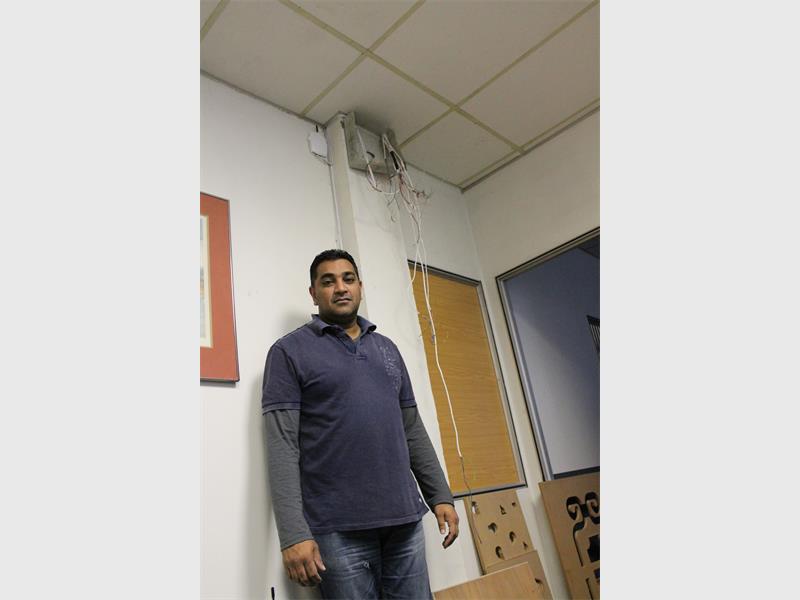
GENERAL Cabinet Works in Pinetown was hit by a group of criminals who stole approximately R200 000 worth of goods last Thursday evening. The security company did not respond to the break-in as it is alleged the alarm did not trigger on its main board.
Navin Rampersad, manager of General Cabinet Works, said that this was the third break-in at the business since November last year. “We have been in this building since 1986, and in 2012 we moved to Blue Security and had them do all of the wiring and installation of passive sensors, beams and magnets throughout the office and workshop,” said Navin. He said Blue Security responded to the incident in November last year and the thieves were interrupted. He said they chose to upgrade the sensors on the property to microwave sensors.
The next robbery happened in February this year; the alarm activated and, according to Rampersad, Blue Security said they did not receive a signal in the control room. The robbers made away with monitors, hand tools, equipment and software to the value of R140 000. “They said it must have been a fault on our side, either with the radio link or the phoneline, but we contacted them the very next morning off the same phoneline to report the robbery,” said Rampersad. “I told myself that it must have been a fluke and that it wouldn’t happen again, as we installed a cellular transmitter for an extra R4 500.”
On Wednesday, 11 May, a day before the break-in, Rampersand was contacted by Blue Security and told that one of the beams had been activated on the property and that there was no activity on site. According to Blue Security’s alarm activity report, the alarm was activated at 4.38pm on Thursday, 12 May. In an independent analysis of the alarm system, it was noted that at 8.42pm that evening, the sensor to Rampersand’s office was triggered, as well as seven other sensors around the building, before the alarm was ripped from the wall and deactivated.
“The men cut through the burglar bars, wedged open a window and entered the main office work floor. They came into my office first, pressed the police alert button and pulled the alarm system out. They came with angle grinders and cut the steel casings that house the towers for our desktop PCs. They stole six of our nine computers, along with the monitors. They also stole tools and CAD design software. The bill is going to be in the region of R200 000 to R300 000.
The men had ample time as they made meals from food they found in our fridge, warmed it up in our microwave and sat and ate it. They knew that nobody was going to respond.
“My question is, is this just with my security company or are there other companies in the area are having similar issues with their security companies?” questioned Rampersad.
Blue Security’s technical director, Clive Samuels, responds:
“We empathise with our client who has been the unfortunate target of these brazen burglars on several occasions and have done everything in our power to assist him to get to the bottom of how the burglars sabotaged his alarm system.
“These burglaries appear to be the work of a highly-experienced syndicate who clearly understand how alarm systems work, since the criminals sabotaged the alarm signal and system to reduce the risk of detection.
“In both cases we did not receive a signal alerting us to a breach in the security of the building and in the latest incident, the criminals had swiftly, within seconds, physically damaged the alarm system’s control panel before it was able to relay a signal to our control centre.
“They ripped the alarm control panel, which contains the wiring and software that communicates with our control centre, off the wall, effectively destroying its communication link to our control centre.
“The alarm supplier conducted an independent test of the alarm system, which revealed that there had been seven instantaneous activations around the building, including the office, the second the criminals pulled out the control panel. These zones were not physically breached.
“Business owners can consider installing a Spyder Box, which is a high-technology system that serves as an ‘alarm’ for the business alarm system. The Spyder Box, housed in a disguised, secret location on the business premises, is interlinked with the main alarm system. If intruders destroy or tamper with the main alarm system then the interlinked Spyder Box sends a signal to the control centre to ensure rapid armed response to the premises. Many commercial and retail businesses have opted for these systems as an additional preventative measure as the more organised criminals have stepped up their efforts to breach security systems in recent years.”