
Chirping with Kloof Conservancy – Cape Robin Chat
Find out more about this feathered Highway resident below.
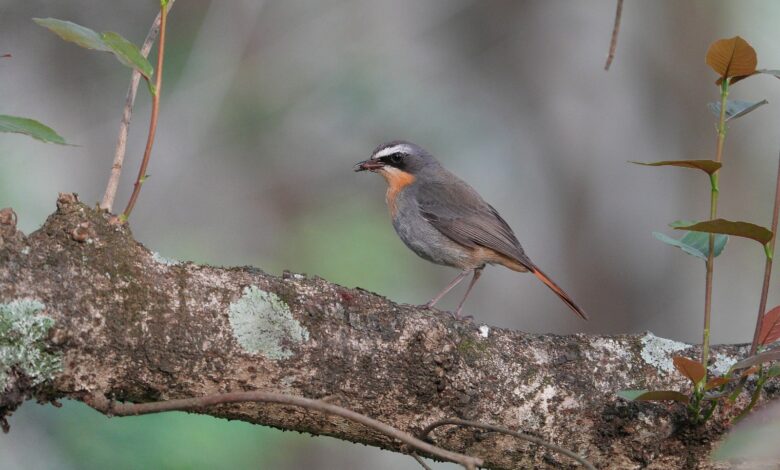
IN this edition, we feature a most endearing local bird, the Cape Robin Chat, well-known for its many imitations of calls of other birds.
Also read: Chirping with Kloof Conservancy – African Fish Eagle
Description
This is a very pretty, smallish bird at 17cm in length and approximately 18g in weight. It’s quite a challenge to describe in layman’s terms as it has various colours with the striking white eyebrows as its most distinguishing feature. It has a pale orange throat and grey breast and sides. The back and the wings are a greyish brown, and the tail looks brown when closed, but when open in flight, it reveals quite striking orange feathers.
Male and females are similar in appearance.
Distribution
The Cape Robin Chat is found across most of South Africa except in the very dry parts of the Northern Cape. They are also found in other parts of sub-Saharan Africa.
Habitat
They enjoy thickets and forest margins where the vegetation is dense as they are somewhat shy and prefer to ‘hide’ out of sight.
Feeding
The Cape Robin Chat feeds predominantly on insects with ants being its favoured food. They also enjoy feeding on a range of other insects, including beetles, wasps, crickets, caterpillars and moths. They will occasionally prey on tiny lizards and earthworms. They feed mainly on the ground but will also hawk prey in flight and on branches and trunk of trees.
Breeding
The Cape Robin Chat is a monogamous species and mates for life. They tend to be solitary nesters and are mostly seen individually or as a pair. Nests are built in trees and are somewhat untidy and made from twigs, dead leaves and roots. The central cup is usually lined with soft lichen or moss. Most of the nest building is done by the female.
The female usually lays two to three eggs and is often parasitised by the Red-Chested Cuckoo. Both adults feed the chicks.
Predators and threats
The Cape Robin Chat is not considered to be under any significant threat but may be at risk from pesticides used in gardens. The nests are often preyed on by snakes, such as the Boomslang, and sometimes other birds, such as the Boubous. Because their nests tend to not be far from the ground, they are also very vulnerable to domestic cats.
Local information
Cape Robin Chats are reasonably common in the Highway area and enjoy gardens with lots of shrubs and fallen leaves as they love to scavenge in leaf litter.
Interesting facts
The Cape Robin Chat calls mainly at dawn and at dusk and has an amazing repertoire of songs – it is known to have mimicked up to 35 different bird species with about 75 different calls.
The Cape Robin Chat was voted as South Africa’s favourite bird in 2015 in an online poll conducted by Birdlife South Africa.
Most of the Southern African birds that include the name ‘robin’ are not actually true ‘robins’ but were given the name by early explorers because they were very similar to the true robins found in Europe.
Our ‘robins’ are more closely related to flycatchers and have all been regrouped under the name ‘chat’ but the name ‘robin’ has stuck because of its popularity and familiarity.