
Chirping with Kloof Conservancy – African Pied Wagtail
Find out more about this feathered Highway resident below.
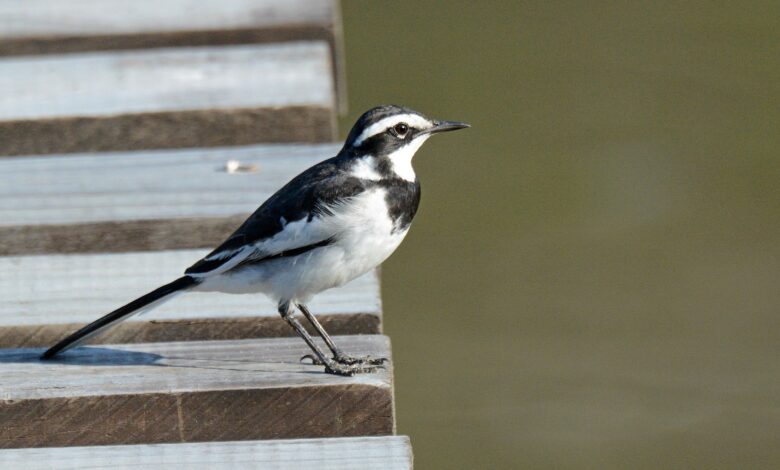
IN this week’s edition we look at a very endearing species, the African Pied Wagtail. As the name implies it constantly “wags” its tail, almost suggesting it is acknowledging your presence and saying “hello”.
Also read: Chirping with Kloof Conservancy – Lesser Honeyguide
Description
This is a small bird at 20cm and a weight of 27g. It is starkly black-and-white with a bold white eyebrow and wing panels and a broad black throat patch. Females are very similar but slightly duller in colouration.
Distribution
They are found primarily along the eastern part of SA, roughly from Gqeberha (formerly Port Elizabeth) to the Limpopo Province and along the Orange River to Swakopmund.
Habitat
They have adapted to a wide range of habitats, including areas in close proximity to humans. They can be found in some of the drier areas as long as there are some wetlands or rivers close by.
Feeding
They feed primarily on the ground where they can be spotted making very busy short sprints while they search for insects and wagging their tail continuously, often in a very exaggerated manner. Their diet consists primarily of insects, but they will occasionally feed on seeds and even small fish.
Breeding
Their nests are on the ground, close to water and built by both adults. The nest is a deep cup made from typical materials found in a wetland. Up to five eggs are laid which take three weeks to hatch. Both adults share the incubation and later the chick rearing duties.
Predators and threats
The African Pied Wagtail is not considered to be under any serious threat and is listed as Least Concern by the International Union for Conservation of Nature. As it is dependent on wetlands there is a risk from habitat destruction where wetlands are drained for development.
Local information
In our area they compete for territory with the Mountain Wagtails which tend to dominate in our typical riverine forests. You are most likely to find the African Pied Wagtail along more open rivers and streams or in wetland area.
Interesting facts
There are a number of theories on why Wagtails wag their tails! One suggests that they do so to flush out insects which they can then snap up. Another theory suggests they do so as a warning sign to potential predators although they appear to wag even if they are totally on their own. Yet another theory suggests that it helps them to balance as they sprint from one insect to the next. Whatever the reason the wagging does make them appear friendly.