
Solidarity launches emergency plan for a two-week blackout
The emergency plan is in the format of a back-to-back A4 document
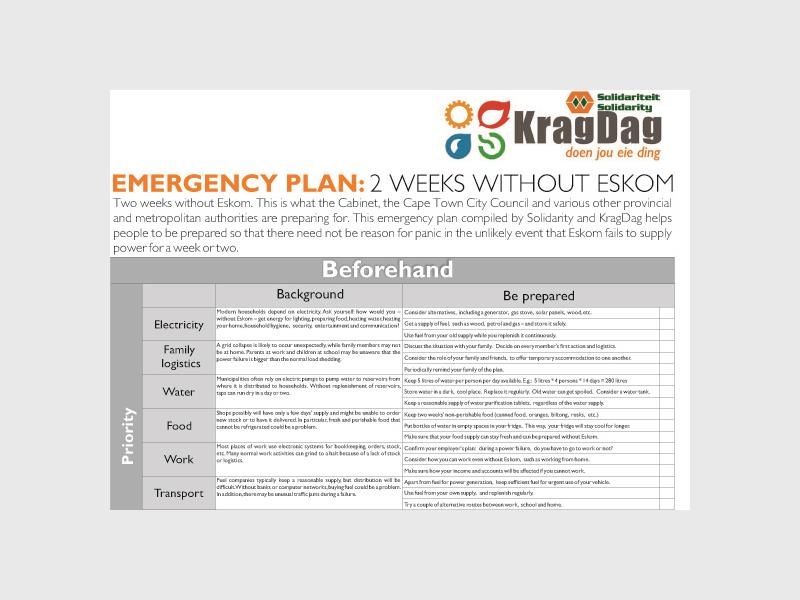
Solidarity, in conjunction with KragDag, launched an emergency plan aimed at the event of a total Eskom blackout.
The plan offers practical tips on how households can prepare for the possibility of being without electricity for up to two weeks.
“Although chances for a collapse of the national grid are slim, Solidarity believes members of the public should consider being prepared for it to some degree. Cabinet, the Cape Metropolitan Council and several other provincial and metropolitan authorities have reportedly started to make such preparations. Moreover, independent energy experts have also referred to the possibility of protracted power outages,” said Piet le Roux, head of Solidarity’s research institute.
“Should an Eskom grid collapse occur the public will, to a large extent, have to rely on themselves and should thus be prepared for it. Even if it doesn’t happen – as it will not in all likelihood – it is still in the public’s interest to be proactive.
“With this emergency plan we want to help our members and the general public to be prepared too, so there would be no reason to panic should Eskom not be able to supply electricity for a week or two.”
Le Roux says that rolling blackouts, also known as load shedding, is Eskom’s way of manually maintaining network stability and it is precisely what prevents a complete network failure.
“However, rolling blackouts are Eskom’s last resort and for it to work, a kind of constant vigilance is required, an attribute Eskom has generally not been known for in recent years, given its maintenance backlogs and delays in its new building programme,” Le Roux added.
Le Roux points out that, from an international perspective, blackouts, or more technically, cascading electricity network failures, are not uncommon events. Over the past 15 years, cascading network failures have occurred in various European countries, Turkey, Brazil, the United States and India.
The emergency plan includes tips that range from planning to have water and food supplies to arrangements on how family members would stay in touch with one another should communication be impeded.
Other aspects also covered deal with safety measures, as well as cooperation between neighbours and other members of the community.
The emergency plan is in the format of a back-to-back A4 document on which households can tick off progress.
It is divided into measures that can be taken beforehand and those that could be taken during an outage.