
Watch the shooting stars just before dawn on Saturday morning
They ordinarily pick up steam after midnight and display the greatest meteor numbers just before dawn
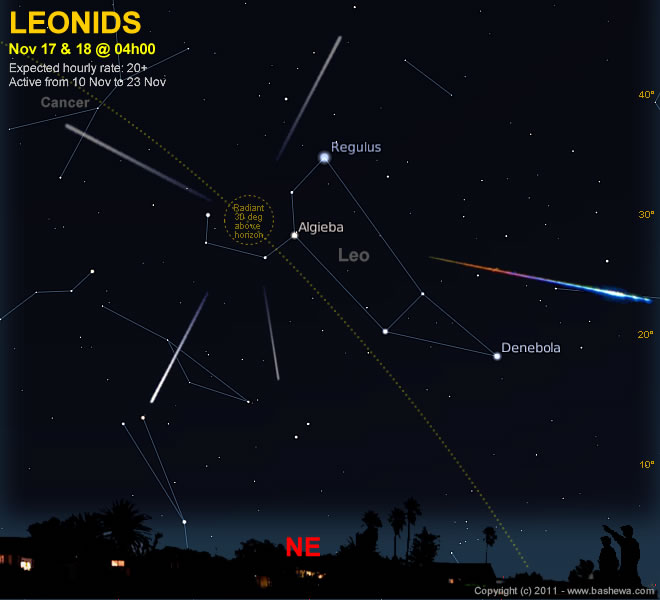
A Leonids meteor shower will peak in South Africa tonight (Friday) .
Leonids meteor streams are groups of meteoroids originating from dust grains ejected from Commet 55P / Tempel-Tuttle, according to Bronberg Weather Station Pretoria.
These small dust grains (meteoroids) are distributed along the parent comet’s orbit concentrated close to the comet nucleus with fewer grains farther away from the nucleus.
Every time the Earth passes through this stream of dust particles (i.e. meteor stream), we experience what is known as a Leonids meteor shower.
💫 SPACE: Leonid #MeteorShower to peak early Saturday with up to 115 streaks visible per hour between midnight & dawn across the sky. Excellent viewing conditions expected in Gauteng.
— Gauteng Weather (@tWeatherSA) November 17, 2017
These brief streaks of light from meteors, sometimes called “shooting stars”, peak on Friday night November 17 when earth moves through the centre of the dust trail left behind by the comet.
How to view the Leonids
Go outside, find a dark spot and look north-east near the constellation of Leo for the Leonids radiant.
Meteor showers are strictly for night owls or early risers. The best time to view the Leonids is from around 3am in the early morning to about 4.15am when dawn breaks.
They ordinarily pick up steam after midnight and display the greatest meteor numbers just before dawn.
The annual Leonid meteor shower has its genesis in debris strewn along the orbit of Comet 55P/Tempel-Tuttle, particles that the Earth encounters from 6 to 30 November. These particles are travelling at close to 44 miles per sec (~250,000 kilometres per hour), so they burn up due to friction with air molecules in our atmosphere some 50 miles (80 kilometres) above the ground, leaving a brief incandescent trail.
The Leonid shower is well known for these fast meteors, the brightest of which can leave persistent trains that appear to hang in the air for several seconds. Particularly bright shooting stars are known as fireball or bolides, created by cometary debris that might initially have been the size of a grape.
Discovered in December 1865, Comet 55P/Tempel-Tuttle has an orbital period of 33 years and the number of meteoroids it spawns (and hence the number of shooting stars seen) grows in intensity when the comet is near perihelion. Sadly, 55P will not return to the inner solar system until 2031 and heightened activity is not expected until the late 2020s.
Information: Bromberg Weather Station Pretoria South Africa