[PART 3] Homo naledi’s significant impact
So far, the scientists have uncovered more than 130 hominin specimens from the new chamber.
Following on yesterday’s breaking news about Homo naledi’s age and how the team of scientists figured out how old the fossils are, an accompanying paper led by Professor Lee Berger and entitled Homo naledi and Pleistocene hominin evolution in subequatorial Africa, discussed the importance of finding such a primitive species at such a time and place.
Refresh your knowledge by reading PART 1 and 2 of this series here:
New questions emerge from Homo naledi’s young age
Homo naledi: How old is it really
The team noted that the discovery of Homo naledi will have a significant impact on our interpretation of archaeological assemblages and understanding which species made them.
“We can no longer assume that we know which species made which tools, or even assume that it was modern humans that were the innovators of some of these critical technological and behavioural breakthroughs in the archaeological record of Africa,” said Berger. “If there is one other species out there that shared the world with ‘modern humans’ in Africa, it is very likely there are others. We just need to find them.”
John Hawks of the Universities of Wisconsin-Madison and Wits and an author on all three papers said: “I think some scientists assumed they knew how human evolution happened, but these new fossil discoveries, plus what we know from genetics, tell us that the southern half of Africa was home to a diversity [of creatures] that we’ve never seen anywhere else”.
Berger added: “Recently, the fossil hominin record has been full of surprises, and I suspect that the age of Homo naledi is not going to be the last surprise that comes out of these caves.”
A new chamber and skeleton
In the third paper, entitled New fossil remains of Homo naledi from the Lesedi Chamber, South Africa, published simultaneously in eLife, the team announced the discovery of a second chamber within the Rising Star Cave system, which contains more remains of Homo naledi.
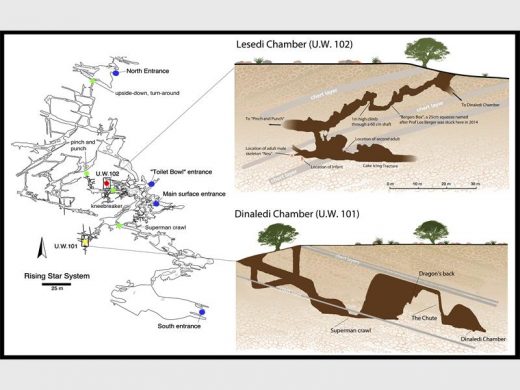
“This chamber, which we have named the Lesedi Chamber, is more than a hundred metres from the Dinaledi Chamber. It is almost as difficult to access, and also contains spectacular fossils of Homo naledi, including a partial skeleton with a wonderfully complete skull,” said Hawks.
It is almost as difficult to access, and also contains spectacular fossils of Homo naledi, including a partial skeleton with a wonderfully complete skull,” said Hawks.
Fossil remains were first recognised in the chamber by Rick Hunter and Steven Tucker in 2013, as fieldwork was underway in the Dinaledi Chamber.
The name “Lesedi” means “light” in the Setswana language. Excavations in the Lesedi Chamber began later, and would take nearly three years.
No easy access
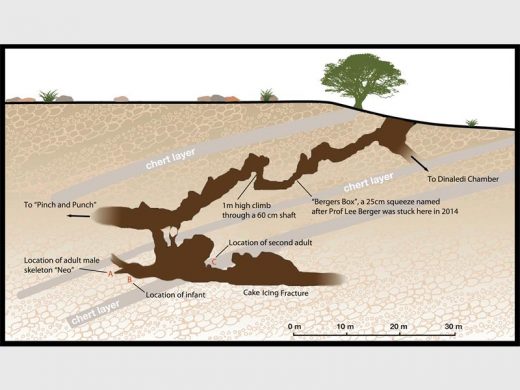
“To access the Lesedi Chamber is only slightly easier than accessing the Dinaledi Chamber,” said Elliott, who was lead excavator of the fossils from the new locality. “After passing through a squeeze of about 25cm, you have to descend along vertical shafts before reaching the chamber. While slightly easier to get to, the Lesedi Chamber is, if anything, more difficult to work in due to the tight spaces involved.”
Hawks pointed out that while the Lesedi Chamber is “easier” to get into than the Dinaledi Chamber, the term is relative. “I have never been inside either of the chambers, and never will be. In fact, I watched Lee Berger stuck for almost an hour, trying to get out of the narrow underground squeeze of the Lesedi Chamber.” Berger eventually had to be extracted with ropes tied to his wrists.
“The presence of a second chamber, distant from the first, containing multiple individuals of Homo naledi and almost as difficult to reach as the Dinaledi Chamber, gives an idea of the extraordinary effort it took for Homo naledi to reach these hard-to-get-to places,” said Hilbert-Wolf.
“This likely adds weight to the hypothesis that Homo naledi was using dark, remote places to cache its dead,” said Hawks. “What are the odds of a second, almost identical occurrence happening by chance?”
So far, the scientists have uncovered more than 130 hominin specimens from the Lesedi Chamber. The bones belong to at least three individuals, but Elliot believes that there are more fossils yet to be discovered. Among the individuals are the skeletal remains of two adults and at least one child. The child is represented by bones of the head and body and would probably have been under five years of age. Of the two adults, one is represented by only a jaw and leg elements, but the other is represented by a partial skeleton, including a mostly complete skull.
To view the gallery, click here
Read the final installment in this fascinating series on recent African archaeological discoveries on our website later today!
Do you perhaps have more information pertaining to this story? Email us at krugersdorpnews@caxton.co.za or phone us on 011 955 1130.
For free daily local news on the West Rand, also visit our sister websites:
Remember to visit our Facebook, Twitter and Instagram pages to let your voice be heard!