
Forty years ago, in factories in the (then) revolutionary countries all over the world, people were lined up one by one, making everyday items.
One man’s entire job was screwing on a cap as quickly as he could as toothpaste tubes passed by his workstation. Today, that job, and most other assembly line work is done by machines at a fraction of the speed and cost. But, as one occupation went the way of the Dodo, others in machine engineering and computer programming stepped in to fill the hole in the job market.
“The world is changing every day,” explained Curro School’s Robotic Class teacher, Hannes Kilian. “The idea of citizenship is very important here. We teach them how to fit into a world that’s always changing. Our kids learn how to regulate the future”.
The idea is that the Curro learners, from as early as Grade 1, adopt the basics of computer and machine programming, so that they can one day thrive in a future which might be regulated more by technology than it is today.
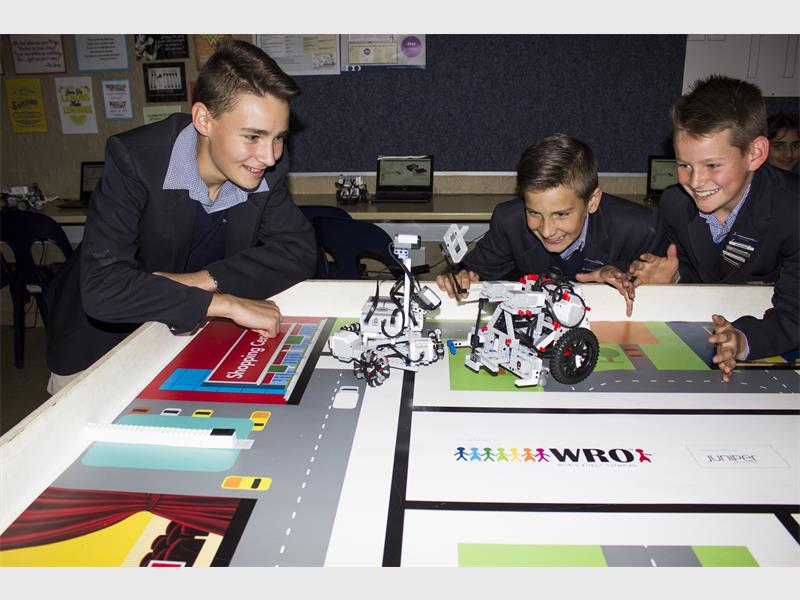
What started out as a module to better fill out the technology subject in school has now turned into a fully-fledged subject. Robotics classes are becoming more prominent all over the country, and Curro has made sure that it’s at the very forefront of the trend. In this class, the learners are taught basic to intermediary levels of programming, working mostly with the Lego Mindstorms’ EV3 robotics kit.
“This is a compass,” one of the learners at the front of the class explained, pointing to components on the rover-like robot, “this is infrared and that’s a colour sensor. This is how the robot tracks where it is and what it needs to do”.
Recently, these learners participated in teams of two in the World Robotics Olympiad’s provincial competition. Though they’re still waiting on the results, confidence is high that a few of their teams will be going through to the national competition level.
“We learned not to focus too much on the program when you have to disassemble and rebuild most of the robot right before the competition,” Zander Potgieter said, with his teammate, Zander Beukes adding that, “There was a problem with our robot, and we needed to fix it a few minutes before we had to start.”
Every young learner had their own story to tell, and they soon explained that it never works out quite like you planned when coding your robot.
“We had problems when we got to the orange part of the course,” Kaitlin Vieira said as she explained how the competition worked.
“We started crying,” she said with a laugh, “because the robot’s arm had to turn and it wouldn’t work. It was 40 points of the competition and we only had three minutes left”.
With nothing left to do, because the robots were programmed beforehand to autonomously go through the course, and they couldn’t enter to work on it, Kaitlin and Shena Mcaslin watched as the timer ran out. But, they noted, they learned a whole lot more when the robot’s programming failed than they would’ve if everything had gone perfectly.