
Increase in the cost of living: How South Africans are coping
A survey run by gig technology company, M4Jam has found that those with little to no regular household income are finding it harder to get by in 2021.

After a full year of battling the Covid-19 pandemic, the cost of living for South Africans has become an issue that is as pressing as the country’s need for vaccination rollout.
For many, who have either lost regular work as a result of lockdown restrictions and social distancing, or cannot find work owing to economic devastation, rising costs are threatening their survival.
A survey run by gig technology company, M4Jam has found that those with little to no regular household income are finding it harder to get by in 2021.
86 percent of survey respondents – from among M4Jam’s registered jobbers, who contract for temporary and short-term work via the platform – were aged 18 to 34, with 20 percent earning no regular household income from the formal economy.
72 percent of those who took the survey were from households with monthly income up to R25 600, while 36 percent had no personal income, and 77 percent earned up to R12 800 personally.
The survey responses paint a worrying picture of affordability for the millions of South Africans being pushed toward the poverty line by a pandemic that has forced the closure of businesses by the hundreds.
“Most of the qualitative feedback from our jobbers pointed to personal financial crises that reflect an economy which was technically in recession even before Covid-19 made its presence felt,” said Georgie Midgley, M4Jam CEO.
“While we are pleased to be in a position to help some South Africans find work via our tech platform, the reality is that the availability of work in our economy is insufficient to make a meaningful dent in the unemployment rate. We can only hope for an acceleration in the rollout of vaccines both locally and abroad, and a swift end to economically devastating restrictions on business.”
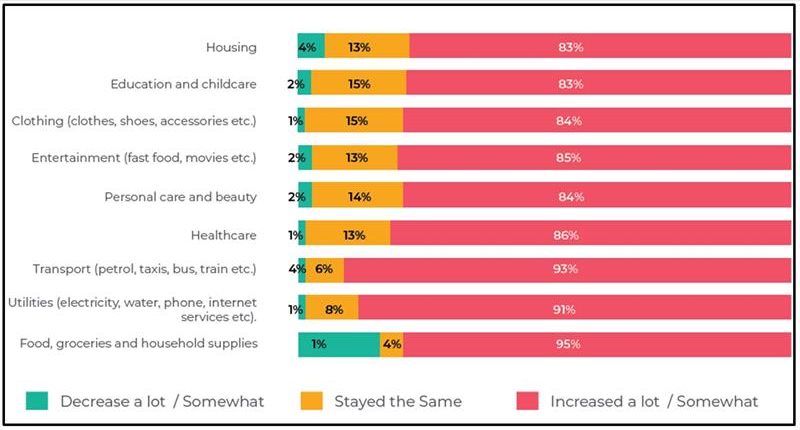
When asked about any noticeable increases or decreases in the cost of living, this is what the respondents had to say:
Weighing up salary or earnings increases against rising costs, 26 percent said their earnings had remained static, while 33 percent saw their monthly earnings reduce, and 42 percent received an increase. 30 percent of respondents were breadwinners, while 70 percent either relied on a partner in their household to contribute toward costs or had no income. 81 percent of respondents said that before Covid-19 they were able to save some money monthly. What is interesting to note is that of those who managed to save, 86 percent were aged 18 to 34.
Calculating how much the cost of household essentials like food, utilities and transport had grown since the onset of Covid-19, 32 percent of respondents said their monthly costs had risen by up to R800, while 17 percent had watched their monthly costs rise between R800 and R2 000. 10 percent said their spending on essentials had inflated by more than R2 000 per month.
84 percent said they had cut down spending on essential items like groceries, healthcare services and beauty products in order to get by, while 93 percent had cut back on non-essential items like fast food and alcohol. The most common coping strategies included reducing non-food consumption such as airtime, data and clothing (52 percent), finding a side hustle (46 percent), reducing food consumption (40 percent) and relying on assistance from friends and family to make ends meet (37 percent).
Purchasing items on credit, extending payment terms, taking loans and accepting help from charitable organisations like churches were other ways South Africans were staying solvent. 47 percent said they had turned to platforms like M4Jam in attempts to find alternative income streams, while 25 percent had managed to keep their jobs, 12 percent lost their jobs and have been unable to find new ones, 7 percent lost their jobs and found others, and 9 percent do not intend finding jobs in the formal sector – instead, relying on various side hustles to keep going.
“One positive aspect of the Covid-19 pandemic is that we have seen a will to help from all quarters of the economy and the country. Opportunities are being created wherever possible, and charitable organisations have done incredible work in helping to stave off poverty,” concluded Midgley.