
Uncovering the Past: The forgotten story of Krugersdorp’s first police station
Step back to the 1890s as we explore the old police station on Commissioner Street, a landmark of law, nationalism and forgotten heritage in the Krugersdorp CBD.

What did law enforcement look like in Krugersdorp before modern policing? The answer lies in the town’s first police station.
In this ninth edition of Echoes of Krugersdorp, produced in partnership with the Krugersdorp Heritage Association (KHA), we explore a lesser-known chapter in the town’s history: the old police station on Commissioner Street in the CBD.
Jaco Mattheyse, co-founder of the KHA, said that to understand this building, one must consider the social and political landscape of Krugersdorp in the 1890s.
• Also read: Synagogue and storefronts: One man’s mark on Krugersdorp’s past
At the time, the District Township – known today as Krugersdorp North – was little more than a skeletal settlement with a few streets and scattered buildings.
“Yet it managed to avoid becoming a ghost town because it retained some permanent residents and held political legitimacy as an administrative centre. Its existence, however, had minimal impact on the British residents of the Stand Township [today’s Krugersdorp CBD],” Jaco explained.
Few references to the District Township appear in local newspapers or archives. Most historical records mention only the Stand Township.
While the Stand Township had a distinctly British character with a largely English-speaking population, it remained under the governance of Dutch-speaking officials from the Zuid-Afrikaansche Republiek (ZAR). Law and order were enforced by the Republican Police, and local courts were presided over by magistrates.
“The key official in town was the Mijn Kommissaris [gold commissioner], who issued mining claims and stand licences and, for all practical purposes, acted as the town’s mayor. A small but prosperous Dutch-speaking middle class of professionals, shopkeepers, merchants and traders also lived in the Stand Township, ensuring a noticeable Dutch presence,” Jaco said.
This, he noted, created an equilibrium between the Dutch-speaking officials who controlled the local state apparatus and the English-speaking commercial elite who dominated the town’s economic and social life – an arrangement that mirrored the relationship between the District and Stand Townships.
• Also read: Through war and worship: A church’s 135-year story
By the 1890s, Krugersdorp had grown into a permanent settlement. Along with the new train station and grander government buildings erected on the Market Square, a police station was constructed in 1897 to meet the needs of a growing population and rising crime.
“Yet the police station was more than a mere response to practical necessity. It also symbolised the growing Boer national chauvinism that emerged following the gold discoveries and the subsequent enrichment of the ZAR government,” Jaco said.
Although built in the western section of town, seemingly undermining the idea that it was meant to project Boer power onto the English-speaking mining population, Jaco suggested that the station could still be viewed as a symbol of Boer authority.
This symbolism becomes clearer when considering the ideological significance of the town’s east-west spatial axis, just as the north-south axis held its own meaning.
“Initially, the site of today’s Department of Home Affairs was considered for the police station, as it marked the western edge of town. Ultimately, the second and final site chosen was lower-lying and more removed from the mines, possibly because the land was cheaper. Still, symbolic considerations likely influenced this choice.”
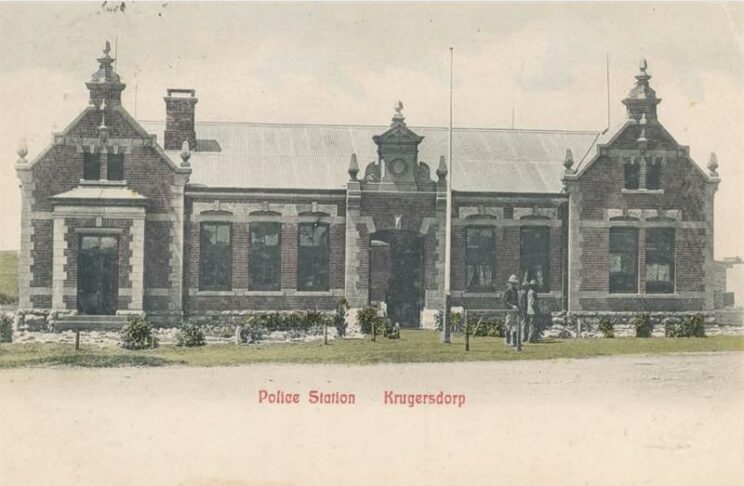
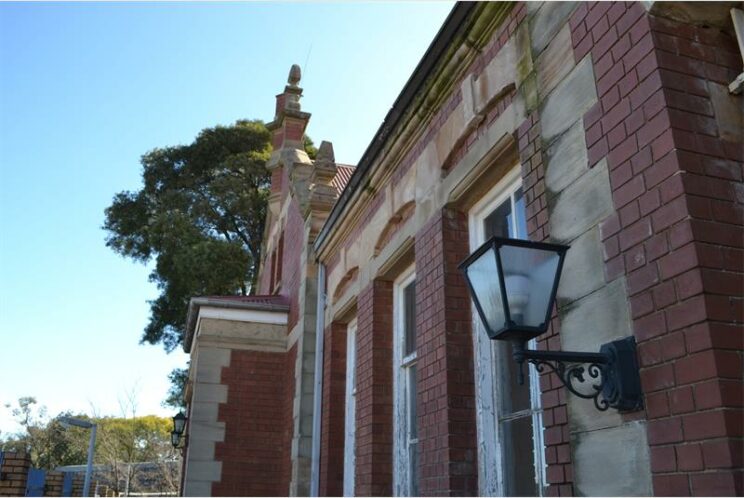
Architecturally, Jaco described the police station as quintessentially republican, featuring Dutch Neo-Renaissance gables, ornate sandstone detailing and red brick walls.
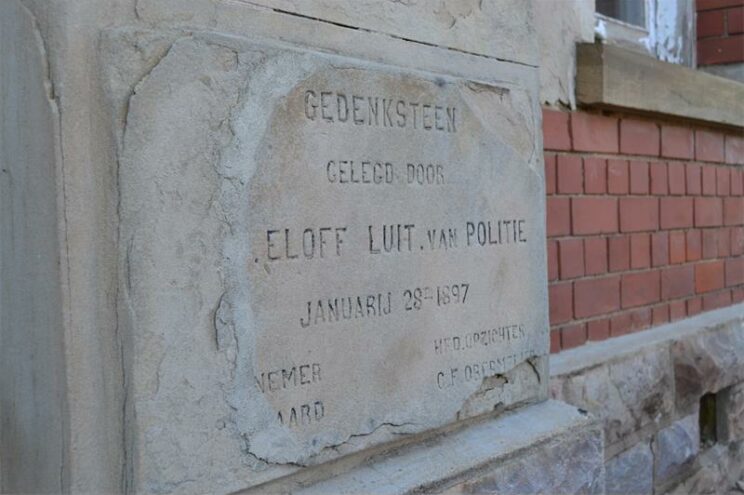
To reinforce its nationalist message, the foundation stone was laid by President Paul Kruger himself. Measuring 26 metres in length, the building made a bold architectural statement. The Republican Police were tasked not only with maintaining law and order, but also with preserving Boer control over an increasingly restless Uitlander (foreigner) population on the West Rand.
• Also read: A burning passion: The story of Krugersdorp’s fire station
“The station formed part of a complex that included a large stable block, which has unfortunately been lost over time. The first station commander was Sergeant Sarel Eloff, the grandson of President Kruger and son of Frikkie Eloff. The building was unique in the old Transvaal – outside Pretoria and Johannesburg, it was rare for towns to boast such a grand police station. None of the smaller Transvaal towns could match it,” Jaco said.
He also noted that several police residences were constructed in the District Township’s ‘sacred’ north, using the same distinctive republican red brick. Their placement symbolically linked the north and west parts of town. Together, these buildings and their style served as a powerful visual reminder of Boer Republican authority.
“This was reinforced by the sight of Boer commandos parading through the streets and the visibility of the Republican Vierkleur flag at strategic points around the town. As a result, the predominantly British commercial hub, centred on the Luipaardsvlei Estate and the Gold Mining Company Limited, found itself surrounded by an assertive, nationalist Transvaal Republican environment.”
This spatial strategy deepened with the establishment of the Boer residential area of Burghershoop, also founded in 1897. Located on the town’s western periphery, Burghershoop consisted of free government stands allocated to impoverished, marginalised Dutch-speaking Boers. Many of these settlers had been displaced from the land during the 1890s due to the capitalist transformation of agriculture, which replaced traditional sharecropping (bywoner) arrangements with wage labour.
“The devastating rinderpest outbreak in the late 1890s further contributed to the settlement’s growth. The founding of Burghershoop, the western positioning of the police station, the Transvaal Republican architectural styles, and the visible nationalist displays by the Krugersdorp Commando all signalled an intentional imposition of Boer nationalist ideology onto what had previously been a more cosmopolitan town.”
Later, the old police station was converted into sleeping quarters for officers after a new station was built next door. Like the old train station, it was plastered and painted white at some point. By the 1980s, the building had become severely dilapidated, but it was eventually restored to its original appearance.
Plans to repurpose it as a museum sadly never materialised. Today, the building stands mostly vacant once more, its red bricks beginning to show the strain of time.
A landmark of strength and symbolism in its day, the old Krugersdorp police station now awaits a new chapter – its walls still echoing the ambitions of a bygone era.