
Sun halo catches curious residents’ attention
Ever looked up and saw a glowing rainbow ring circling the sun? Here is why ice crystals high in the atmosphere create this optical illusion – and how to capture it without hurting your eyes.
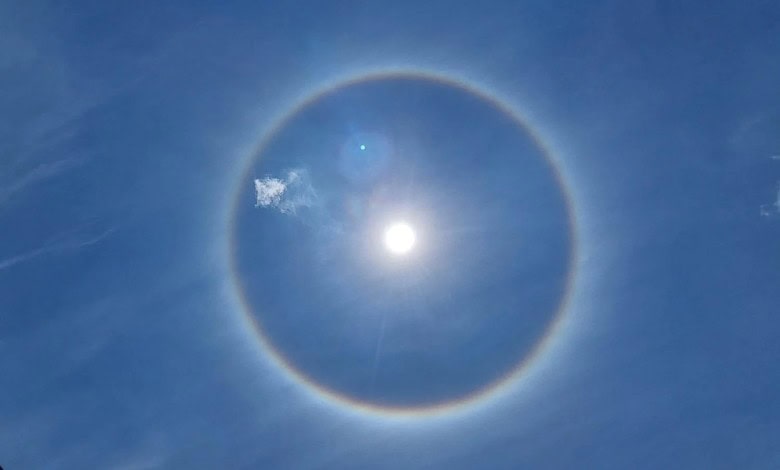
Residents stepped outside today to photograph an unusual glowing ring circling the sun, prompting local weather enthusiast Juandré Vorster to explain the science behind the display.
Vorster, known as ‘The Weather Hooligan’, explained that this fascinating atmospheric phenomenon called a sun halo is formed when sunlight passes through tiny ice crystals suspended in high-altitude clouds, usually cirrus or cirrostratus clouds.
He said these ice crystals act like millions of tiny prisms, refracting (bending) the sunlight and creating a circular ring around the sun, sometimes displaying subtle rainbow-like colours.
“Although many people associate sun halos with cold weather, the phenomenon does not necessarily mean that cold conditions are reaching ground level. The ice crystals responsible for the halo are found high up in the atmosphere, where temperatures are extremely low, even when conditions on the ground are warm,” said Vorster.
He added that a halo can also indicate the presence of moisture and high-level cloud ahead of an approaching weather system or frontal boundary.
“It’s one of nature’s beautiful reminders of how fascinating our atmosphere can be,” he said.
What causes a sun halo
According to Farmers’ Almanack, a sun halo is caused by sunlight passing through millions of tiny ice crystals suspended in thin, high cirrus or cirrostratus clouds. Cirrus and cirrostratus clouds form between 20 000 and 40 000 feet up, where the air is cold enough year-round for ice to form.
How to see and photograph a sun halo safely
The biggest practical issue with sun halos is that you have to look toward the sun to see them. Looking directly at the sun for more than a moment can damage your eyes.
Use this method instead:
• Block the sun with your hand, a streetlamp, a tree, or a building edge
• The halo sits 22° out from the sun, so once you have the sun blocked, you should see the ring around your hand or the tree
• Sunglasses help with general sky brightness, but they are not a substitute for blocking the sun directly
• For photographs, hold up a finger or use the edge of a building to occlude the sun, and shoot in the direction of the halo. Most modern phone cameras handle the dynamic range well enough to capture the ring


