WRC seeks new ways to solve Giyani water problems
The Limpopo provincial government has taken a significant step towards addressing the water crisis in Giyani, by signing an agreement with the Water Research Commission (WRC) recently.
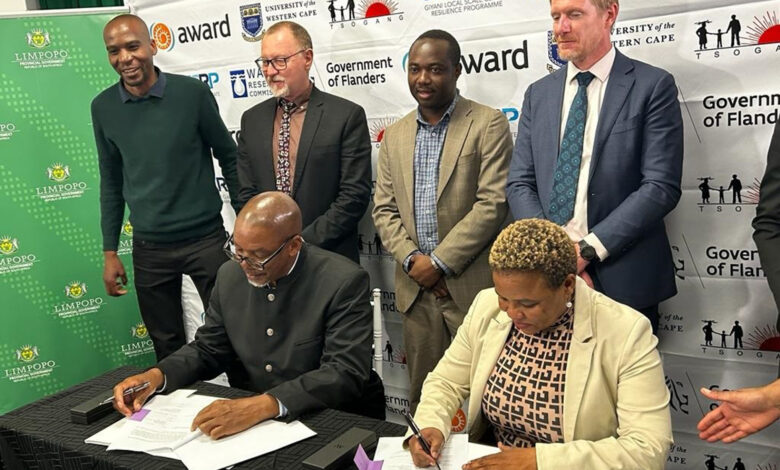
The agreement is part of the newly launched Giyani Local Scale Climate Resilience Programme (GLSCRP) which aims to enhance climate resilience and water utilisation in the Giyani area. The programme focuses on scaling and optimising multipleuse water systems, services, and alternate energy options. The GLSCRP is a 3-year communityled programme scaling multiple water use systems (MUS) and solar energy to develop, research and demonstrate practical and sustainable water and climate adaptation solutions in the area to improve water sources, utilisation, community resilience and local economic development.
The project is currently implemented in the five agricultural sites of Daniel Ravalela Farm, Dzumeri Farm, Loloka Farm, Dzumeri Farm Two and Muyexe Community Project. It is also being implemented on four community sites of Mbhedle, Mayephu, Mzilela and Matsotsosela, with a population of approximately 5 000 residents. Walter Segooa, deputy director general for stakeholder management coordination, signed the memorandum on behalf of the provincial government. The government of Flanders has given R40 million over three years to support this initiative, with the funding set to conclude in 2024.
Also read: Villagers solve the water problem themselves
Afterward, the project will be expected to sustain itself. Nikolas Bosscher of Flanders highlighted the significance of this collaboration. “The challenges faced by South Africa, particularly in Limpopo, are the semi-arid climate and water delivery or availability issues. In Giyani, these challenges are even more pronounced, especially in meeting the MDG 2026 targets.” Dr Jennifer Molwantwa, CEO of the WRC, emphasised the importance of harnessing skills and knowledge to empower communities to manage their own environment.
“This project has laid the foundation for us to learn and do more with less. The lessons learned from this programme will serve as valuable information and in 2024. Afterward, the project will be expected to sustain itself. Nikolas Bosscher of Flanders highlighted the significance of this collaboration. “The challenges faced by South Africa, particularly in Limpopo, are the semi-arid climate and water delivery or availability issues. In Giyani, these challenges are even more pronounced, especially in meeting the MDG 2026 targets.”
Dr Jennifer Molwantwa, CEO of the WRC, emphasised the importance of harnessing skills and knowledge to empower communities to manage their own environment. “This project has laid the foundation for us to learn and do more with less. The lessons learned from this programme will serve as valuable information and They encourage people to visit the areas in Greater Giyani Municipality to see the implementation of flushing toilets without reticulated water, showcasing the innovative solutions being developed to address the water challenges faced by the community