
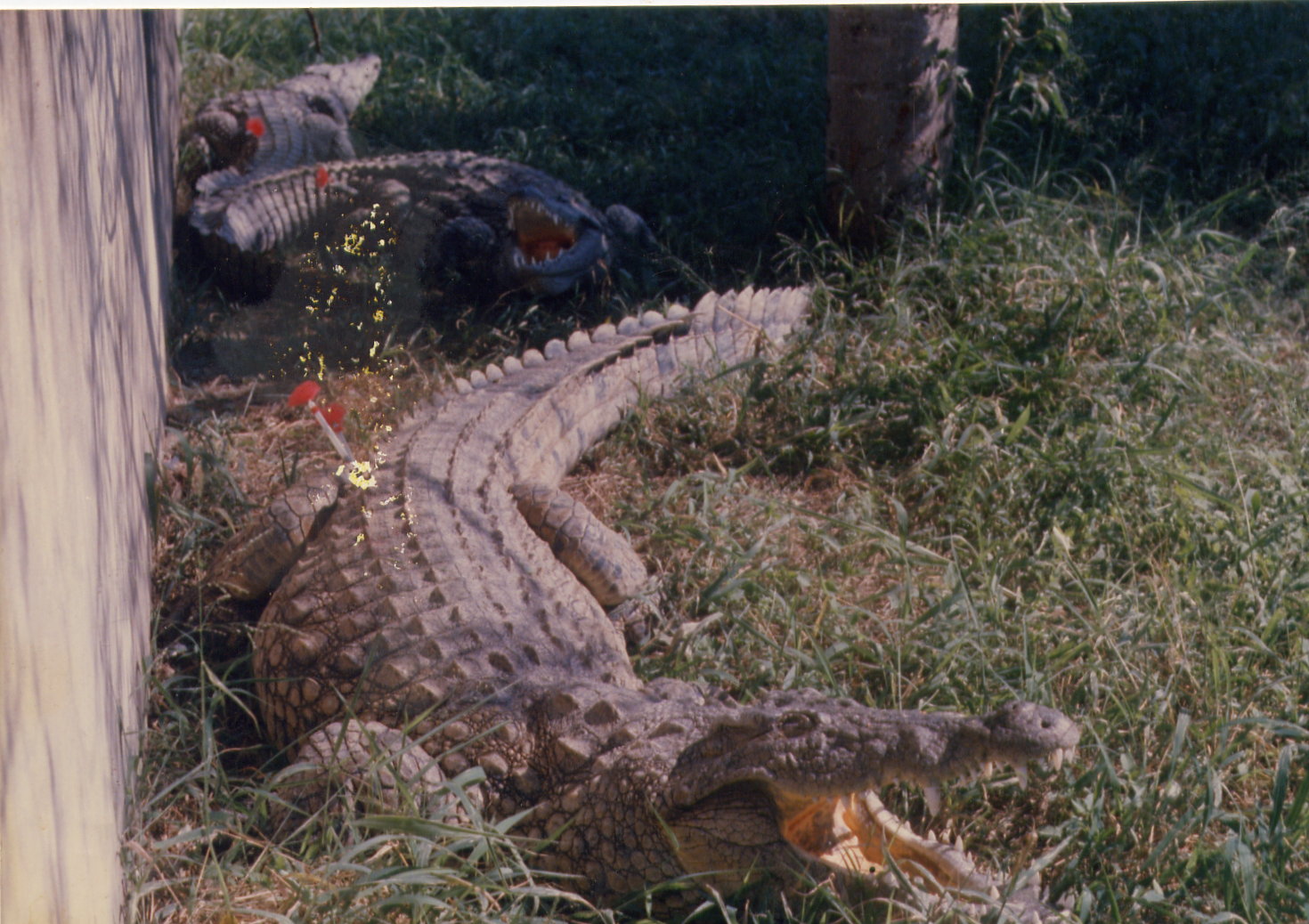
During 1988, while on a visit to Maputo, I took time off to visit the zoo. I remembered the “Jardim Zoologica” from my childhood – a magnificent tropical paradise. I strolled through the erstwhile magnificence in absolute horror. Half the cages were empty, the enclosures and fencing in ruins.
The remaining animals were in a sorry state. It was a desolate island of suffering. By then the protracted Mozambican civil war between Frelimo and Renamo had been dragging on for years, and the zoo was obviously very low on the priorities list. On my return to S.A. I immediately contacted my friend Dr. Cobus Raath, who was at that stage still employed by the National Parks Board as chief of game capture. He had the necessary pull, skills and contacts. We registered a Section 21 non-profit company, the “Maputo Zoo Fund”, and got to work. For the next four years we spent most of our free time renovating the zoo.
It was hard work, with frequent highs and lows. Trying to drum up support from African bureaucrats who were engaged in a war was not easy. We did eventually manage to get support from three gentlemen who eased some of our obstacles – Major General Domingos Fondo, Amaral Matos (President of the City Council) and Joao Baptiste Cosme, the mayor. Thanks to these gentlemen, we could get on with the work without too many hassles. It being Africa, however, it was never plain sailing. We built new cages and fixed the old ones, relocated animals and laid on vegetable gardens.
Food of any kind was a rare commodity in this war ravaged country. Over weekends, when we were there, things went smoothly and all seemed to be progressing well. During the week, however, the zookeepers and staff were selling the vegetables from pavement stalls. We had an agreement with a nearby chicken farm that they would dump all their sick and dead chickens at the zoo as food for the carnivores.
To our dismay we discovered that a lot of these chickens also ended up in the pavement stalls. But this was part of the battle, and we tried to control it as far as possible. There were also other things going on in the zoo, which we could somehow never get a grip on. We were guests in the country, and could not afford to become too pushy or nosey. All kinds of powerful people had all kinds of sidelines going. There was, for instance, a very shifty and elusive character who had permission to use some of the cages to keep small birds. These wild birds were caught in fine mesh nets in the bush surrounding the city, temporarily kept in the zoo, and then crated and exported to collectors in the US and elsewhere. No-one could (or would) ever tell us who this guy was, where he got permission or permits, and what exactly it was he was doing. Another bane of our lives was the children.
There were literally hundreds of bored picannins, ranging from about four to fourteen years old, who pestered us relentlessly. When the war started some twelve years previously, most of the Portuguese citizens fled the country, with the result that most of these youngsters had probably never seen a white man in their lives. To them our labours in the zoo must have seemed God- like. Initially we literally had to swat them off our persons like flies. They were all over us, begging, touching, hanging onto our clothing and chattering incessantly. It was so bad that, by our second visit, we were greeted by two or three hundred smiling little faces, all chanting their newly acquired international language – “fokkoff, fokkoff, fokkoff!.”
Through an interpreter we eventually got the message across that we needed space to work in. So they reluctantly allowed each of us a personal space of about two metres. Cobus and I each had our own “Man Friday”. The chosen king of the day was allowed inside the two metre radius, and had to help carry equipment etc. To this day I still firmly believe that they would have killed for this privilege, given half a chance. We always had an escort of Frelimo soldiers to keep an eye on us and presumably protect us. On one of these weekends we were accompanied by an SABC TV crew, who was making a documentary about the goings-on in the zoo. There were too many people about, which was probably contributory to the fact that the eyes in the backs of our heads missed some clandestine movements which should have been spotted. After a long day we all sat down in what was left of the cafeteria, and were offered a green beer of doubtful origin in large jugs. When Cobus opened his briefcase, his calculator was missing. So was his Man Friday.
One of the soldiers trotted off, soon to return dragging Man Friday along by the scruff of his neck. The youngster had been trying to sell the calculator to passers-by outside the gate. He probably thought it was a remote control which could make lions fall asleep. Our interpreter asked us what punishment we wished the soldier to inflict on the picannin. I sometimes still wonder, if we had suggested a firing squad at sunrise, he would have survived. In those days, this was raw Africa. Judging by the trembling felon, these thoughts probably also crossed his mind.
We were still contemplating a reasonable solution, when Hoepel, Cobus’ veterinary technician at the time, scraped his chair back and got up slowly, the epitome of menace. Hoepel was an extraordinary character – short and stocky, he was as strong as an ox, and took nonsense from nobody. But he also had a sharp, humorously inventive mind. An anticipatory silence descended on all as Hoepel slowly descended the steps, eyes fixed mesmerisingly on the trembling youngster. Unfortunately the cameramen were so caught up in the potentially explosive scene unfolding before their eyes, that the cameras were forgotten. As Hoepel, bent over in a sort of crouch, approached the picannin menacingly, the latter’s eyes were getting bigger and bigger, and the trembling took on the likes of a reed in a strong current. Hoepel stopped half a metre from the boy, staring into his eyes silently.
Then he brought his hand to his mouth agonisingly slowly. Three hundred pairs of eyes focused on that hand, and nobody breathed. The picannin was petrified, not knowing what wrath this strange god was going to wreak on him.
Then Hoepel suddenly whipped out his dentures and nipped the youngster on the ear with them. All hell broke loose. With bloodcurdling screams everyone stampeded for the gates. From that day on, we found it a lot easier to discipline the horde of youngsters. The crocodile, like the shark, is one of nature’s more successful designs. Crocodilus niloticushad stopped evolving more than 200 million years ago, because it was perfect for its environment. I sometimes think Mother Nature had foreknowledge of the Maputo Zoo, because the crocodiles flourished under these circumstances. They bred like rabbits. They threatened to eat the Maputo Zoo Fund to a standstill – we had to do something. A South African friend of mine, Barry Jacobs, owned a game farm near Hectorspruit, a short distance from the Mozambican border. In exchange for crocodiles, he would make a substantial contribution towards the Zoo Fund. It took us a full three months to get all the necessary documentation in order to transport six crocodiles across an international border, and release them in the wild. The date was set, and everything was organised for the big day. We were going to use a drug called Flaxedyl, which is a muscle relaxant.
The crocodiles would be wide awake all the time, but would be unable to move. The drug was safe enough to allow us the time to transport them all the way from Maputo back to South Africa, and they would only recover once we administered the antidote. For transport we planned on using one of Barry’s seven ton open trucks, with a six inch layer of soil on the back. We calculated that, if we get through the border post when they opened at 5am, we would comfortably make it back before they closed for the evening. The day before our departure, however, the first case of anthrax was diagnosed in the Kruger Park.
An anthrax outbreak in Kruger was a serious matter, and there was no way Cobus would be able to take a day off. Some of our documentation was dated, so postponing our trip was out of the question. I am a dentist, not a crocodile hunter – I had no option but to listen to a quick crash course in the darting and transportation of crocs. Cobus gave me a compressed-air dart gun, eight darts and a bottle of Flaxedyl. “I found this on a shelf in the lab,” he said as he handed me the bottle with only the word “Flaxedyl” written on it with a black felt-tipped pen. He also gave me a sealed bottle of Flaxedyl powder, “for in case”. A further complication was that I did not have a heavy duty drivers licence, so Barry was going to have to drive his own truck.
Customs officials in Africa were a breed on their own. Our man for the morning smirked as he listlessly fingered through our stack of documentation, revealing the absence of one of his front teeth. “Ah, so you go catch the crocodile, eh?” “Well, actually we are just fetching them from the zoo, to release in the wild.” “What for?” “This man here,” I said, indicating Barry, “bought them for his game farm. We need the money to keep the zoo going.” “Ah, I see,” Gap-tooth said, eyeing Barry. “You pay much money for crocodiles?” I knew we were on thin ice here – the official was already calculating the extent of his bribe. “Nah,” I said, shrugging off the banal thought of money. “Just a small contribution to the Maputo Zoo Fund.
We’ve been working very hard over the past three years, restoring your zoo. Every little bit helps.” “Eh,” was his only comment as he stamped our entry visas. I was fervently hoping that the man would be off duty by the time we returned. The city of Maputo is only eighty kilometres from the border post. Having flown down on all our previous visits, we had no idea what twelve years of civil war could do to a road. It was a nightmare. Endless kilometres of giant potholes were interspersed with small patches of remaining tarred surface.
Sometimes Barry could push the truck to forty, but most of the time we were crawling through potholes at walking pace. The few vehicles we encountered on the road, were a sight to see. The locals had refined pirate hitch-hiking to a fine art. They would wait at the roadside, at a spot with a succession of deep potholes. Anything that came past with as much as a handhold was fair game.
All the vehicles were literally covered in people – they were on the running boards, on the backs and on the roofs. When we reached Maputo shortly before 9 am our truck was packed to capacity. First, we had to drain the pond in the croc enclosure. If a darted croc should rush into the water, it would drown as the drug kicked in. With this done, we selected our six lucky crocs, and proceeded to dart them.
One was a magnificent specimen of four metres, which I dubbed Geles (as in “yellow”). The Flaxedyl was supposed to take no more than ten minutes to fully immobilise the animal. For safety we gave it twenty. I then gingerly approached Geles and, just to make sure that he was totally incapacitated, prodded him with a broom. In about one thousandth of a second he whipped around, and took the front half off the broom. The Flaxedyl wasn’t working. All the crocodiles were still fit and wide-awake, sporting little red bouquets as if planning a dinner party.
Fortunately two students from the nearby Eduardo Mondlane University had gotten wind of our project, and had pitched up to see if they could lend a hand. They assured me they had access to chemical scales and distilled water, so off they went to reconstitute some more Faxedyl. Meanwhile, I had only two darts left, and I needed six. Recovering a dart from a wide-awake crocodile’s backside and still retaining both arms was no mean feat. Two sweaty hours and six brooms later we had five of the darts back – Geles could keep his for the time being.
The students had done their job well, and the darting proceeded as planned. Geles was so heavy that we had to roll him onto a net, and it took probably fifteen helpers to get him onto the back of the truck. By now we were running out of time, as the border post would be closing at six. We were dog-tired and stressed out by the time we left the zoo. But from the moment we left the city, we spent the eighty kilometres back to the border post screaming with laughter. The sides of a seven ton truck are too high for someone to see into the back.
But still low enough for an agile person to grab hold of, and with a flying leap to land in the bed of the seemingly empty truck. It looked as if we had a trampoline on the back. To see an unsuspecting pirate hiker landing on all fours in the back of the truck only to find himself surrounded by crocodiles and staring into Geles’ unblinking eye over a distance of six inches, was a sight never to be forgotten. There were some really spectacularly acrobatic departures. A couple of times we had to stop to offload baggage that the hikers had flung onto the back prior to mounting themselves. The hikers never approached us to thank us for offloading their luggage – instead we had to settle for distant abuse in a foreign language. But it was one hell of a trip. We arrived at the border post with half an hour to spare, and with Gap-tooth waiting for us like a bear trap. On entering the customs office, I had the distinct impression that everyone in the facility had been awaiting our return wit great anticipation.
Everyone had stopped working, and some were sauntering out to have a look at our cargo. The rest were watching Gap-tooth. The man was once again fingering through our inch-thick stack of permits and documents. “Eh, you need-a one more permit”. “We need no more permits – everything we need is there. We made very sure.” He could just as well have been stone deaf. “You need-a one more permit.
For this, you will have to go back to Maputo.” He had probably already started spending his bribe. We weren’t having any of it. A protracted argument ensued, but the man wouldn’t budge. I tried name-dropping. It was clear that Gap-tooth had never heard of the likes of General Fondo, Amaral Matos or Baptista Cosme. By now it was already past closing time, but nobody seemed inclined to go home. I decided to try for a trump. “Come with me,” I said, crooking my finger at him. “I want to show you something.” We led a whole procession out to the parking area. I motioned Gap-tooth to get up on one of the rear tires and look into the back of the truck, while I joined him. Geles was giving us the unblinking evil eye.
Cold, primitive, and, with a little imagination, hungry. “You see,” I explained, “these crocodiles are already waking up. I have no more medicine to put them to sleep again. In fifteen minutes or so they will probably be running around all over the place, looking for food. Now, the crocodiles are nothing to me – we have too many in the zoo anyway, and we can’t feed them all. They are hungry. Next week, I can go get the other permit in Maputo, and get more crocodiles easily. My personal papers are in order, so you cannot stop me from leaving. So what I’ll do, is I will offload my cargo right here, and go home. I’ll see you again in about a week or so. Meanwhile, tell your people to be careful for a couple of days – the crocs will eventually find their way down to the river.” He didn’t call my bluff – we zoomed through customs like greased lightning. True to reptilian gratitude Geles, who had just become a proud father, nearly killed me a year later. But that’s a different story.
https://leonmare.blogspot.com/