
Huge sinkhole on N1 south a ‘danger zone’
"We have had some engineering specialists on the scene and will need to do further studies that will involve ground-penetrating radar."
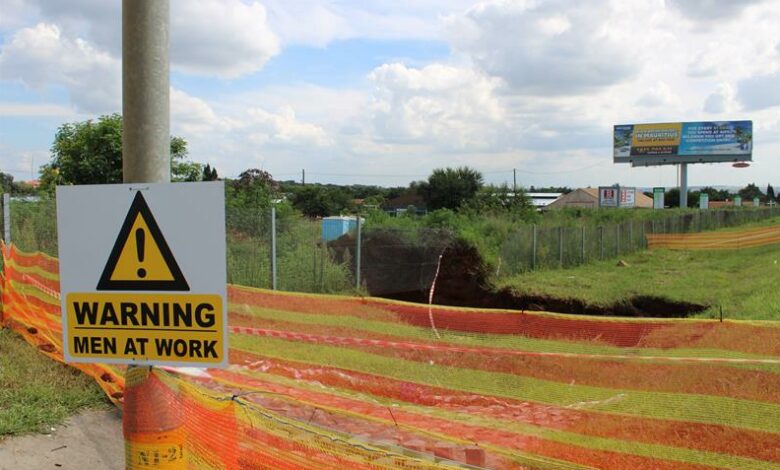
The South African Roads Agency Limited (Sanral) is busy assessing the extent of a sinkhole that formed last week on the N1 southbound just after the R21 turn-off.
According to Progress Hlahla, manager of Sanral’s northern region, they were informed of the sinkhole on Thursday.
“Our initial assessment indicated that the sinkhole formed due to the heavy rains we have had as sinkholes often occur in that specific dolomitic area,” Hlahla said.
“We have had some engineering specialists on the scene and will need to do further studies that will involve ground-penetrating radar,” Hlahla said.

Hlahla said it was uncertain how long it will take to repair the sinkhole.
“It is a big hole. We need to investigate how big and wide it expands underground. We are not sure at this stage what material will be used to close up the hole, and will be guided by the geological report we await,” Hlahla said.


Tshwane metro police spokesperson senior superintendent Isaac Mahamba, said the police’s main concern was to safeguard the scene and to ensure that traffic flows.
“The N1 is still accessible; however, fewer lanes are available for traffic to use in that spot. Residents must kindly keep in mind that it is a danger zone,” Mahamba said.
According to DA ward councillor, Johan van Buuren the sinkhole was formed on Wednesday.
“Police safeguarded the scene with barriers to keep traffic safe, and Sanral officials also responded swiftly,” Van Buuren said.
“Further inspections and assessments by geological experts will follow since it is a rather big hole and it is situated right next to a highway, which is of great concern.”
Van Buuren said the awaited geological report will, however, indicate the exact size and the extent of the damage underground as well.
“I was informed by Sanral officials that various options will be considered per expert advice,” Van Buuren said.
ALSO READ: Schools for inland provinces set to reopen for 2022 academic year


Sinkholes are prevalent in Centurion due to dolomite deposits in the area. Especially heavy rainfall, water leaks, ponding, borehole drilling and building activities contribute to the formation of sinkholes, which are porous, act like a sponge when it gets wet and starts to crumble.
Rekord reported last year that R10-million was allocated in the municipal budget to sinkhole repairs in Centurion as part of the current financial year.
In one success for the metro, the intersection of Jean Avenue and Gerhard Street was completely reopened in 2018 after R25-million worth of repairs were completed on a sinkhole that formed nearly two years before.
Sinkholes not only cause a lot of frustration to homeowners but also to business owners who often complain that they had been cut off and isolated from the residents due to the sinkholes that block roads. Subsequently, residents have to take detours to get around.
In general, it also hurts development and property values.
Read original story on rekord.co.za

