
SA’s gut-wrenching food reality: Millions hungry while good food is binned
Over 10 million tonnes of food are wasted in South Africa each year, despite more than half of the population being food insecure.
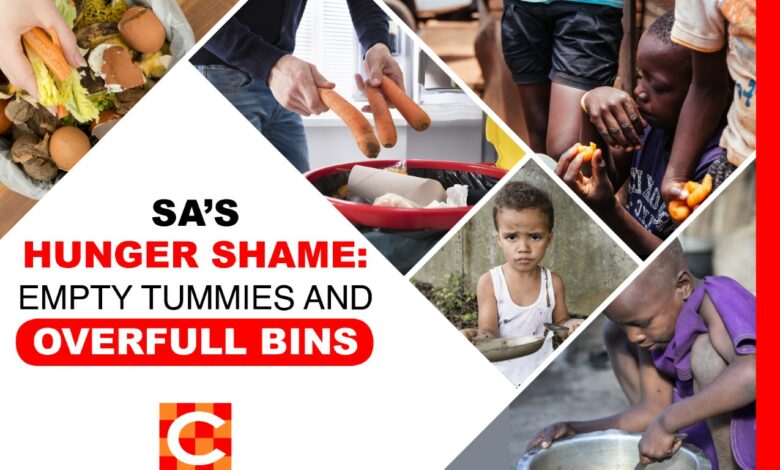
Hunger and food prices are reaching record highs, with almost one in seven people worldwide estimated to be under-nourished.
The 2022 Global Food Security Index paints an extremely bleak picture of the current state of affairs, showing a worldwide deterioration in food security for the third consecutive year due to the effects of the Covid-19 pandemic, climate change and armed conflict. Measured on affordability, availability, quality and safety, and sustainability and adaption, Finland, Ireland and Norway were found to be the most food secure, with Syria, Haiti and Yemen the least secure.
South Africa ranked 59th out of 113 countries, worse than Costa Rica (18), Bulgaria (29), Kazakhstan (32), Romania (45), Ecuador (48) and Guatemala (58). According to 2021 data from the Council for Scientific and Industrial Research (CSIR), nearly 16% of South Africa’s 60.6 million citizens suffer from acute food insecurity, while 51% are food insecure.
Despite its ranking in the lower half of the list, South Africa is the most food-secure African country and is more food secure than it was in 2021, when it ranked 70th.
A big threat to food security in South Africa is the country’s estimated avoidable food waste of approximately 10.2 million tonnes each year, at a cost of R64b to the economy. The average South African household throws away 6kg of edible food per week. In a 2019 CSIR research paper, entitled Food waste research for South Africa, the following were listed as reasons for household food wastage in the country:
- Date codes (sell-by and expiry dates)
- Product appearance (old/off/rotten/smells bad)
- Forgotten produce in storage
- Packaging can’t be resealed and provides poor protection
- Prepared too much
- Slow consumption
- Pests
- Bought too much
- Picky eaters
- Poor cooking skills
Surplus food must be donated
While the South African government has committed to reducing food waste by 50% by 2030, in accordance with the United Nations’ Sustainable Development Goals, FoodForward SA says too much edible food is destroyed unnecessarily in a country where millions are starving. As a result, the organisation, established in 2009 to address widespread hunger, has started a petition to change regulations governing food donations and labelling.
Andy du Plessis, managing director of FoodForward SA, says the ‘obscene amount of food waste or rather surplus food, presents a massive opportunity to curb food insecurity while saving the environment’.
“By repurposing the surplus, we can recover good quality food and redistribute it to vulnerable people who don’t have access to or cannot afford a nutritious meal. Surplus food is still quality food and is not substandard.”
During the previous financial year (2021/2022), FoodForward SA distributed 48 million meals, recovered from edible surplus food from the consumer goods supply chain, through its network of 2 225 beneficiary organisations across South Africa.
FoodForward SA, Global FoodBanking Network, the Consumer Goods Council of South Africa and the Harvard Law School’s Food Law and Policy Clinic have drafted recommendations for a Food Donations Policy Atlas for South Africa.
Du Plessis says they are planning to present policy recommendations to the office of the president as a viable solution to address food insecurity at scale.
“Given the slow rate of job creation and low economic growth forecast for South Africa for the near future, the only viable option in the short term to achieve food security is a food donations policy.
“In this regard, we are calling for changes to existing policies. This includes changes to food safety guidelines for the regulation of food donations, liability protection for food manufacturers and other donors, for the government to look at date labelling issues, which will require minor amendments to the Consumer Protection Act, and tax incentives for food donors.”
Also read: Exposé reveals 14 children under 5 starved to death in Nelson Mandela Bay
Read original story on highwaymail.co.za

