
NSRI rescue vessel makes long trip from Cape Town to Richards Bay
A crew from the National Sea Rescue Institute made a stop in Durban as the vessel was sent from the Western Cape to KZN.
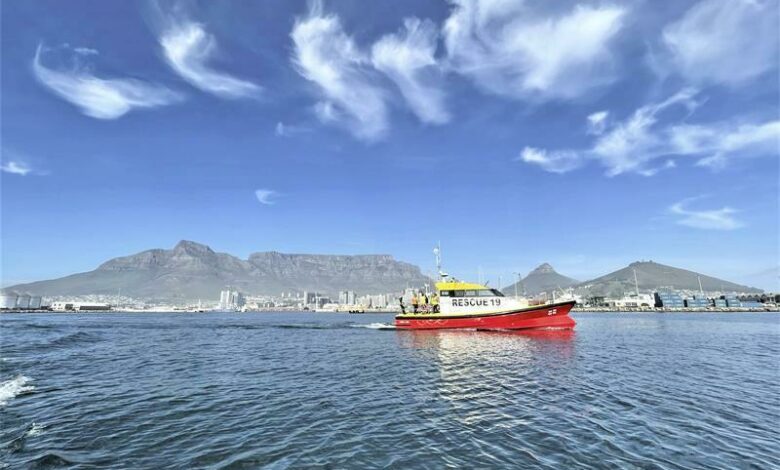
The National Sea Rescue Institute (NSRI) recently sent a Offshore Rescue Craft (ORC) on the longest sea trip in the organisation’s history. The vessel was sent from Cape Town – where it was built – to Richard’s Bay where the boat will be stationed to aid in the NSRI’s work, keeping the community safe when they are off the coast.
The vessel made its first stop in Mossel Bay to refuel and restock supplies, followed by three more stops: Gqeberha, East London and a stop in Durban last Friday before completing its last leg to Richards Bay. The leg from Cape Town to Mossel Bay was 14 hours long, as was the one from East London to Durban. The total distance the ORC travelled was 1 068 nautical miles, equivalent to over 1 900km, and the crew averaged a speed of about 38km/h.
Brett Ayres, the director of rescue services at the NSRI, said the sea craft and crew set off last week Monday, and arrived in Richards Bay last Saturday.
“We have several sea rescue stations along the coast, and the station in Richards Bay was due to receive an offshore rescue craft – it’s a large deep-sea rescue vessel which was built in Cape town – hence the trip,” explained Ayres.
He added that the 4m-long, 5m-wide vessel made the trip without a hitch.
“With all this bad weather we’ve had, the crew managed to find a gap with perfect weather, although, even if weather was bad, the sea craft is designed for tough weather. It’s self-righting and will stay afloat if it gets capsised by a big wave. The craft can maintain quite a good speed through high seas, and it’s very safe for crew to cover a good distance offshore. It has a modern hull, which is the underneath of the boat, designed to cut through water and cut the impact when crews go through rough sea swells,” said Ayres.
This was the fifth vessel of its kind stationed around South Africa as the NSRI works to replace eight old vessels across the country.
“The challenge in KwaZulu-Natal is the exposed coastline – there are only two harbours – one in Durban and one in Richards Bay. A vessel of this size can only be launched from a harbour – it can’t be launched from a beach. There is a long distance from Richards Bay up to Mozambique to cover between the Mozambique border and East London,” said Ayres
The first of the upgraded vessels was stationed in Durban in 2019.
“It was built before [the] Covid-19 [pandemic] and was one of the only vessels available to service offshore mariners who got sick and needed to be extricated off their vessels,” said Ayres, who added that the new craft is a better and much safer operation compared with the older models.
The ORC was transported by sea because it was much cheaper than road freight transport.
“Preparing for a trip of this nature requires a lot of planning. One needs to do a full passage plan, as well as consider logistics, weather and sea conditions. A passage plan is a process where you consider all the hazards and plot a safe passage, with all the different bearings, speeds and fuel consumptions for each leg. You also must make sure that there is enough fuel on the vessel which requires a few stops along the way,” said NSRI training manager Graeme Harding who was the delivery skipper for the voyage.
The ORC arrived at Richards Bay last Saturday afternoon.
“We will now be able to see a vast improvement in our capability to deliver rescue services in the northern parts of KZN. As Richard Bay is our most northern class one station, they are located at an essential strategic location to cover our coastline. We now have two ORCs in the province – the other in our Durban rescue base, meaning KZN is now well covered – and that we can respond quickly and safely to a far larger coastal area.
“We will continue to do our job of saving lives on South African waters, and the ORC certainly makes this more effective,” concluded Ayres.
Read original story on bereamail.co.za

