
Suspended Malalane attorney challenges LPC ahead of April disbarment battle
Zietta Janse van Rensburg accuses the Legal Practice Council of withholding evidence ahead of the court case in which she will oppose the council’s application to have her debarred.
With just one month to go until the formal application to have her struck from the roll of South African legal practitioners, suspended Malalane attorney Zietta Janse van Rensburg has again approached the Mpumalanga High Court with allegations of wrongdoing on the part of the Legal Practice Council (LPC).
According to an article published by Lowvelder, Janse van Rensburg and her legal representative, Adv Hennie van Rensburg, took two jabs at the regulatory body in the form of urgent applications on March 4 and 11, respectively.
The first had to do with the fact that the LPC confiscated files from Janse van Rensburg’s offices, and that they have documents relating to disciplinary proceedings against her in their possession. She has requested access to these files to prepare for her April 14 opposition to their application.
The request was made in December. LPC attorney Thembeka Ratshibvumo said the body had given Janse van Rensburg permission to have supervised access to everything she needs. Despite this, Adv van Rensburg said: “There was no response from the LPC on my client’s request for information and access to the information. The LPC is under obligation to provide information and if they don’t, they are themselves barred from using it in the future… We sit with nothing, like a blank page.”
He requested that Acting Judge Montsho-Moloisane compel the LPC to make its evidence against Janse van Rensburg available. Adv van Rensburg relied on High Court Rule 35, but Ratshibvumo argued that the rule does not apply to motion proceedings unless a court directs that it should, based on exceptional circumstances.
Judgment was reserved and had not yet been made available at the time of going to press.
Ratshibvumo, arguing both matters, pointed out that Janse van Rensburg had had more than two months to file her answering affidavit for the April 14 case, but failed to do so, and that she then decided to bring urgent applications at the eleventh hour, thereby deducting from the true urgency thereof.
Meanwhile, on March 11, Adv van Rensburg presented his client’s latest urgent application, with Acting Judge Kgama Shai presiding over the proceedings. This time, Adv van Rensburg sought to have excerpts from the LPC’s founding affidavit in the April matter struck out. The parts they want removed from the record are allegations of theft and fraud – ‘none of which she was found guilty of’, he said, labelling these paragraphs as ‘scandalous, vexatious and irrelevant’. Shai found that the application was not urgent and that these arguments should be reserved for April 14, striking Janse van Rensburg’s urgent application from the roll.
Another issue that the parties were at odds about during both proceedings was whether the application to have Janse van Rensburg struck from the roll of legal practitioners has been opposed or not. The LPC has enrolled the matter as unopposed as no answering affidavit was filed following Janse van Rensburg giving notice of her intention to defend the matter. Adv van Rensburg maintained that ‘you cannot serve an answering affidavit if there is scandalous, vexatious and irrelevant information in the founding affidavit’, confirming that his client still views the matter as an opposed one.
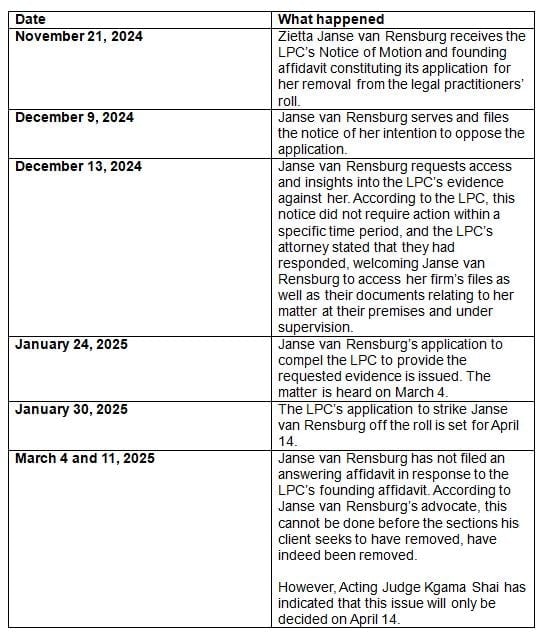
Timeline leading to April 14, 2025:
The Legal Practice Council (LPC) has enrolled its application to have Zietta Janse van Rensburg removed from the roll of legal practitioners, as unopposed on the Mpumalanga High Court case roll.
The LPC and Janse van Rensburg’s legal representatives are at odds regarding whether this matter qualifies as opposed or unopposed. Lowvelder’s timeline explains why.
Media law attorney Helene Viljoen writes:
In an unusual turn of events, Adv Hennie van Rensburg’s March 4 arguments began with the request that Lowvelder representative Irma Green be barred from attending the virtual court proceedings between his client, Zietta Janse van Rensburg, and the Legal Practice Council.
His request to Acting Judge Montsho-Moloisane follows Green’s recent court report that relayed how Judge Henk Roelofse rapped the advocate over the knuckles for his conduct in the much-reported-on Shofeeds civil court case, urging him to abide by court rules. Adv van Rensburg accused Green of poor reporting and factual errors.
ALSO READ: Johann Möller court case: High court judge not impressed
Adv van Rensburg told the judge that the media had to follow certain procedures to receive a link for virtual hearings.
The judge asked Green to explain her presence, upon which she confirmed that she applied in writing after a telephonic conversation with the judge’s secretary, stating that she was from the media.
With reference to the case against his client, Adv van Rensburg said sensitive and personal issues might be ventilated between parties, which are confidential and should not be published. Montsho-Moloisane ruled that Green could remain present and report on proceedings, but that personal and confidential information should not be published.
In so doing, Montsho-Moloisane gave effect to Rule 62(3) of the Uniform Rules of Court which states that civil court proceedings are generally open to the public by default. “Save where otherwise provided by law or where the court in any particular case directs otherwise, the sittings of the court shall be in open court.”
What made Adv van Rensburg’s request so startling was that he demanded the media be ejected from court entirely – something that is at odds with the principle of open justice that has been declared crucial to our democracy. (S v Dzukuda and Others; S v Tshilo, 2000 (4) SA 1078 (CC)).
The fact that the principles of open justice and the proper administration of justice are not necessarily at odds with one another was confirmed in our Constitutional Court more than a decade ago. One example, albeit in a criminal court context, was the international broadcasting of the Oscar Pistorius murder trial, which the Constitutional Court allowed.
Media practitioners receive regular and rigorous training on South African Media Law and the fact that the right to report freely is not absolute. Both civil and criminal courts may prohibit the media from reporting on certain portions of evidence or proceedings. Section 154(3) of The Criminal Procedure Act 51 of 1977 was, for example, amended in the Constitutional Court case of Centre for Child Law and Others v Media 24 Limited and Others. As a result, the media may not identify minor accused, witnesses or perpetrators in court reporting – not even after they have turned 18.
Sex offence victims may not be identified without their consent, and divorce proceedings may not be reported on. Domestic violence matters are not open to the media, nor are Children’s Court cases.
In conclusion, the media’s right to report on court proceedings does not by any means cater for a sensationalist free-for-all fest. It is a crucial requirement for a democracy where justice is seen to be done and is accurately and consistently recorded.
Breaking news at your fingertips… Follow Caxton Network News on Facebook and join our WhatsApp channel.
Nuus wat saakmaak. Volg Caxton Netwerk-nuus op Facebook en sluit aan by ons WhatsApp-kanaal.
Read original story on www.citizen.co.za

