
Fostering: A bittersweet experience
It takes a special type of person to open their heart and home to a foster animal. Have a look at the experience of creating a temporary home for a pet in need.

Monica van der Merwe, the marketing manager of Tears Animal Rescue in Cape Town, has fostered numerous animals. She explains what being a stand-in-mom means to her.
Fostering means nurturing animals until they can be placed in a permanent home with a family who will love them forever.
She helps the animals in her care master basic commands and assists them on their house training journey. While under her wing, animals are taught how to behave in the home, how to behave around people and how to ignore distractions in different environments.
“Unfortunately, most rescue organisations do not have space to house all the animals in need in their communities, nor do they have all the resources available to care for every animal in need, especially the young animals. Puppies and kittens need more nurturing and care than adults,” she says.
Shelters can be extremely loud, busy and stressful to animals. And with any rescue organisation, animals are coming and going all the time, which exposes the more vulnerable animals to diseases. Young unvaccinated puppies and kittens are more susceptible to picking up diseases than older animals, she says.
“My first foster was unplanned and very spontaneous; we had just had a litter of seven rescued puppies arrive at the shelter. I noticed the smallest of the litter was a third of the size of his litter-mates and had a bad eye.
“Without thinking, I said: ‘Shall I foster this baby?’. They did not hesitate; I was set up with a bed, blankets, food, medication, and even toys to take home with me to foster this tiny puppy.
“He had severe entropion in one upper eyelid, which was causing a deep corneal ulcer.”
Entropion is a condition in which the eyelid is turned inwards, resulting in the eyelashes rubbing against the eyeball.
A vet tacked the eyelid up to angle the eyelashes correctly and he was sent home with antibiotics and eye drops. Eventually, the ulcer healed and the stitches were removed, leaving the pup with full sight in the affected eye.
“Watching a puppy grow is a magical thing. Especially from a tiny runt to a happy, healthy puppy. Seeing their little personalities shine through is another treat.
“It was still a challenge, but one of the most rewarding ones. We snuggled every day, had baths, and almost everything he did made our hearts flip.
“It’s hard to say goodbye…”
Van der Merwe admits that foster owners sometimes form strong connections with the animal. “But you go into fostering knowing that it’s temporary and you are raising a happy, healthy puppy; it’s bittersweet.”
Not everyone agrees with fostering
The SPCA movement in South Africa does not permit the fostering of SPCA animals, says Keshvi Nair, the spokesperson for the National Council of SPCAs.
“This is in terms of the Society for the Prevention of Cruelty to Animals Act 169 of 1993. Our main reason for not permitting animals to be fostered is that animals can, and do, quickly bond with the people who are taking care of them. They settle into their home environment and start to relax,” she says.
When they leave their foster home, they have to start all over again in a new environment. “This can be very stressful,” Nair says.
The power of touch
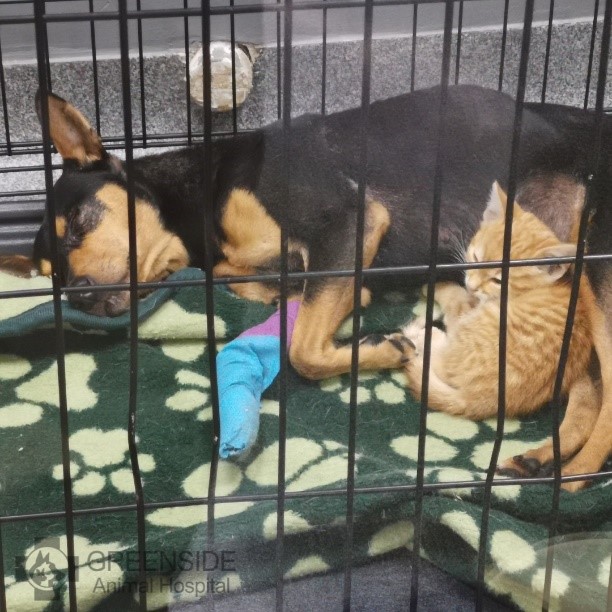
A stray kitten recently demonstrated the healing power of touch when he slipped out of his cage and into the cage of a stray dog in the Greenside Animal Hospital’s isolation ward.
The ginger kitten, aged between six and eight weeks, was put into isolation because his vaccinations status was unknown, while the stray dog was receiving treatment for an illness.
Although dogs and cats are usually kept apart at the animal hospital, the kitten prompted staff to bend the rules.
The little dog showed no aggression towards the kitten and the veterinary team decided their friendship was beneficial to both their well-being and they were left together for warmth and companionship.
World Veterinary Day falls on April 30 this year. The theme, set by the World Veterinary Association, is ‘Strengthening veterinary resilience’. This is an apt topic in South Africa, where a shortage of vets places strain on those in the profession. The upside is that veterinary science is a great career choice for youngsters, who will have an excellent chance of securing employment.
Read original story on letabaherald.co.za

