
Language board clarifies ‘spelling error’ on new banknotes
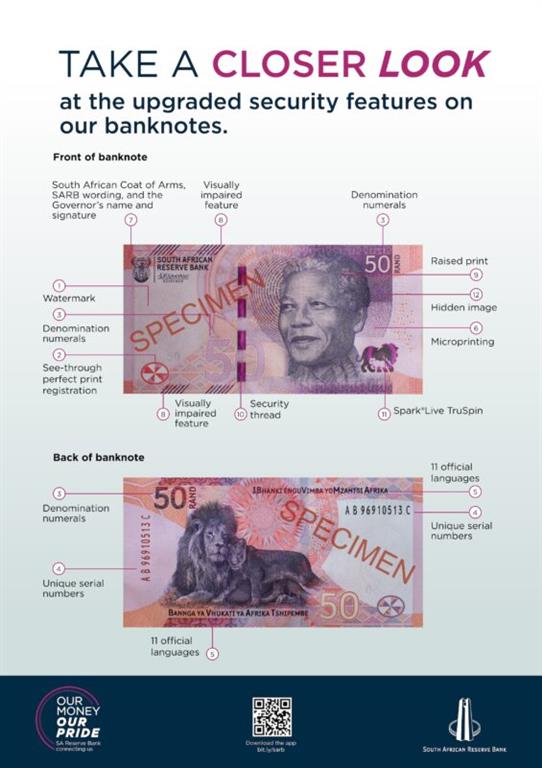
On the R100 note, the Xitsonga translation of 'Reserve Bank' was changed, with the second ‘N’ in Banginkulu dropped. The word now reads as Bangikulu.

The Pan South African Language Board (PanSALB) has clarified the change of Xitsonga spelling from ‘Banginkulu to Bangikulu’ on the upgraded notes and coins.
This comes after reports of a spelling error in the translation of the words ‘Reserve Bank’ into Xitsonga.
PanSALB rebutted those reports and said the words were verified and are correct.
“There were consultations between the South African Reserve Bank and PanSALB, and the terms were verified and authenticated by the Xitsonga National Language Body, a statutory and advisory structure established in terms of the PanSALB Act.
“Therefore, the PanSALB hereby confirms the words written in Xitsonga, ‘Bangikulu’, as reflected on the upgraded banknotes, are accurate and correct and consistent with the revised spelling and orthography rules published by the language board in May 2022.
“PanSALB notes the confusion that may have been caused by the change and wishes to encourage members of the public to download the latest revised spelling and orthography rules available in all official languages on the PanSALB website,” the language body said.
It explained that on the old notes, there had been an error in the translation.
“The Xitsonga National Language Board (NLB) has pointed out that in prior notes, the term ‘Bangikulu’ was spelled erroneously as ‘Banginkulu’, with a /n/ that was not supposed to be there. The following is the explanation for why the Xitsonga NLB advised the removal of the /n/ in the current banknotes.
“Bangikulu is a compound noun, which is formed by two words, the noun ‘bangi’ and the adjective stem ‘-kulu’ to form bangikulu. The /n/ cannot be accounted for as to where it comes from. As much as we cannot say bangi leyinkulu or yinkulu, we also cannot say banginkulu.
“The /n/ that goes with the adjective stem ‘-kulu’ can only be accounted for in nouns that pertain to humans. Matsalanankulu, mhaninkulu, and papankulu are a few examples. This is because the /n/ on these words is an allomorph of /mu/, which can stand as a prefix of class one words,” said the PanSALB. – SAnews.gov.za
Read original story on albertonrecord.co.za

