
Sub-adult male cheetah joins Njozi at Rietvlei Nature Reserve
After a journey of more than 240 kilometres, a sub-adult male cheetah from Welgevonden has finally been released with the 18-month-old female, Njozi, at Rietvlei Nature Reserve on Thursday.
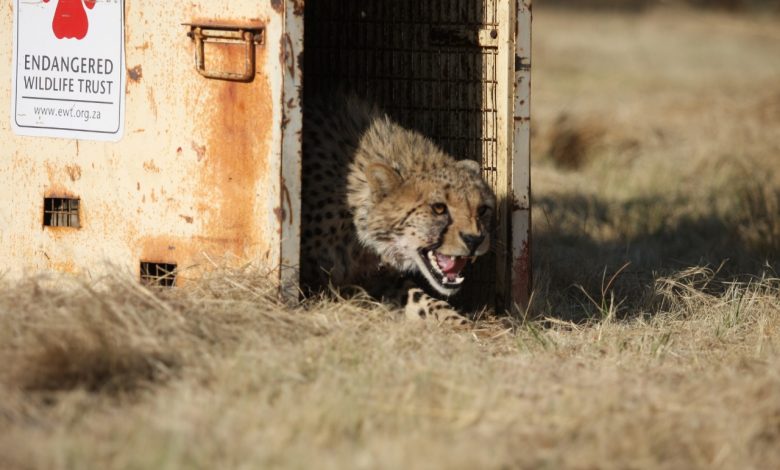
Welgevonden Game Reserve ranger Muhluri Armstrong Maluleke left early on Thursday afternoon to safely release the cheetah into a boma, where both cheetahs will remain in the enclosed area for a month.
Maluleke said that it was quite a mission to capture the male cheetah last week as the four remaining cheetahs disappeared over the 36 000 hectare reserve over the hills.
“Just before dawn on Thursday, we managed to locate the cheetah, darted him and started the three-hour journey to Rietvlei,” said Maluleke.
Endangered Wildlife Trust’s (EWT) cheetah range expansion project coordinator Vincent van der Merwe said they were hoping to relocate the male and his brother to Mozambique in early January, but due to unfortunate circumstances the brother died.
“We don’t know what killed him,” said Van der Merwe.
He said the plan of action was to basically still use the single male from Welgevonden for reintroduction into Mozambique.
“We will, however, release them in Rietvlei after a month together where they will start hunting together and make mistakes together. Thereafter, they will naturally separate as cheetahs do.
“The male will start reaching sexual maturity and start irritating Njozi. She will split from him as she is only ready to reproduce from about March next year,” said Van der Merwe.
Two Botswana males will join Njozi (the Swahili word for dream) coming in January next year, the same time the Welgevonden male will be relocated.
Rietvlei manager Adelene Marais said that they are very excited to welcome the young sub-adult cheetah at the reserve.
“It was decided not to give the youngster a name, as he will be transported to Mozambique at the end of the year.
“Until he (the male cheetah) acclimatized and the male and female learn to hunt together, he will be transferred later as part of the meta-population programme.
“We are grateful to be part of such a great initiative like the population programme,” said Marais.
More about cheetahs
- Cheetahs are unrelated to all other cat species in Africa; their closest living relative is the Puma from North America.
- Most people consider the cheetah to be a species that prefer open grassland habitat. The cheetah is actually quite tolerant of vegetation. They do very well in the area of the Eastern Cape where they change their hunting tactics from long chances to ambush tactics.
- Cheetahs are much more adaptable than previously thought. They can tolerate and learn in a wide variety climatically conditions, ranging from tropical climate (where temperatures reach up to 45ºC in Southern Africa), two very cold desert climates in Asia and the Karoo (where temperatures can dip to under 10°C). They are occasionally seen in snow.
- Cheetah mothers are quite promiscuous in the same litter of cubs. They are quite happy to mate with multiple males. It is good for cheetahs from a genetic perspective as it encourages genetic diversity in the gene pool.
The first cheetahs that were seen by the early Dutch arrivals in the Karoo were called “luiperd” and then only later became “vlakteluiperd” and today they are known as “jagluiperd” in Afrikaans.
Read original story on rekordeast.co.za

