
Video: Prasa saves R200m by identifying ghost employees
Transport Minister Fikile Mbalula shares findings made by Project Ziveze on matters at the Passenger Rail Agency of South Africa.
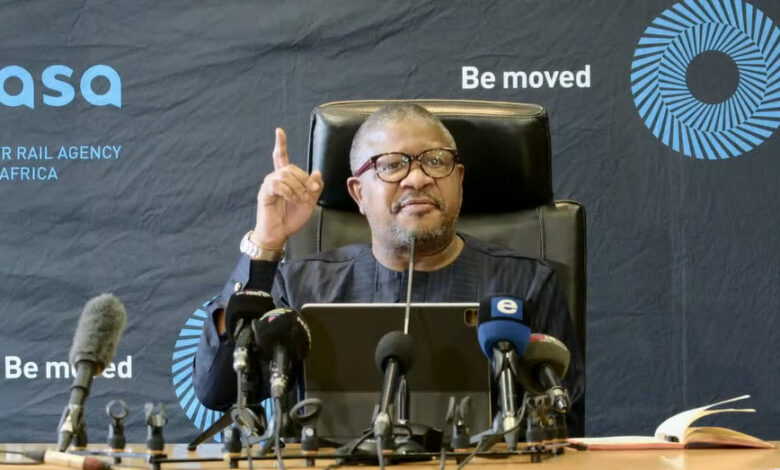
Addressing a media briefing in Johannesburg on Monday, Transport Minister Fikile Mbalula said Project Ziveze was launched 10 months ago to verify all Passenger Rail Agency of South Africa (Prasa) employees, after material irregularities were uncovered within Prasa’s information and communications technology (ICT) systems, human capital management (HCM), and payroll.
The scope of the project also extends to validating whether the employment of foreign nationals is in line with the provisions of the law.
“We are on course to rid Prasa of all forms of corruption. Those officials who aid and abet these dastardly deeds of corruption will face the full might of the law. We have a duty to ensure that public resource are channelled towards delivering services to the citizens in a responsible and cost effective manner,” the minister said.
During phase one of the project all employees were invited on a voluntary basis to come forward to be verified with copies of their ID, qualifications and the HCM Employee Data forms.
“During this phase, out of the 17 268 recorded employees on Prasa’s payroll system, 14 268 employees presented themselves for verification. During the same period, 1 159 employees resigned. Failure by 3 000 employees to come forward for physical verification led to suspicions that there could be a number of ghost employees at Prasa,” Mbalula said.
Prasa then commissioned the services of an independent service provider to establish if these were indeed ghost employees, and to identify weaknesses in the Prasa system as well as identifying culpable officials who may have colluded with unscrupulous people to create ghost employees where this was found to be the case.
The investigation was conducted with the support of the Department of Home Affairs, the South African Revenue Service (SARS), Umalusi, and the South African Qualifications Authority (SAQA).
The investigation flagged 2 143 employees, who were then grouped according in the following categories:
- Possible ghost employees who could not be physically verified.
- Employees masquerading as somebody else, thus possible identity theft.
- Fraudulent qualifications submitted.
- Employees with serious criminal offences.
“The preliminary investigation revealed that 1 480 employees either cannot be physically verified and their files or documentation are non-existent, while others resigned without the necessary supporting documentation at the start of the project. The investigation also revealed a number of instances where ID photos do not match the face of employees. This has triggered further investigations,” Mbalula said.
The investigation concluded that the root cause of these findings are:
- Incorrect data capturing of employee information, resulting in a corrupted employee database.
- Weaknesses in the Prasa’s ICT system.
- Weaknesses in Prasa’s internal control environment.
“As a consequence of the developments to date, the next steps include taking urgent action to address the findings and challenges identified to date,” the minister said.
These include:
- A forensic investigation that will conduct a deep dive on critical issues flagged in the preliminary investigation.
- A digital fingerprint and photo ID verification process with the assistance of the Department of Home Affairs. This exercise is currently underway and the completion of this exercise will then enable Prasa to freeze the salaries of those flagged.
- Digitisation of files and supporting documents.
- Clean up of the employee database.
- Employees who submitted fraudulent qualifications will be served with letters to explain themselves within 48 hours from today, failing which stricter action will be taken in line with the applicable prescripts.
- Criminal charges will be laid against those who have committed fraud.
“Through Project Ziveze, we have been able to save Prasa approximately R200m since the inception of the project in November 2021. Our efforts must translate into Prasa becoming a truly credible and ethical organisation, that prides itself of its professional ethos and robust governance systems,” the minister concluded.
Read original story on sedibengster.com

