
Video: Rare bioluminescent phenomenon illuminates waves at Umdloti
A family ran down to the beach to get a closer look and captured the glowing waves in a video.
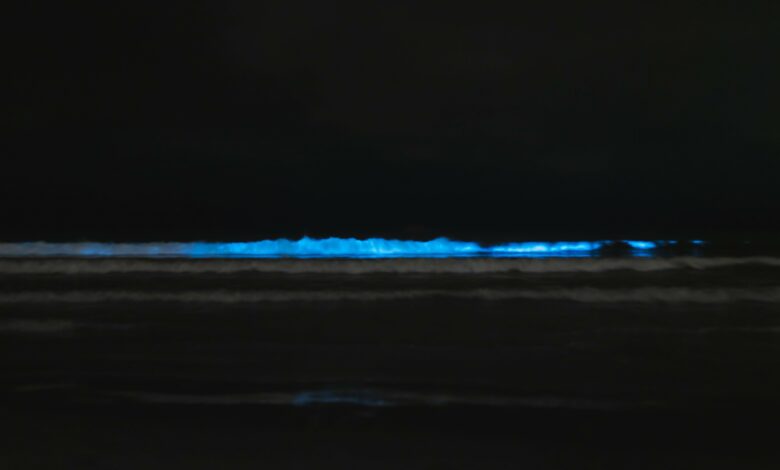
Josie Makkink and her family had a magical once-in-a-lifetime experience spotting bioluminescent plankton at Umdloti last Sunday night.
Known as the northern lights of the ocean, bioluminescence occurs when a living organism produces and emits light from its body owing to an internal chemical reaction that turns chemical energy into light energy.
Makkink said they were having a family dinner on the balcony of their North Beach Road apartment at about 19:15 when they noticed some of the crashing waves glowing blueish green.
At first, they were sceptical and chalked it up to light from the shore reflecting off the waves. But when it kept happening, they realised they were witnessing one of nature’s most extraordinary wonders.
The family quickly ran down to the beach to get a closer look and Makkink’s sister, Rose Barnsley, captured the glowing waves in a video.
They were also fortunate to discover a tiny bit of washed-up bioluminescent plankton glittering in the sand.
“It was just such a magical evening, a once-in-a-lifetime experience,” said Makkink.
Currently studying in Cape Town, she has heard of people seeing bioluminescence in the Western Cape in places such as Fish Hoek, Gordon’s Bay and Simon’s Town, but never in KZN.
uShaka Sea World Education executive manager Jone Porter told The North Coast Courier that bioluminescence could be a flash or a glow and was used by various species at different depths to thwart predators, attract prey or even to lure a potential mate.
In the ocean bioluminescence is most common in the twilight zone, 200-1 000m below the surface where there is very little sunlight, but it can sometimes be seen on the surface such as when there is a large concentration of bioluminescent plankton in the water.
“Several deep-water corals have bioluminescence in their tentacles. They use it to attract plankton to catch as food.”
She said some twilight zone creatures such as seal sharks, goblin sharks and diamond squids use bioluminescence to lure prey without startling it, and then catch it.

Others such as headlamp myctophids would emit light to stun or confuse their prey before catching it.
On the other hand, prey used bioluminescence defensively by startling or misdirecting a predator or using it as a burglar alarm t An example of bioluminescence, similar to that seen in Umdloti last Sunday night.
o alert the group to the presence of a predator.
Some might even use it to alert a second, larger predator in the hopes that it would go after the first predator and inadvertently save its own life.
Bioluminescence differs from fluorescence and phosphorescence in that it does not involve the absorption and reflection of light from an external source, but it is the organism that creates its own light.
Read original story on www.citizen.co.za

