
Videos: Orcas Port and Starboard reshape coastline as shark hunting strategy evolves
Marine biologists have documented how a pair of killer whales drove great whites from Western Cape strongholds, triggering widespread ecological shifts.
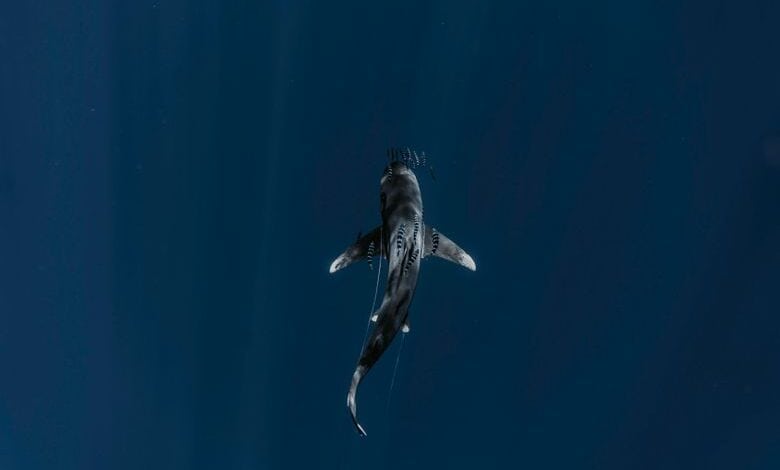
When great white shark carcasses with missing livers first began washing up on South African beaches in 2017, the cause mystified researchers.
In a 2022 report for Caxton Network News, journalist Liryn de Jager documented how a pair of male killer whales – dubbed Port and Starboard due to their distinct bent dorsal fins — were single-handedly driving great whites away from historical strongholds like Gansbaai and False Bay. The pair targeted the shark’s energy-dense, lipid-rich livers with surgical precision, forcing the apex predators to flee their traditional hunting grounds in a pattern comparable to wild dogs avoiding lions in the Serengeti.
Subsequent reporting across the Caxton network tracked these oceanic shifts along the Western Cape coastline.
Expanding pod sightings
In early 2023, the Knysna-Plett Herald reported on an unusually large group of 16 orcas filmed putting on an extraordinary display off Plettenberg Bay. Marine mammal scientist Dr Gwenith Penry noted then that larger opportunistic pods of transient orcas – which typically hunt marine mammals such as dolphins, seals and sea lions – were increasingly hunting sharks and rays along the South African continental shelf.
Watch the video:
Co-ordinated incursions
In mid-2023, the Mossel Bay Advertiser reported how Port and Starboard caused havoc among local shark populations near Mossel Bay. Drone footage captured by Christiaan Stopforth of Drone Fanatics showed the duo actively hunting 2.5m great whites, while a separate 2.9m great white carcass washed up near the Hartenbos River mouth. Shark Research Unit director Nico Booyens confirmed at the time that the sudden presence of the orcas repeatedly triggered mass evacuations of local shark populations.
Watch the video:
Refining the hunt
Recent investigations highlighted by the BBC point to an even more significant development: South Africa’s marine landscape has become a case study in rapid evolutionary learning.
Marine biologists, led by Dr Alison Towner, have documented that the orcas’ strategy has evolved from co-operative group attacks to astonishing solo efficiency. In a world-first sighting off Mossel Bay, Starboard was filmed killing a great white and extracting its liver in under two minutes – demonstrating that the specialised technique no longer requires pod co-ordination.
Cascading ecological consequences
The prolonged displacement of great whites has sent ripple effects throughout the coastal marine ecosystem:
- Secondary predator shifts: Bronze whaler sharks initially filled the void left by great whites in coastal bays. However, Port and Starboard quickly adapted, adding bronze whalers to their prey list.
- Seal and penguin dynamics: Unchecked by great whites, Cape fur seal populations expanded their hunting territories, putting severe pressure on critically endangered African penguin colonies.
- Global observations: Oceanographers have since identified similar liver-targeting orca behaviours in other regions, including coastal California and the Gulf of California.
Watch as orcas attack a great white shark in the Gulf of California:
Or view the video here: https://www.facebook.com/reel/1111864605084031
Human pressures and signs of adaptation
While Port and Starboard forced a dramatic migration, in 2022 Towner emphasised that human activities, such as anti-shark nets, unregulated longline fisheries and prey depletion, remained severe threats long before the orcas arrived. However, recent coastal monitoring offers a glimmer of hope.
Two years ago, spotters in False Bay documented the return of great whites, prompting researchers to examine whether these apex predators are slowly learning to adapt their defence tactics to coexist with the ocean’s ultimate hunters.
Watch the video:
Breaking news at your fingertips… Follow Caxton Network News on Facebook and join our WhatsApp channel.
Nuus wat saakmaak. Volg Caxton Netwerk-nuus op Facebook en sluit aan by ons WhatsApp-kanaal.
Read original story on images.pexels.com

