
South African motorists face yet another fuel price hike
Soaring global oil prices and a weakening rand threaten steep petrol and diesel price increases for households next month.

South African motorists will be hoping for some relief from Finance Minister Enoch Godongwana’s Medium-Term Budget Policy Statement (MTBS) today, (October 21), as they face the prospect of another crushing fuel price hike in November, reports the Citizen.
Mid-month data show petrol prices are on track to rise by nearly R2 a litre.
This comes as soaring global oil prices and a weakening rand continue to hammer fuel price recoveries.
CEF data
According to the CEF’s data, petrol prices are showing an under-recovery of R1.67 and R1.72 per litre for Petrol 93 and 95.
Diesel price recoveries are better off, with under-recoveries of R1.23 and R1.24 per litre for 0.05% and 0.005% sulphur.
Record prices
If current trends persist, motorists could face another round of record-high fuel prices at the pumps as escalating Middle East tensions continue to disrupt global oil markets.
Diesel prices first reached historic levels in May following the US-Iran conflict, while petrol set a new record in June, adding to price pressures that began with the Russia-Ukraine war in 2022.
The record prices are expected to put households under severe pressure and may prompt motorists with petrol-guzzling cars to consider more fuel-efficient or electric vehicles.
The Department of Mineral and Petroleum Resources (DMPR) is expected to confirm the adjustment soon, with new prices kicking in on Wednesday, 4 November 2026.
Projections
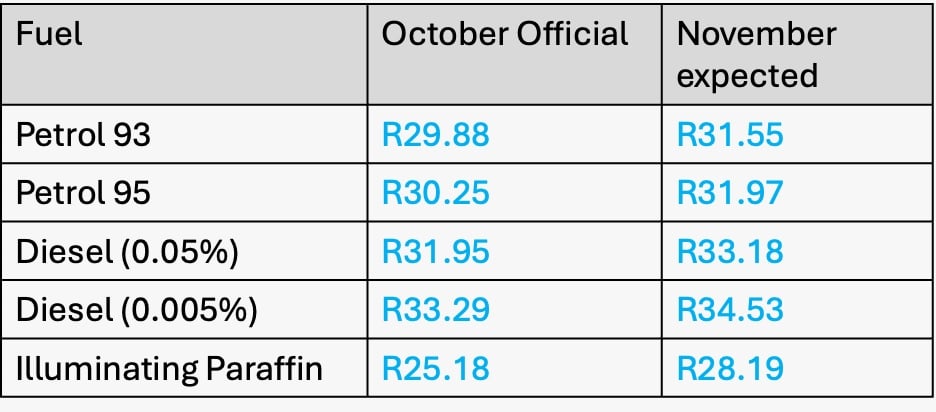
If these projections hold, motorists could pay the following in October 2026:
- Petrol 93: increase of R1.67 per litre
- Petrol 95: increase of R1.72 per litre
- Diesel 0.05% (wholesale): increase of R1.23 per litre
- Diesel 0.005% (wholesale): increase of R1.24 per litre
- Illuminating paraffin: increase of R3.01 per litre
Squeezing motorists
Automobile Association CEO Bobby Ramagwede argued that South Africa’s record fuel prices are doing more than squeeze motorists; they are limiting people’s access to jobs, education, and essential services.
In a piece published by Moneyweb, Ramagwede warned that soaring petrol and diesel costs, driven by high oil prices, a weaker rand and rising transport expenses, are placing the biggest burden on low-income households and could fuel higher inflation, unemployment and living costs.
Ramagwede said the government should provide relief by cutting fuel levies, reviewing fuel pricing mechanisms, and rebuilding strategic fuel reserves, arguing that South Africans are paying the price for global conflicts and domestic policy failures
Breaking news at your fingertips… Follow Caxton Network News on Facebook and join our WhatsApp channel.
Nuus wat saakmaak. Volg Caxton Netwerk-nuus op Facebook en sluit aan by ons WhatsApp-kanaal.