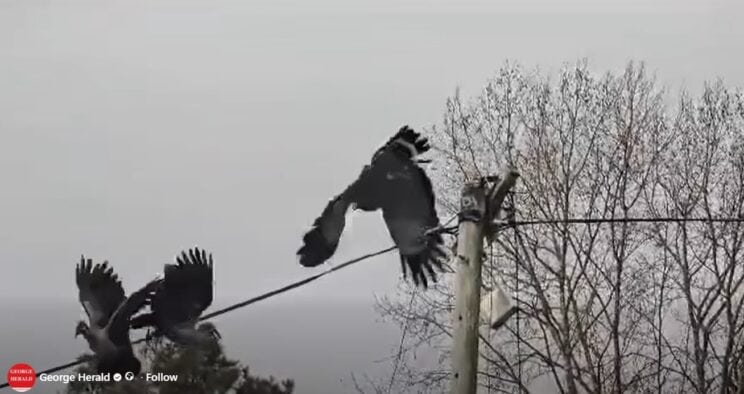
Watch: Hadeda eggs on the menu for this clever predator
A George resident captured a rare glimpse of an African harrier-hawk raiding a hadeda nest – and it turns out this feathered predator is simply doing what nature intended

Jurgens Burger recently shared an unusual video with George Herald, showing an African harrier-hawk targeting a hadeda ibis nest and feeding on its eggs and young.
It might look strange and, at first, even a little cruel. But this is perfectly normal behaviour for the African harrier-hawk, says Dr Lindy Thompson, the research and monitoring co-ordinator at the Endangered Wildlife Trust’s Birds of Prey Programme.
“African harrier-hawks are remarkably skilled predators. They can climb trees, hang upside down and use their long legs to reach into nests and tree cavities that other raptors cannot access,” she says.
“They use their long legs and flexible feet to extract their food from nests, holes and crevices.”
Lady hawk or bald gentleman?
And one would never know whether it was a little lady or a bald gentleman that raided the nest. As Thompson explains, “It is not visually possible to determine the sex of a hawk.”
It’s not personal, hadeda
But no, says Thompson, the hadeda ibis is not a natural enemy of the African harrier-hawk. And unlike many South Africans, the African harrier-hawk is not irritated by the hadeda ibis.
It just does what it is supposed to do: Eat and survive.
South Africa’s noisy neighbour
The hadeda ibis, meanwhile, has become a familiar but often unwelcome presence in many suburbs. When your sleep is disturbed by that loud ‘haaa-haaa-haaa-de-daaa’, or sometimes just a long, nasal ‘Haaaaa!’, you might feel like grabbing your nearest shoe and giving the culprit a gentle reminder about the joys of sleeping in.
And their droppings next to your swimming pool can be a messy sight – not to mention the smell.
But we need them
“Despite their reputation, hadedas are native to South Africa and play an important role in the ecosystem by helping to control insects and other garden pests. They forage in damp soil for earthworms, insects, snails and other small creatures, including centipedes, spiders, butterfly pupae and beetle larvae.
“Hadedas are iconic and part of our natural heritage – so much so that South African musician The Kiffness even has a song about them. They may be noisy, particularly at dawn and dusk, and their calls can certainly make them a nuisance to residents, but they are far more useful than their reputation suggests,” says Thompson.
And whatever you do, don’t blush
And if you ever hear the high-pitched, piercing whistle or scream, often described as a ‘wee-ee-ee’ or ‘kee-kee-kee’, from an African harrier-hawk, don’t embarrass it by either complimenting it or shaming it.
Because, unlike other birds, says Thompson, the African harrier-hawk can blush.
Click the image to watch the video: