

Farmers and monkeys clash
Monkeys cause headaches and financial losses for sugar cane farmers.
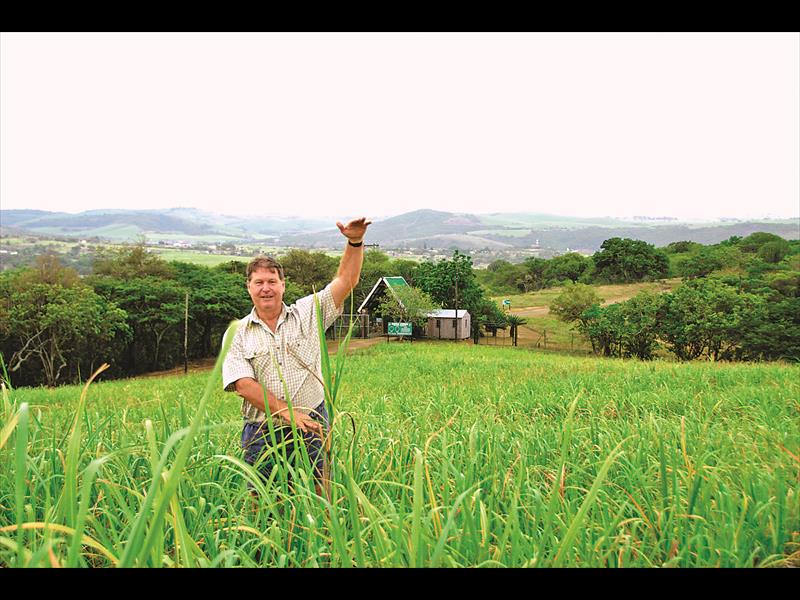
Like many crop farmers, local sugar cane farmer Peter Saville suffers substantial annual financial losses due to damage caused by vervet monkeys to his sugar cane.
“I lose about 1000 ton of yields per year at R400 per ton to monkeys, adding up to R400 000 per annum,” said Saville.
He said this season, the combination of drought and monkeys raiding his cane has caused his fields to look desolate.
“The monkeys break off the growth point in the middle of the young sugar cane plant to get to the sweet stuff and in doing so they stunt the plant’s growth,” said Saville.
The knock-on effect of the damage is that weeds grow where damaged sugar cane does not form a sun blocking canopy quickly enough, further impairing cane growth and shrinking the harvest.
“To replant sugar cane at R25 000 per hectare only to have it destroyed again by monkeys is to spend money with no return,” said Saville.
Saville has been an honorary Ezemvelo KZN Wildlife ranger since 1977 and does not want to hurt monkeys.
“They are lovely but I have had to shoot a lot of monkeys in my life and it is sickening,” said Saville, who described them as almost human-like.
Population control
Saville shares his farm, north of Darnall, rich in natural forest, with about 700 vervet monkeys and he said they have also been eating the crops of the surrounding impoverished community.
He believes the vervet monkeys on his farm are flourishing because even during the drought, the sugar cane provides a constant source of food, enabling them to reproduce all year. He suggested possible ways to control the population include culling, the re-introduction of natural predators like crowned eagles, leopards and pythons, and contraceptive methods.
Monkey activist and founder of Monkey Helpline, Steve Smith did not agree and said the local monkey population is under stress and should be protected.
“Monkey numbers are reducing drastically because they cannot reproduce at the rate that they are dying,” said Smit.
However University of KwaZulu-Natal’s Professor Colleen Downs at the university’s School of Life Sciences said one must consider the bigger picture.
“With changing land use (from natural bush to farmland or urbanisation), biodiversity reduces and some species adapt much better than others,” said Downs.
Species that have adapted particularly well to changing land use include vervet monkeys, caracals, porcupines, bush pigs, dassies and hadedas.
“Believe it or not, the hadeda was scarce in the 1950’s, but they adapted better than other species to changing landuse, especially unrabnization, over time,” said Downs.
Of vervet monkeys’ three main natural predators (leopard, python and crowned eagle) only the crowned eagle has been able to adapt to urban life.
Research is being done into the possibility of introducing this natural predator as a means of monkey population control. One of Prof Downs’ doctoral students, Shane McPherson, found in his research that the pair of crowned eagles at Victoria Country Club in Pietermaritzburg prefers to catch female vervets with dependent infants because they are slower and easier to catch.
“This is an example of nature’s way of controlling populations,” said McPherson.
But Downs said not enough research had been done yet to be able to make generalised statements regarding vervet monkeys.
“We can however say with certainty that human-wildlife conflict increases with the changing land use and that by feeding monkeys people are making it worse,” said Downs.
She said shooting at monkeys may cause them to become more vicious and is therefore a not a good idea.
“People must be conscious of how their input might be affecting the bigger problem. It is possible for vervet monkeys and people to co-exist,” said Downs.
She admitted that there is currently very little vervet monkey population control and said some vets are looking into the possibility of introducing a contraceptive for this purpose.
Stay in the loop with The North Coast Courier on Facebook, X, Instagram & YouTube for the latest news.
Mobile users can join our WhatsApp Broadcast Service here, or if you’re on desktop, scan the QR code below.