

Umdloti’s great mussel nursery
Thanks to being named a coastal conservancy, mussel beds are thriving.
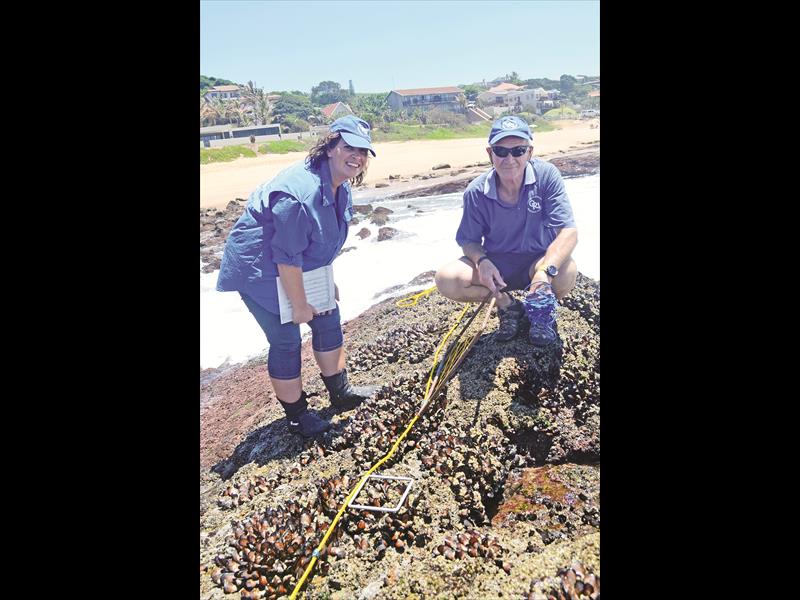
Umdloti mussel beds are thriving, thanks to the area being named a coastal conservancy, the only one on the KZN coast.
The survival and thriving of these invertebrates is important, because they play an integral role in the coastal ecosystem.
The little filter feeders remove food particles from the water, giving it a clearer and cleaner look.
Mussels also provide living space, protection and food for rock lobsters, octopus and fish such as the blacktail and pompano.
Sadly, mussels are struggling to thrive in their natural habitat, mainly due to ‘rock robbers’ (the over harvesting of mussels).
Even with the implementation of permits and the 30 mussels per bag, per day rule, mussel beds are still severely deteriorating.
For this reason, certain key mussel sites were chosen to be monitored for better protection.
Umdloti is one of these special sites and the recovery of the mussel beds have been documented by the Oceanographic Research Institute (ORI) since the 1980s.
In 1998, the collection of mussels, rock lobsters, crabs, mole crabs and redbait was prohibited in Umdloti.
According to the director of ORI, Professor Rudy van der Elst, the mussel cover has more than doubled on the monitored reefs.
He said Umdloti mussel beds are considered to be an important source of mussel spat (formed from larval) for other reefs along the KZN coast and is a great mussel nursery.
Erika Steyn, assistant scientist, and Desmond Hayes, scientific technician, from ORI monitor the Umdloti mussel beds twice a year.
“We do a check and count in spring and autumn,” said Steyn.
To do this, they use a 20 meter long, bright yellow rope, which is put along the permanent yellow markers in the rocks.
They measure the percentage mussel cover on the rocks and from sea to shore with a grid system.
Where mussels grow in layers, they collect a small area of mussels, to examine them and work out the mussel density and the amount of new mussels.
“I measure every single mussel we take with us,” said Hayes.
According to Steyn, between 10 000 and 11 000 people buy permits to collect mussels, crayfish, oysters and other shellfish every year in KZN. This of course hampers the mussel bed growth significantly.
Steyn said there is a fierce race for space on the rocky reefs between the mussels, Cape rock oyster, redbait and algae.
“Mussels usually win, given a chance, because they are highly productive and the thousands of mussel larvae smother existing redbait and oyster beds.”
Steyn said it is very difficult for mussel larvae to colonise a reef that has been completely cleared by rock robbers, as algae takes over and then the mussels struggle to get a good grip on the rocks.
According to Steyn, more than 3000 harvesters collected an estimated 29 tonnes of brown mussels in 2012 along the KZN coast.
Umdloti residents are supporting the coastal conservation initiative to try and lower these numbers and increase the coastal ecosystem.
“We are very happy with the project and the support we have received from ORI and Ethekwini,” said Patrick Bean, an Umdloti resident and avid conservationist.
Stay in the loop with The North Coast Courier on Facebook, X, Instagram & YouTube for the latest news.
Mobile users can join our WhatsApp Broadcast Service here, or if you’re on desktop, scan the QR code below.