

“Sir Ernest Henry Shackleton was the most amazing seaman; polar explorer and leader of men. He took a party of 27 people into the Weddell Sea area of northern Antarctica, was shipwrecked, spent 500 days living on the ice, then managed to land three lifeboats on a remote island, before sailing one of these with five companions 1 600 km to the safety of South Georgia Island. And in all that, he did not lose a single person.”
The adventures of the legendary British explorer have held a lifelong fascination for Dr Gordon “GV” Price, an engineering geologist who lives in Simbithi Estate, who recently joined 93 people from around the world in a visit to Antarctica to commemorate the 100th anniversary of Shackleton’s expedition to cross that huge, icebound continent on foot from north to south via the pole.
Sir Ernest Henry Shackleton (1874 – 1922) was a polar explorer who led three British expeditions to the Antarctic, and along with Robert Scott was one of the principal figures of the period known as the Heroic Age of Antarctic Exploration.
After the race to the South Pole ended in December 1911 with Norwegian Roald Amundsen’s conquest, Shackleton turned his attention to the crossing of Antarctica from sea to sea, via the pole, in 1914. Disaster struck when his ship, Endurance, became trapped in pack ice and was slowly crushed.
“They survived for over a year, first in the ship and then camped on the sea ice after the ship was destroyed,” said Price.
Several attempts to get back to land – any land – by riding on large icefloes failed. Drifting ever north and with Spring approaching the 28 strong party was forced to take to the water in three life boats, eventually landing on Elephant Island – a remote and inhospitable place.
Shackleton, known to his men as “The Boss” then set sail in one of the converted lifeboats – the James Caird – for the whaling station at South Georgia Island 1600 kilometres away. Sailing through huge icey seas; once totally swamped, plus losing their sea anchor, but with incredible navigation they reached King Haakon Bay at South Georgia.
Next followed a heroic climb over the island’s ice mountains by Shackleton; Tom Crean and Frank Worsley to get to the other side of the island; the Norwegian whaling station at Stromness Bay – and salvation. Shackleton then returned to Elephant Island to rescue the remainder of his party. A venture, because of the huge seas and ice, that took four attempts only succeeding with help from the Chilean Navy.
To give an idea of the immensity of their escape, the distance they sailed in lifeboats is roughly the distance between Cape Town and Johannesburg. The huge seas sank a freighter off South Georgia at the time of their journey.
To get to Antarctica, Price flew to Buenos Aires and then to Ushaia, a port at the southernmost tip of Patagonia, where he joined a group of about 90 Shackleton enthusiasts – including the great man’s great grand-daughter Alexandra – from mainly the UK, New Zealand, RSA and France, to start off their three-week adventure.
First port of call was Port Stanley in the Falkland Islands and islands of the West Falkland Archipelago, home to millions of seabirds and migratory birds including the black-browed albatross, rockhopper penguins, Magellanic penguins, oystercatchers, geese and the endemic flightless steamer duck.
From there it was a three-day sail to South Georgia, home of tens of thousands of king penguins, fur and elephant seals. They visited abandoned Norwegian-built whaling stations and Shackleton’s grave at Grytviken Harbour on South Georgia.
Being a special commemorative trip and with descendants of Shackleton’s original party aboard, they were keen to mark the significance of each stop at a significant landmark.
“They had some rather excellent whisky that they hauled out regularly, and we had to drink toasts to Ernest, to the original party, to the Norwegians – in fact, to everybody. The whisky in that weather was great!”
Members of the tour were keen to teach everyone their national toasts, and so the islands rang to the shouts of ‘Slainte!’ for the Irish, ‘Cheers!’ for the Brits, ‘Skäl!’ for the Norwegians, and “Mdhundu Wako!”. GV had taken great delight in teaching the group to raise their glasses to ‘Your bum!’ in Xhosa – much akin to “bottoms up” – GV being a bit of a Xhosa linguist and a humourist.
After a further eight days sailing through the South Orkneys and the South Shetland Islands, they arrived at Antarctica.
“It is an absolutely magic place,” said Price.
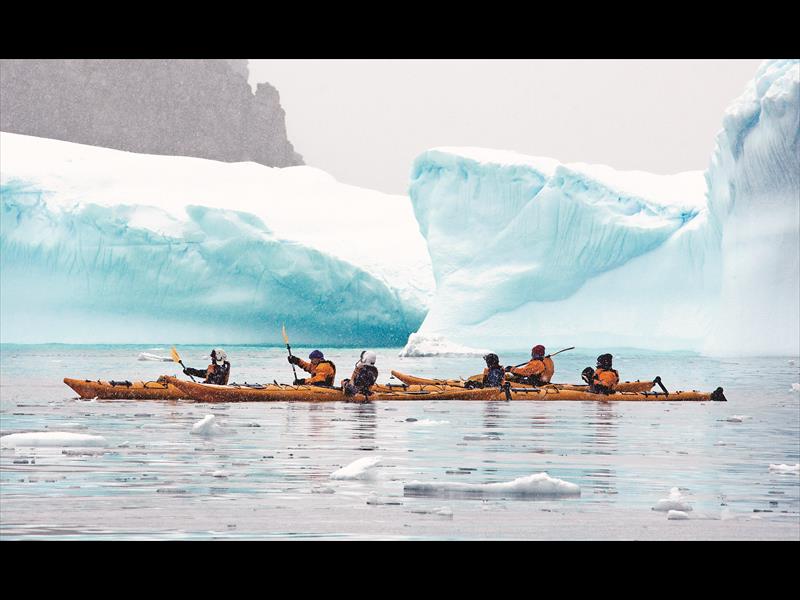
“You cannot believe the size of the absolutely colossal icebergs and the colours. The ice isn’t white, it’s every shade of the most brilliant blues.”
Being a keen canoeist and surf skier – he has competed in 34 ‘Dusi marathons – Price was very keen to test the waters.
“We were fortunate to be able to spend a lot of time kayaking along the Antarctic Peninsula. It was very cold, but with the sun out most of the time, temperatures rarely dropped below -5 degrees Centigrade.”
Setting foot on the Antarctic continent was one of the highlights of the trip.
“It was one for my bucket list. I have long wanted to visit Antarctica because of my interest in polar exploration, but it also means I have now visited all seven continents.”
Stay in the loop with The North Coast Courier on Facebook, X, Instagram & YouTube for the latest news.
Mobile users can join our WhatsApp Broadcast Service here, or if you’re on desktop, scan the QR code below.