

One might call what happened to Mary Kok a miracle.
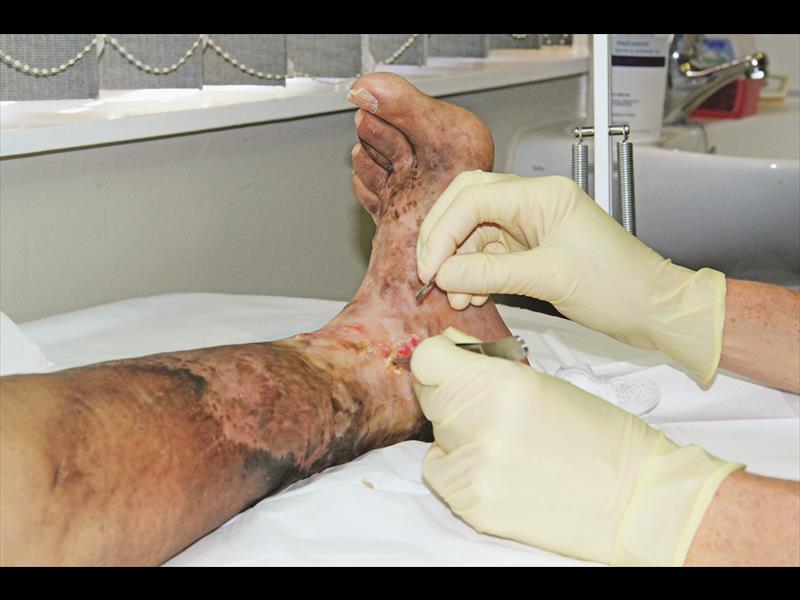
For almost as long as South Africa has had a democracy, Kok lived with the unbearable stench of the decomposing flesh of her own leg, with swelling and excruciating pain.
Due to receiving incorrect treatment for 18 years this Durban resident was living with an infected severe venous leg ulcer.
Every night she slept with plastic sheets on her bed to catch the daily pool of ooze before it soaked into her bed.
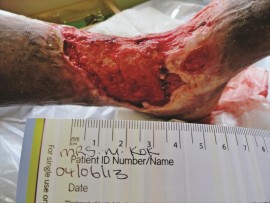
In 2013 she arrived at private nursing practitioner, Trish Idensohn’s practice door at Clinicare, Ballito with the infected ulcer that has grown to be the size of a child’s foot.
“The sore was just a prick in the beginning (20 years ago),” said Kok.
Idensohn immediately treated the infection and then applied compression therapy, changing her bandages twice a week.
“My mother had a painful expression on her face for years and years and two months after starting treatment with Trish, my mother’s face changed and she looked happier and not in so much pain,” said Kok’s son, Allister.
As part of her treatment, Kok underwent surgery at Alberlito Hospital in May 2013 to redirect the flow of blood in her leg.
Dr Deon Steer successfully tied off the saphenous vein (the largest superficial vein of the leg), forcing the blood to find another route back up to the heart.
Today her wound is a fraction of the size it was two years ago, she only required treatment once a week, and a full recovery is expected soon.
“It is really a blessing to be relieved of this,” she said.
Idensohn said Kok’s patience during treatment has been incredible.
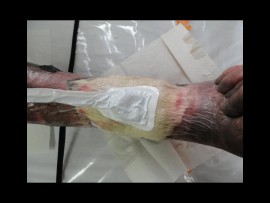
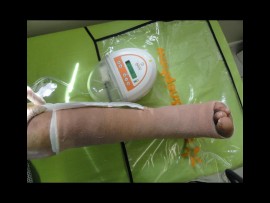
During her treatment under Idensohn, Kok also underwent negative pressure wound therapy, a therapeutic technique using a vacuum dressing to reduce the fluid in the ulcer and promote healing.
This gross condition commonly isolates its sufferers, mainly because of the smell. Patients often cannot sleep in the same bed as their spouses or eat at the same table as other people.
Pain killers do little for the pain and, besides potentially causing stomach ulcers, continued use of anti-inflammatory medication eventually stops the wound from healing.
“A wound heals in stages and one of the stages involves inflammation. Taking anti-inflammatories at this stage causes the healing process to get stuck at the inflammatory stage,” said Idensohn.
She said the gold standard for treating venous leg ulcers is compression.
Idensohn said the leg ulcer is caused by chronic venous insufficiency, which means venous wall and/or valves in the leg are not working properly and struggle to pump enough blood back to the heart, causing blood to pool in the legs – hence swollen feet and legs.
With nowhere to go, the blood enters the tissues and eventually breaks through the skin, forming a sore or “venous leg ulcer”.
Idensohn said leg ulcers are common and many people just live with it for years, or have their leg amputated when it gets that bad, because they are not aware that the condition can be successfully treated.
There are many possible causes for the condition, including a genetic predisposition, old age, too many pregnancies and weight.
Stay in the loop with The North Coast Courier on Facebook, X, Instagram & YouTube for the latest news.
Mobile users can join our WhatsApp Broadcast Service here, or if you’re on desktop, scan the QR code below.