
Sleeping with the enemy
A daring experiment to prove snakes only attack when threatened.
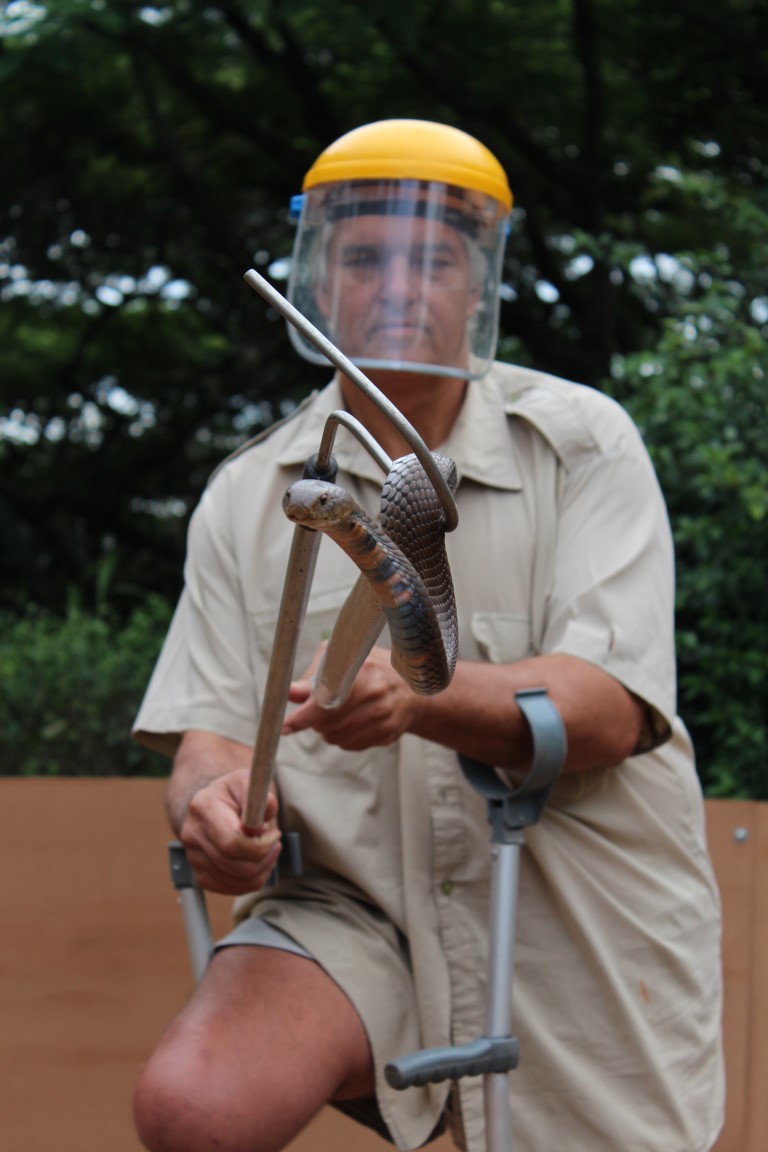
To most, the thought of voluntarily spending the night in a make-shift hut with not one, but three Mozambican spitting cobras borders on the insane.
However, after speaking with Neville Wolmarans it is clear that his reasons for this endeavour are entirely rational.
Born in the bush and amassing over 50 years of experience studying and handling snakes, Wolmarans has dedicated his life to understanding the complex world of snake behaviour and the toxic venoms defining their infamy.
“Snakes were actually a phobia of mine as a kid,” said Wolmarans, who caught his first snake; a boomslang, at the tender age of eight.
For Wolmarans, however, phobia turned into fascination as he became committed to re-educating people about both the dangers and wonders of these intriguing animals.
His decision to spend the night in a hut with three cobras is part of an education initiative to help people in rural areas learn how to avoid snake-bites and what should be done if one is encountered and an individual is bitten.
Mozambican spitting cobras are among the most common species of snake found in rural areas west of the N2 highway, so human encounters are relatively high.
In the summer season, these snakes move into people’s huts in pursuit of prey and are also active at night and early morning when it is cooler.
Given that many of these people are out of reach of hospitals and without life-saving anti-venom; death as a result of being bitten are a constant threat.
Wolmarans stayed on a mattress in the centre of the hut while his team monitored the activity of the cobras on thermal-imaging cameras. Interestingly, not a single snake gave him a problem; each avoiding him while instinctively following the scent trails left by small frogs and rodents on the surface of the hut’s circular wall.
This is a massive first step in proving that snakes do not bite humans for feeding purposes, but instead out of retaliation when threatened.
His incident free night in the snake-pit aims to spread an important message; that sleeping in the middle of the hut is a good way to avoid being bitten.
It is important to note that precautions should also always be taken and if you discover a snake do not take matters into your own hands.
Wolmarans and his team at Ndlondlo Reptile Park charge a R250 call-out fee for safe snake relocations, which is considerably more affordable than the R7, 500 one would pay for hospital admittance and snake-bite treatment.
“Conservation is a mindset,” said Wolmarans, whose education project aims to dispel the myths around snakes in order to secure their status as animals worth protecting. This conservation and social education initiative is inspired by his realisation that “What is here is not mine or yours; but belongs to future generations.”
For more information, contact Neville Wolmarans on 082 561 4969.
Stay in the loop with The North Coast Courier on Facebook, X, Instagram & YouTube for the latest news.
Mobile users can join our WhatsApp Broadcast Service here, or if you’re on desktop, scan the QR code below.