

By-law is clear: no drinking at North Coast beaches!
KDM spokesperson Sipho Mkize told the Courier there were "elements of discomfort" around the by-law because it appeared to be targeting a certain race group.
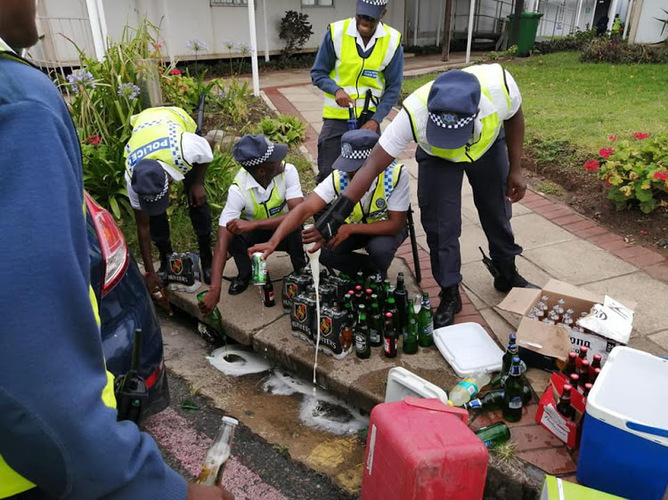
The public drinking and bad beach behaviour that has caused a furore amongst Dolphin Coast residents in recent months took a new turn this week with the discovery that in fact, KwaDukuza municipality does have by-laws prohibiting drinking in public – but they are not being applied.
Both the municipality and police have sidestepped the issue, saying it was not clear that public drinking was unlawful.
This week, however, the Courier uncovered a copy of the provincial gazette of KwaZulu-Natal which promulgated two KDM by-laws dealing with drinking in public places in 2005.
The by-law relating to nuisance and public amenities by-law addresses the issue and the law is clear.
No alcohol is allowed to be consumed in spaces which the public has a right to use.
According to local prosecutors, KDM has not brought any cases of public drinking to court recently, but the situation on the North Coast may change soon if a Durban high court case forces application of public drinking laws in Mandeni.
The Tugela Mouth Ratepayers Association will appear in court on March 6 to challenge Mandeni municipality for failing to enforce provincial ordinances against public drinking.
In terms of the law, where local government has failed to protect the public’s constitutional rights to safety in public places, then provincial legislation protects them.
If the court rules in favour of the ratepayers it will effectively open the door for others to challenge local councils and hold them accountable for service delivery and bylaw enforcement.
KwaDukuza council has been raising questions around the social aspects of such laws.
KDM spokesperson Sipho Mkize told the Courier there were “elements of discomfort” around the by-law because it appeared to be targeting a certain race group.
The municipal by-law relating to public nuisance includes offenses against decency and morality and clearly prohibits loitering, littering, urinating and spitting in public.
Disturbance of the peace is also included.
The Public Amenities by-law states that no person shall bring into a public amenity any alcoholic liquor.
Any person contravening the by-laws shall be guilty of an offence and upon conviction shall be liable to the fines determined by a chief magistrate of the court with jurisdiction in the area in which the offence has been committed.
However, according to a local prosecutor there is no record of recent cases prosecuted in KDM for breaking the by-laws.
Dolphin Coast Residents and Ratepayers Association (DOCRRA) chairman Deon Botha said there was sufficient legislation in place that covered drinking of alcohol in public.
“In the event of lack of bylaws the department of Co-Operative Government and Traditional Affairs (COGTA) has a document containing a set of by-laws for municipalities (2016) to use.
“It seems the COGTA document has been accepted by KDM. Under the nuisances and behaviour in public places its states no person may in a public place consume any liquor or be in a state of intoxication and under the beaches by-law no alcohol is allowed to be consumed on beaches, except on licenced premises or where temporary authorisation has been granted by the municipality,” said Botha.
Blythedale residents are also dealing with similar issues.
A resident who did not wish to be named said revellers converge on the beach and car park at weekends and on public holidays for nights of partying and drinking.
“There is no law enforcement in place and on a Monday morning it’s a sight for sore eyes as there is debris banked up all along the car park. It is absolute chaos, and there is no regard for the beach, the environment or the community.”
Attorney and Ballito resident Riaan Verster said the municipality was liable for by-law enforcement.
“KDM has authority to enforce these by-laws and that its failure to do so has more to do with its incapacity or lack of willingness to act, rather than gaps in the by-laws. If KDM believes these by-laws aren’t enforceable, the onus would be on them to advise why. As far as I can see these by-laws have not been repealed,” said Verster.
Verster said the fines were a side issue.
“We don’t want anyone to be prosecuted, we want the laws to be enforced so that the behaviour can be prevented. By the time you are arresting people and issuing fines it is too late. Prevention is what is needed here, not prosecution,” he added.
Ethekwini municipality faced similar problems a few years back when drunk and disorderly behaviour along Durban’s Golden Mile threatened to drive away tourism.
Revellers partying at Blue Lagoon and along the North Beach promenade trashed the area every weekend, leaving behind piles of rubbish and smashed liquor bottles.
In 2016 the city passed a new by-law making drinking in public a criminal offense, attracting a R2500 fine.
By-law enforcement formed part of the core competencies for the Metro police, beside traffic enforcement and crime prevention.
Ethekwini municipality spokesperson Msawakhe Mayisela said the city had adopted a zero-tolerance against drinking and municipal by-laws were not negotiable.
Mayisela said that anyone caught disobeying the rules of designated public spaces would be brought to book.
“We have noticed that drinking in public encourages the over-consumption of alcohol and binge drinking, rowdiness and violence,” he said.
Download The North Coast Courier mobile app, now available free from the Apple iStore and on Google Play, for IOS and Android phones.

Stay in the loop with The North Coast Courier on Facebook, X, Instagram & YouTube for the latest news.
Mobile users can join our WhatsApp Broadcast Service here, or if you’re on desktop, scan the QR code below.