

Here’s why water costs differ dramatically across 4 municipalities
The water sector does not have a distinct or independent regulator, which means in the absence of an economic panel of experts to assess water costing and pricing, water boards can propose different tariffs for the same service.

Water charges in South Africa are anything but straightforward.
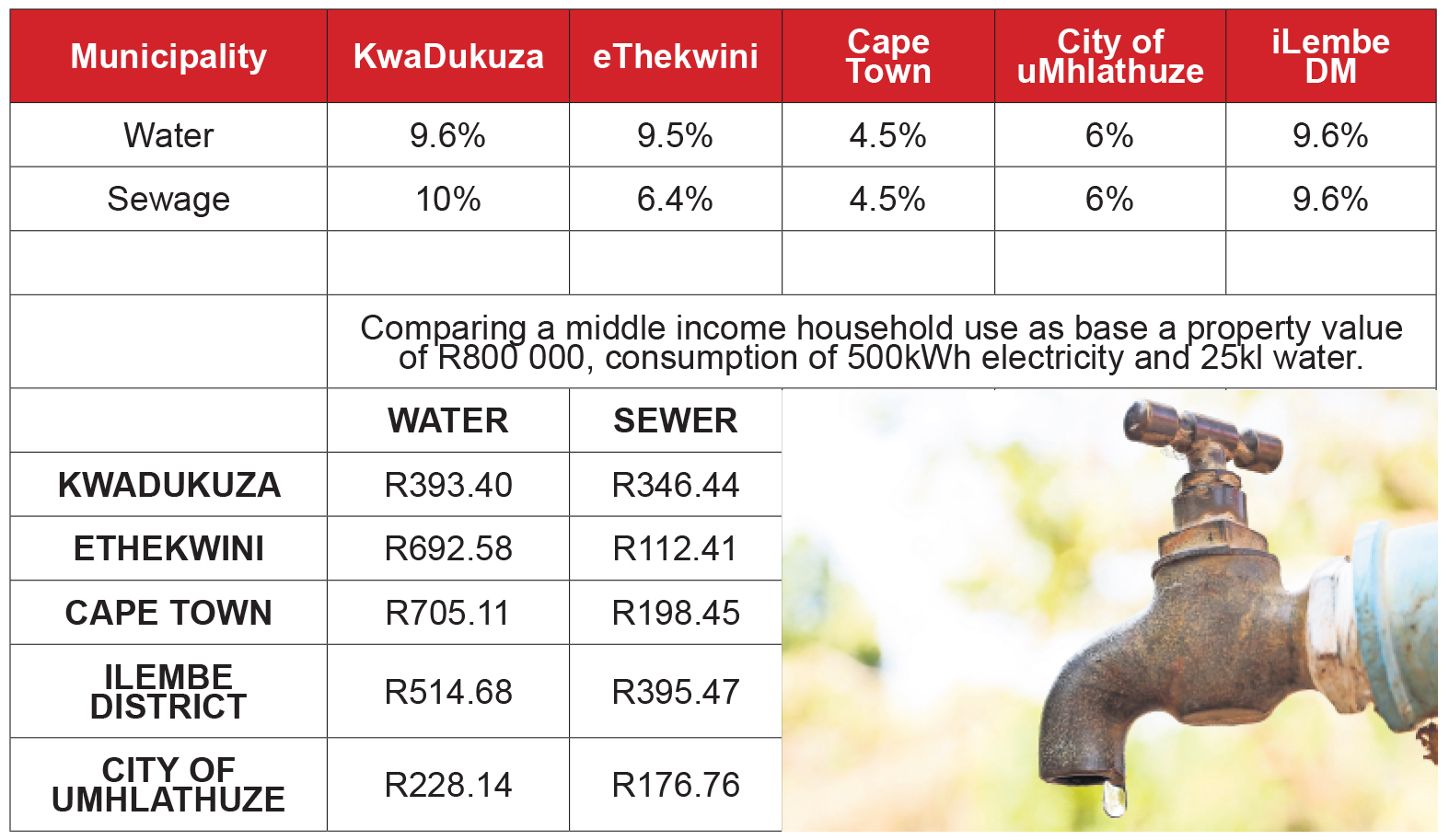
When we compared the different water tariffs over five municipalities, using the same amount of water consumption per household, the discrepancies in tariffs for the provision of water and sanitation services were large.
The water sector does not have a distinct or independent regulator, which means in the absence of an economic panel of experts to assess water costing and pricing, water boards can propose different tariffs for the same service.
South Africa has many different players in the provision of water and sanitation services.
There are 8 water boards which service the municipalities.
Umgeni Water is the largest supplier of bulk potable water in KwaZulu-Natal and supplies 7 municipalities including eThekwini metropolitan municipality and iLembe district municipality.
It covers 44% of KZN’s geographical area and 73% of the households.
Siza Water, a private entity, also buys bulk from Umgeni Water and supplies the area between the Tongaat River and the Umvoti River, including the urban areas of Zimbali, Ballito, Umhlali, Shakaskraal, Chaka’s Rock, Salt Rock, Sheffield Beach and Tinley Manor.
Mhlathuze Water, based in Richards Bay supplies the uMkhanyakude, King Cetshwayo and Zululand district municipalities.
Mhlathuze Water proposed bulk water tariff increase was 9.37% for the new financial year while Umgeni Water increase was one of the highest at 9.6%.
Both tariff increases exceeded inflation and were slammed by ratepayers, particularly in light of Covid-19.

Siza Water absorbed a large part of the increase and upped their water tariffs by only 5% – a rate lower than that of their water board, while iLembe District municipality did not add to the 9.6% increase, saying ratepayers could not afford more.
Siza Water managing director Shyam Misra said:
“In determining the proposed increase for this year Siza Water were able to have a lower increase (5%) than that passed on by Umgeni Water’s 9.6%, as although bulk water is a material cost, other costs have not escalated by this percentage.
“Hence for example the lower electricity cost, staff costs, and lower consumer price index that gets applied to other costs in the business results in lowering the pass-through costs of Umgeni Water’s bulk water tariff percentage,” said Misra.
Although Ilembe District municipal manager Geoffrey Kumalo protested the 9.6% increase, Umgeni Water was unrelenting, saying the increase in tariffs was to recover operating costs.
Umgeni Water corporate stakeholder manager Shami Harichunder said:
“Rising raw material, production, administration and labour costs are among key factors that influence future price of commodities and services – and invariably in an upward trajectory.
“Umgeni Water remains financially stable and that it is able to provide infrastructure required to extend and secure water services.
“It would be safe to surmise that when water services authorities (municipalities) begin formulating their tariffs, after Umgeni Water’s proposed tariff is made available to them, they factor in costs associated with reticulation, provision and maintenance of infrastructure, energy and administration. They also have to try to establish revenue requirements to supply water services on a sustainable basis over the useful life of each scheme, while also determining expected consumption over the useful life and future replacement and/or refurbishment costs of the scheme.
“In the end, while water has to be affordable and within easy reach, Umgeni Water has to remain financially self-sufficient. The alternative to this is neglect of and slow delivery on infrastructure and high tariffs intended as catch-up on past poor planning and under-budgeting.”
He said residents are charged on a sliding scale per kilolitre (1000 litres) – the more you use, the more you pay – and tariffs are further influenced by a property’s value.
Most municipalities have a two-tier billing system for water.
As a user you are billed for the water that you use and then you are billed for the water that you discharge into the sewers.
They work on the assumption that 75% of the water used by a household is discharged in this way.
Tariffs are the most significant revenue source available to local authorities and still account for almost half of municipal revenues.
For sanitation, ‘consumption’ of service is almost impossible to measure.
It can be most accurately estimated based on levels of water consumption, to which it is closely related, property value and simpler measures, such as the number of toilets.
The new tariffs came into effect from July 1.
For the purpose of the comparison we based the type of water supply on domestic full pressure for property rate-able values greater than R250 000.
For example, a domestic customer on a full-pressure water supply, using 25kl in one month, would be charged as follows:
Do you want to receive news alerts from The North Coast Courier via WhatsApp? Send us a WhatsApp message (not an sms) with your name and surname to 061 718 4438.

Stay in the loop with The North Coast Courier on Facebook, X, Instagram & YouTube for the latest news.
Mobile users can join our WhatsApp Broadcast Service here, or if you’re on desktop, scan the QR code below.