

Sugarcane and sand wedges: A trip back in time with Salt Rock’s history
Though Umhlali was already an established village further inland, boasting a smattering of storefronts and railway access, it took another 50 years for Salt Rock to find its footing.
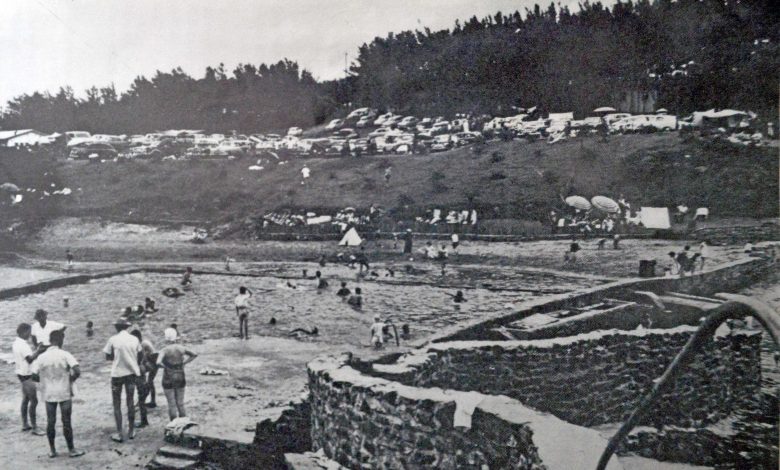
Just 100 years ago, Salt Rock was nothing but a collection of sugarcane farms and rickety beach cottages – a far cry from the bustling village of today.
Legend has it that the name comes from the era of King Shaka, whose maidens would gather salt from the seaside rocks at low tide.
The birth of the town is less disputed however, and as with most developments on the North Coast in the 20th century, sugarcane was an integral part of the process.

Basil Hulett, the grandson of sugarcane farming pioneer, Liege Hulett, was the first real developer of Salt Rock village in the early 1930s.
Though Umhlali was already an established village further inland, boasting a smattering of storefronts and railway access, it took another 50 years for Salt Rock to find its footing.
By 1930, Hulett was the single biggest sugarcane farmer in KwaZulu-Natal.
“He cut 20 000 tons a year, transporting the crop to the mill by ox-wagon,” said Jack Nash in his book, ‘Ballito: The story of a township 1953-1963’.
His prowess was such that he represented the South African government at the world cane growing conference in London in 1934.
It was his industry and the position of his farm which led to early township development.
Initially, Hulett drew up plans for a 9 hole golf course on the portion of his farm nearest to the sea, with an old thatched cottage to serve as a clubhouse.
“When Colonel Whylie officially opened the club by driving his ball straight down the first fairway, those thatched rafters must have reverberated from the applause and ensuing celebration at the inauguration of the 19th hole; or could it have been the 10th in those days?” wrote Nash.
The success of the course was such that Hulett decided to build a hotel over the road, overlooking the ocean at Granny’s Pool.
He was persuaded by his wife, Gwen, to move the location further south to its current position on Basil Hulett Drive and the Salt Rock Hotel was born.
“A deep gully ran in between the plateau and the higher hinterland. But Gwen was not to be put off so easily.”
The gully was filled in by Hulett’s son, Ralph, who worked with a team of 16 oxen, transporting soil in a scoop which held only half a cubic yard of fill.
A builder named Rorvik built the 30-room hotel and it was completed in 1933.
In order to make sure the Salt Rock Hotel was never overshadowed by new developments, Hulett decreed that no building with more than two storeys could be built in Salt Rock and there are no high rise developments to this day.
Hulett was so invested in the hotel project that he could no longer run the entirety of his farming operation and sold the major portion, retaining the beachfront area for future development.
In 1934, he subdivided 75 beach front plots and sold them at £75 (R140) each.
At the same time, he also bought the beach immediately in front of the hotel from the Fisheries Department.
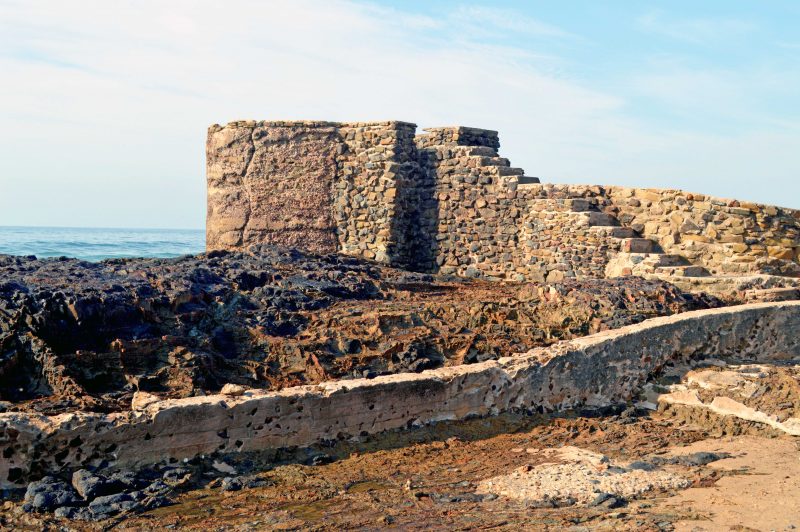
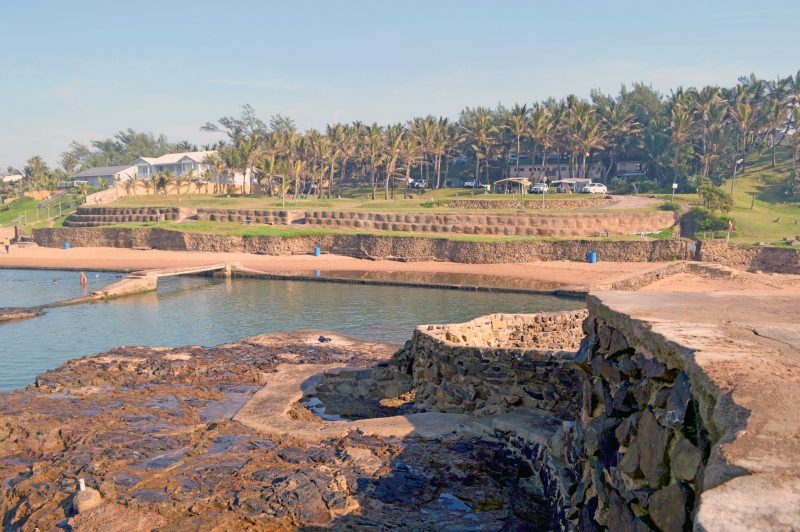
With this agreement in place, he set about building a tidal pool for the use of the guests.
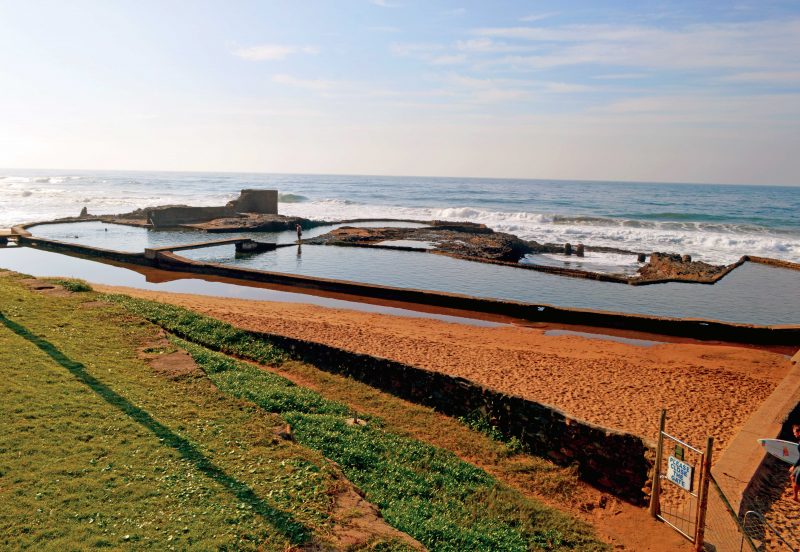
It was not the immediate success that he had expected, however, and he later realised that most of his clientele had not learned to swim.
There were originally 3 fishing towers built near the tidal pool in order to draw local fishermen to the area.
Hulett built a 4th, stringing a hawser between two of the towers and extending a rope into the ocean which guests could hold onto.
The innovation worked and ran without fail until enough people had learnt to swim.
On Saturday nights at the hotel, a live band would perform the latest foxtrot, waltz and tango melodies of the era.
“It was a colourful, elegant scene. During the blackout days of the war there was dancing every night, and guests continued to wear formal dress despite the humidity and restricted ventilation.”
The colour and elegance remains, although in a slightly more relaxed form, when you visit Salt Rock today.

Stay in the loop with The North Coast Courier on Facebook, X, Instagram & YouTube for the latest news.
Mobile users can join our WhatsApp Broadcast Service here, or if you’re on desktop, scan the QR code below.