

Loggerhead turtle hatchlings expected soon
Beachfront residents along the northern beaches at Salt Rock and Sheffield are reminded to leave their sea-facing lights off for the next few weeks as hatchlings may become confused by the lights.
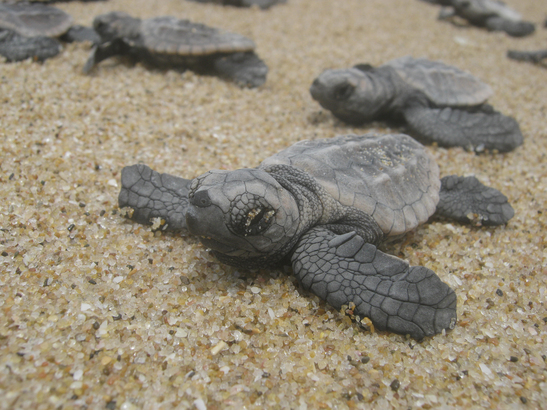
Every year between October to February, the North Coast becomes a breeding ground for loggerhead turtles, with some sightings between Chaka’s Rock and Tinley Manor.
With an average of 120 eggs laid per nest, loggerhead hatchlings have only a 1-in-1 000 chance of surviving to maturity.
Ann Kunz of the South African Association for Marine Biological Research (SAAMBR), said turtles were quite specific as to where they would nest.
They always return to the beach where they hatched, but disturbances caused by human activity and light from beachfront properties are disastrous for turtles, the reasons why we no longer see them as frequently along our coastline.
Adult loggerhead turtles arrive at around November for mating, with the females then coming ashore to lay their eggs at night. Nesting occurs between 10pm and midnight.
“Females haul out onto the beach, nesting several times a season with varying clutch sizes. The sex of the babies are temperature dependent,” Kunz said.
“Warmer temperatures are associated with females and cooler temperatures with males.”
According to Kunz, loggerheads nest on average every 12 to 17 days during the breeding season.
Females will not breed again for another 2 to 4 years, but possibly up to 9 years.
About 60 days after nesting, the eggs hatch, but hatchlings will remain buried under the sand for a few days after hatching, usually emerging at night.
Beachfront residents along the northern beaches at Salt Rock and Sheffield are reminded to leave their sea-facing lights off for the next few weeks as hatchlings may become confused by the lights.
Hatchlings make their way into the ocean using the downward slope of the beach, as well as the reflections of the moon and stars on the water.
Beachgoers walking their dogs are also asked to keep their dogs from digging up possible nesting sites.
Loggerhead turtles are considered a vulnerable species by the International Union for the Conservation of Nature (IUCN).
Four of the 9 sub-populations of loggerheads were classified as threatened, with the remaining 5 classified as endangered.
During December last year the IUCN released new red list assessments of the loggerhead species, noting they were now regarded as vulnerable globally.
The IUCN said loggerheads were found to be conservation-dependent and that any decline of current conservation efforts would be detrimental.
“It is only because of prolonged conservation efforts that some loggerhead sub-populations are now being categorised as ‘near threatened’ or of ‘least concern’ rather than higher threat categories such as ‘vulnerable’, ‘endangered,’ and ‘critically endangered’.
“Moreover, within a sub-population categorised as ‘least concern’ or ‘near threatened’, there may still be sea turtle stocks that face a high risk of extinction at a national or local level.”
Hatchlings have been known to wash ashore. Should you come across a turtle or hatchling in need of aid, do not return it to the water as it is probably exhausted and may struggle to keep its head above water.
Place the turtle on a wet towel and cover it from direct sunlight and contact SAAMBR’s 24-hour line at 031 328 8222.
For breaking news follow The North Coast Courier on Facebook, Twitter, Instagram and YouTube.
Join our Telegram Broadcast Service at: https://t.me/joinchat/yJULuN8NaCs5OGM0
Join our WhatsApp Broadcast Service: Simply add 082 792 9405 (North Coast Courier) as a contact to your phone, and WhatsApp your name and surname to the same number to be added.
Stay in the loop with The North Coast Courier on Facebook, X, Instagram & YouTube for the latest news.
Mobile users can join our WhatsApp Broadcast Service here, or if you’re on desktop, scan the QR code below.